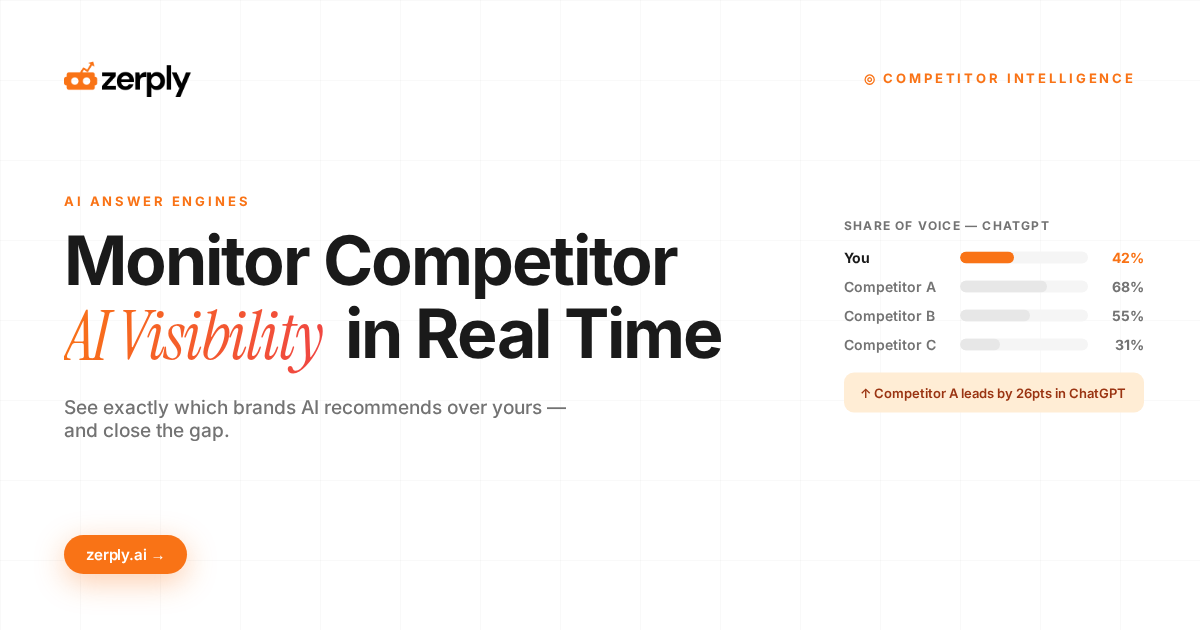
How to Monitor Competitor Visibility Across AI Answer Engines in Real Time

AI-generated answers now influence how customers discover, compare, and choose brands, making real-time visibility across answer engines essential. Learn how to track citations, measure prompt share, and surface AI-native signals that reveal where your brand stands against competitors. With practical frameworks, dashboards, and phased rollout steps, you can build a reliable visibility system that protects your reputation and sharpens your competitive edge.
AI-generated answers are now the first touchpoint for how buyers understand categories, compare solutions, and form brand preference. For SMBs, this shift is especially disruptive: visibility is no longer determined by rankings but by whether an engine chooses to surface your brand at all.
Small and mid-sized businesses now win or lose purchase decisions inside these answer boxes. This piece delivers a pragmatic, engine-aware framework any SMB or IT team can use to track competitor visibility across popular AI answer engines in near real time.
You will learn how to detect when your brand or rivals are cited, measure prompt share, and convert those signals into prioritised actions.
We walk through baseline monitoring, prompt taxonomy design, prompt-share dashboards, AI-native KPIs, phased implementation steps, and governance tips so you move from theory to insight within weeks.
Why AI Answer Engines Require a Different Visibility Approach

Traditional SEO ranking checks miss what matters in AI-generated answers. Engines synthesise results, sometimes omit citations, and update models frequently, which can cause brand exposure to swing overnight. Competitor visibility in this context refers to how often an engine surfaces a brand inside its generated answer.
Prompt share shows the percentage of monitored prompts that mention each brand or niche. Together with AI intelligence, the practice of extracting, normalising, and activating these AI-native signals enables teams to spot shifts early, defend reputation, and prioritise content fixes before traffic or perception erodes.
🎯 Food for Thought: About one in 10 U.S. internet users already use generative AI tools specifically for online search, and AI-powered tool usage in the U.S. is forecast to reach 241 million people by 2027.
Framework Overview: The Minimum Viable System for Real-Time Competitor Visibility
A lean setup can deliver fast, actionable insight without enterprise overhead. Start with a narrow scope, define prompts, and track a handful of metrics you can govern.
1. Pick Engines and Scope
Choose one to three AI engines that matter most to your audience, such as ChatGPT’s web mode, Perplexity, or Google’s AI overviews. Limit geography or topic to reduce noise. Document each engine’s citation behaviour so you can normalise results later.
2. Build a Prompt Taxonomy
Organise prompts into clear buckets: product, competitor comparisons, use cases, and local queries. Tag every prompt with intent, topic, entity mapping, and sampling cadence. Version each prompt and record its creation date to maintain a clean audit trail.
3. Define AI-Native Metrics
Track citation frequency, prompt share by brand or niche, response position index (RPI), top-cited pages, and citation sentiment. Create per-engine normalisation rules and a canonical entity map so synonyms and misspellings roll up correctly.
📊 Good to Know: Perplexity AI usage grew from around 230 million monthly queries in mid-2024 to 780 million in May 2025, and traffic estimates show hundreds of millions of visits per month with strong month-over-month growth.
Building a Prompt-Share Dashboard
A real-time dashboard turns raw answer data into insights everyone can use.
Data Ingestion & Normalisation
Pull data from scraped AI outputs, engine APIs, and scheduled prompt sweeps. Normalise fields such as engine, timestamp, prompt ID, matched entity, citation text, cited URL, and sentiment. Store prompt versions and sampling methods alongside results for full auditability.
Visualisations to Include
- Prompt-share by brand/niche – Stacked area or doughnut chart filterable by engine, topic, and timeframe.
- Engine-level visibility panel – Displays citation frequency, RPI, and top-cited pages per engine.
- Trendlines & heatmaps – Rolling 7- and 30-day views of citation trends and prompt volume by topic.
- Top prompts driving visibility – List high-volume prompts and which brands they surface.
- Drill paths – Click any data point to see raw answer excerpts and the matched prompt version.
- Sentiment/quality indicator – Flag negative or misattributed mentions so teams can respond quickly.
Alerting & Governance
Set threshold-based alerts for sudden prompt-share swings, new competitor mentions, or RPI changes. Maintain prompt versioning, a weekly review cadence, and an audit log for every dashboard refresh. Require minimum sample sizes before firing alerts to reduce false positives.
KPIs and Sample Dashboard Panels to Measure Impact

Monitoring competitor visibility only becomes meaningful when the signals you collect translate into measurable performance shifts. The KPIs below show you not just where you stand in AI answer engines, but where to focus effort for tangible business impact.
Core AI Visibility KPIs
- Citation frequency – Count of brand mentions per engine and prompt bucket.
- Prompt share – Percentage of prompts that surface a brand; the primary competitor visibility indicator.
- Response Position Index – Normalised score showing where the brand appears in the answer.
- Top-cited pages – Canonical URLs driving citations, so content owners know what to refine.
- Citation sentiment/attribution quality – Flag mentions as favourable, neutral, or misattributed.
- Sampling & confidence – Display sample size and data freshness next to every KPI.
Business-Outcome KPIs & Mapping
- AI referral proxy – Track landing pages and UTM signals where engines pass clicks; acknowledge engines that do not.
- Conversion mapping – Correlate improved prompt share and RPI with traffic, form submissions, or leads.
- Prioritisation score – Combine prompt-share delta, conversion potential, and effort to rank actions.
- Reporting cadence – Weekly snapshots for operations; monthly deep-dives tying visibility changes to revenue metrics.
Implementation Roadmap for SMBs and IT Teams
Implementing AI visibility monitoring works best when teams scale in controlled stages rather than trying to track everything at once. The phased roadmap below shows how SMBs and lean IT teams can prove value early, build confidence in the data, and expand coverage without overwhelm.
Phase 1 – Starter Sweep & Baseline
Select one or two engines and 50–150 high-priority prompts across three to five topics. Run an initial sweep, capturing current citations, prompt share, and top-cited pages. Deliver a baseline report and quick-win list within two weeks to validate sampling and ingestion.
Phase 2 – Dashboard & Governance
Build a single prompt-share dashboard using the visual components above. Configure basic alerts, set weekly ops reviews, and document prompt versioning. Provide an audit log so stakeholders can trust the data.
Phase 3 – Integrate With Analytics & Iterate
Tag landing pages for AI referral tracking, map visibility signals to web analytics, and run small experiments (content tweaks, schema updates). Expand prompt coverage and add engines as signal quality allows.
Refine KPI thresholds and alert rules, generating a prioritised backlog tied to business KPIs and a monthly performance report.
💡 Quick Data Point: As 65% of organisations now report regular use of generative AI, and a majority are already experimenting with AI agents, tying competitor visibility tracking into your existing AI roadmap makes this framework easier to justify and scale.
Common Challenges and How to Mitigate Them
Real-time AI visibility tracking introduces its own sources of noise, gaps, and operational strain. The points below outline the most common pitfalls, closely mirroring the broader list of common LLM visibility tracking mistakes SMBs run into, and how to minimise their impact before they skew your decisions.
Data Noise & Sampling Bias
Use repeatable sampling cadences, enforce minimum sample sizes, and document your method within metadata to control bias.
Attribution Limitations
Recognise that some engines synthesise answers without referrals. Lean on RPI and prompt share as proxy metrics and combine them with qualitative audits for context.
Resource and Technical Constraints
Start with a focused prompt set and a single dashboard view. Leverage CSV exports plus a lightweight BI tool or a low-code monitoring vendor to secure early wins.
Practical Examples: Starter Prompt Sets and Sample Dashboard Wireframe
To make your visibility tracking operational, you need repeatable prompts and a dashboard layout that highlights shifts at a glance. The following starter sets and wireframe components show how to create a reliable foundation.
Sample Prompt Sets to Start With
- Product-focused: “best [product type] for [use case]”, “compare [brand A] vs [brand B]”
- Use-case: “how to solve [problem] with [product category]”
- Local/geographic: “[service] near me” or “[product] in [city]”
- Competitor capture: branded queries, misspellings, and negative-intent prompts to track reputation signals.
Sample Dashboard Wireframe Components
- Top row : engine-level summary cards (citation frequency, prompt-share change, alerts).
- Middle : prompt-share stacked area by brand/niche with engine and topic filters.
- Bottom : table of top-cited pages with click-to-view answer excerpts and prompt versions.
- Sidebar : alert log, governance notes, and a prioritised “next actions” list.
Strengthening Your Competitive Edge in AI-Driven Search
As AI engines reshape how buyers discover and compare brands, real-time competitor AI visibility has become essential. With the right metrics, prompt-share dashboards, and governance in place, you can shift from reactive monitoring to proactive intelligence that protects your reputation and strengthens your market position.
If you want to put this framework into action quickly, Zerply helps you do it without heavy engineering. You get a ready prompt taxonomy, a clean CSV schema, and a plug-and-play dashboard for immediate visibility tracking across AI answer engines.
Explore Zerply to see how real-time AI visibility can elevate your competitive strategy.
FAQs
- What factors cause sudden spikes or drops in competitor visibility within AI engines?
Fluctuations often stem from model updates, index refresh cycles, changes in citation policies, or shifts in how engines prioritise entities for a given topic. Even small taxonomy or content changes can cascade into major visibility swings.
- How often should SMBs run AI visibility sweeps to maintain reliable data?
Most teams benefit from a daily or every-48-hour cadence for high-volatility queries, and a weekly cadence for broader prompt sets. Engines update frequently enough that monthly sweeps miss key inflexion points.
- What’s the best way to validate whether an AI engine’s negative or incorrect mention is influencing perception?
Pair visibility tracking with brand sentiment monitoring, customer interviews, and lead-source analysis. If users reference AI-generated claims, that’s a strong indicator that the engine’s output is shaping real-world reputation.
- What metrics show whether AI visibility improvements actually impact revenue or pipeline?
Look for uplift in model-referenced page visits and improved conversion rates as pages begin to gain citations. Also track increased presence in mid-funnel prompts and higher qualification rates in sales conversations that reference AI outputs.
Written by
Founder, Zerply.ai & Wittypen
Preetesh Jain is the Founder of Zerply.ai and Wittypen. He specializes in SEO, Answer Engine Optimization (AEO), AI search visibility, content marketing, and product development. Through his work building AI-powered marketing platforms, he helps businesses improve their organic presence across Google, ChatGPT, Perplexity, Claude, and other emerging discovery channels. He regularly writes about AI search, organic growth, content strategy, and the future of digital marketing.