How to Measure Your Brand’s Visibility in LLM-Powered Search

AI visibility is the measurable representation of a brand inside LLM-generated answers, expressed through mentions, citations, and entity ranking within model outputs. As traditional SEO metrics fail to capture this in-answer influence, brands must adopt new methods to track how AI systems surface and position their content.
Content marketers, SMB owners, and IT professionals are watching search behaviour tilt toward chat interfaces powered by large language models (LLMs), a shift that is fundamentally changing how AI answer engines influence customer decision-making.
These tools answer questions directly, mention products, and cite sources without sending users to traditional blue links. As a result, relying on clicks, average position, or keyword volume no longer reveals whether your brand even appears in the conversation.
The gap is urgent. And with 81% of consumers needing to trust a brand before they consider buying, every missed mention becomes a missed opportunity to build credibility.
This guide closes that gap. You will learn which new metrics expose in-answer influence, how to measure them across multiple models, and how to act on the findings to protect and grow brand visibility inside AI experiences. Along the way, we will show where LLM tracking tools such as Zerply fit into a practical workflow.
Why Traditional SEO Metrics Understate Brand Influence in LLM-Driven Results
In just 30 days, Qatar Airways generated nearly 16,000 mentions and reached more than 108 million internet users, placing it ahead of 81% of brands in overall visibility. This highlights how brand influence can grow dramatically in AI-powered environments without ever showing up in traditional SEO metrics.
Search and discovery still begin with a query, but the response is no longer a list of links. LLMs synthesize information, sometimes paraphrasing or summarizing brands without generating a visit to the source site. That design makes three classic SEO signals unreliable for gauging influence:
- Click-Through Rate (CTR) : If the answer satisfies intent in the chat window, there is no need to click, so CTR drops even when the brand is still recommended.
- Average Position: LLM answers live above or outside organic listings, rendering “position” irrelevant to the user’s first impression.
- Organic Traffic : Declining traffic may disguise steady or growing brand mentions inside AI answers, leading teams to misinterpret performance.
These blind spots have business consequences. Marketers lose attribution credit for earned media, PR teams miss unseen endorsements, and product teams overlook invisible influence points in the buyer journey. Closing the measurement gap demands KPIs that capture presence inside model outputs, not just on search engine results pages.
***👉 Also Read** : How to Monitor Competitor Visibility Across AI Answer Engines in Real Time*
What is AI visibility?
AI visibility is the measurable presence and influence a brand holds inside LLM-generated answers: mentions, positioning, and citations, that shape awareness and conversion even when no clicks occur.
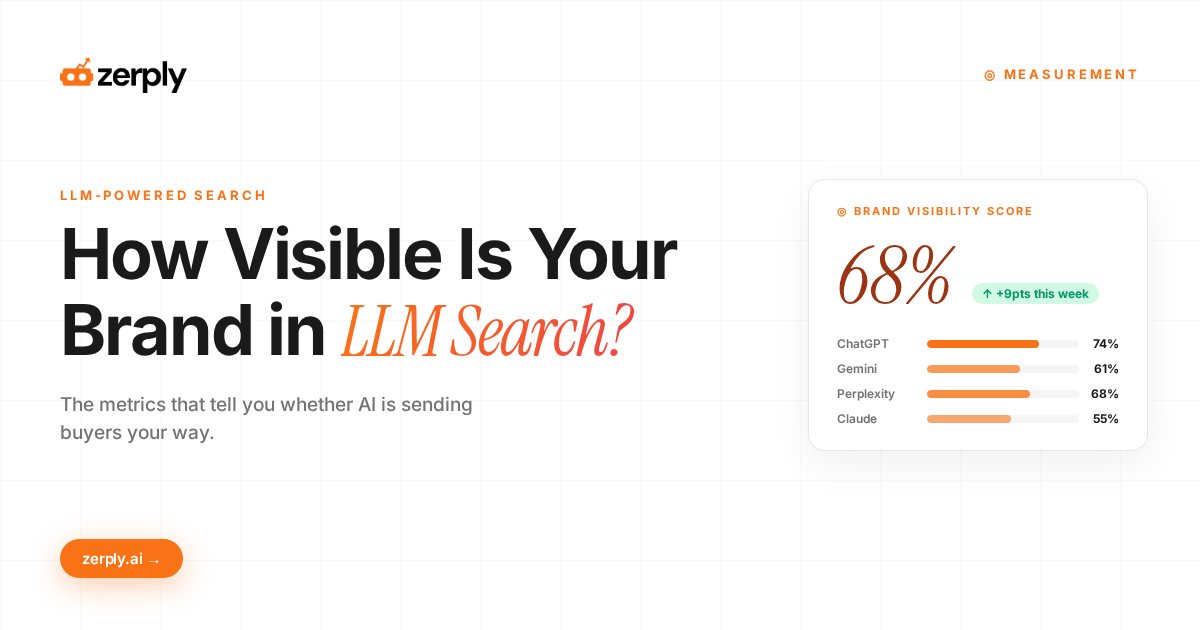
Three core metrics make this influence tangible: brand mention share, answer rank, and LLM citation coverage:

Brand Mention Share (What It Measures and Why It Matters)
Brand mention share is the percentage of sampled LLM answers that explicitly mention your brand or product when relevant queries are asked. A high share signals durable brand visibility and earned awareness that extends beyond clicks.
Content and PR teams rely on this metric to judge whether thought-leadership pieces, press coverage, or social buzz translate into AI answers. Measuring requires LLM tracking across multiple models and prompt variations to avoid single-query bias.
Track trends by prompt type (informational versus commercial) and by model provider to see where visibility gaps emerge.
Answer Rank (How to Interpret Position Inside LLM Answers)
Answer rank reflects your brand’s prominence when multiple entities appear in one response: first-mentioned, recommended list order, or highlighted callouts. The first position carries authority and steers downstream decisions.
To measure, capture each answer, parse entity order with NLP, and normalize ranks across prompts and models. Improving rank often correlates with publishing authoritative data, structured snippets, or concise definitions that models can surface quickly.
LLM Citation Coverage (Tracking When the Model Cites Your Content)
🔎 Did you know? For *65% of consumers* , the voices of a brand’s CEO and employees significantly influence whether they purchase.
LLM citation coverage is the share of answers that explicitly cite or reference your domain: URLs, titles, or quoted snippets. Citations act as the new backlinks, conferring credibility and driving reputation signals.
Track coverage by logging answer text and metadata, then matching citations to known domains.
To boost coverage, publish uniquely citable assets such as original research and clear how-tos, and use structured metadata so retrieval systems can identify your content. Remember that some models hide retrieval steps, so treat coverage as probabilistic insight rather than absolute truth.
💡 Pro Tip : Wondering how to *use LLM visibility to drive organic traffic* ?
Here are some steps to follow:
- Find prompts where you appear and optimise content around those themes.
- Identify pages earning citations and strengthen them with clearer data and structure.
- Spot competitor mentions you’re missing and create content to fill the gap.
Practical Measurement Framework (Overview)
A repeatable pipeline makes AI visibility measurable: define priority queries → sample across LLMs and prompt archetypes → capture answer text and citations → extract mention share, answer rank, and citation coverage → store prompt context for explainability → Integrate signals into existing workflows.
Multi-Model, Multi-Prompt Sampling Best Practices (LLM Tracking Approach)
Sampling matters because personalization and model differences create variance. Select representative informational, commercial, and conversational prompts. Test across major LLM providers and vary the temperature or retrieval settings when available.
For volatile topics, sample weekly; for evergreen content, monthly suffices. Always tag each sample with its prompt archetype for reproducibility.
Explainability: Capture Prompt Context and Answer Provenance
Store the full prompt, model name, settings, and returned answer. Capture any “why” or provenance fields, such as citations and retrieval notes, that the model exposes. Explainability lets editors trace why a mention appeared or disappeared, turning raw data into actionable briefs.
Integrations & Workflows: Make LLM Tracking Actionable
Push visibility events into editorial trackers, ticketing systems, and CRM tools, so spikes or drops trigger content updates, PR outreach, or technical fixes.
Common integrations include brief generators, Slack alerts for lost citations, and dashboards correlating AI visibility with downstream leads, often anchored to branded-demand data pulled straight from Google Search Console.
🔎 Pro Tip : Want to *avoid common AISEO mistakes* ? Make sure you track how AI models actually present your brand, not just how you rank in search results. It ’ll help you understand your true influence in AI-driven discovery and optimise where it matters most.
How Zerply Measures AI Visibility in Real Time
Here’s a breakdown of how Zerply measures AI visibility in real time:
1 . Automated Multi-Model Tracking
- Sends curated prompts across major LLMs.
- Captures full conversation context for accurate analysis.
2. Instant Visibility Metrics
- Calculates brand mention share, answer rank, and citation coverage within minutes.
- Normalises results for easy comparison across models.
3. Real-Time Monitoring & Alerts
- Highlights anomalies or sudden drops through dynamic dashboards.
- Flags missing mentions or citations as they occur.
4. Explainability & Root-Cause Insights
- Shows the exact prompt and answer text responsible for a visibility change.
- Helps teams understand why a mention appeared or disappeared.
5. Workflow Integration for Fast Action
- Enables marketers to generate updated content briefs with one click.
- Provides API access so engineering teams can pipe data into warehouses, Slack, or analytics tools.
***👉 Also Read:** How to Optimise for “Zero-Click Answers”: A Practical Guide to Getting Cited in AI Summaries*
Actionable Tactics to Improve AI Visibility
Studies draw on a dataset of LLM responses containing 5.17 million citations from OpenAI, Gemini, and Perplexity collected between August 25 and September 26, 2025. This shows the growing influence of AI-generated citations on consumer discovery and highlights why brands must monitor their presence across models.
Follow these targeted tactics to strengthen your brand’s presence inside AI-generated answers and increase your chances of being mentioned, ranked prominently, and cited across LLMs:

- Create Highly Citable Assets: Publish original research, industry benchmarks, and practical playbooks to encourage models to reference your content and boost citation coverage.
- Strengthen Authoritative Pages: Add fact boxes, schema markup, and well-structured headings so LLMs can easily surface and prioritise your key information.
- Expand Earned Media and Expert Contributions: Share expert insights through quotes, guest articles, and podcast appearances to increase brand mentions across informational queries.
- Optimise Metadata and Canonical Signals: Use canonical URLs, clear titles, and clean markup to help retrieval systems correctly identify and cite your content.
- Run A/B Prompt-Level Experiments: Test different content formats and updates with LLM tracking tools to see how they affect citation rates and ranking signals before publishing widely.
Own Your Brand Narrative in the AI-First Era
LLM-powered search has changed how brands are discovered, evaluated, and trusted—and traditional SEO metrics cannot keep up. Measuring brand visibility now means tracking what happens inside AI-generated answers: whether your brand is mentioned, how prominently it appears, and when your content earns citations.
With Zerply by your side, your team can move beyond guesswork and understand how AI systems truly shape your brand narrative. You gain a clear view of mentions, citations, and competitive positioning across models, plus the insights required to strengthen authority, improve content relevance, and grow visibility in a world where AI is the new gateway to discovery.
Get started now to take control of your brand’s visibility in the AI era and ensure your expertise is represented where decisions are actually being made!
FAQs
- Can my brand appear differently across LLMs, and should I measure each model separately?
Yes! Each LLM is trained and updated differently, so your brand’s mentions, rankings, and citations can vary widely. Measuring each model separately helps you spot gaps and tailor your strategy.
- How often should brands audit their AI visibility as models evolve?
Because LLM outputs change quickly, fast-moving industries should check weekly, while stable categories can monitor monthly. Automated tracking ensures you catch shifts the moment they happen.
- Is it possible for my brand to be misrepresented in AI answers and how do I correct it?
Yes, AI answers may contain outdated or inaccurate brand information. Publishing clear, authoritative content and strengthening third-party coverage helps models correct and update their responses.
Written by
Founder, Zerply.ai & Wittypen
Preetesh Jain is the Founder of Zerply.ai and Wittypen. He specializes in SEO, Answer Engine Optimization (AEO), AI search visibility, content marketing, and product development. Through his work building AI-powered marketing platforms, he helps businesses improve their organic presence across Google, ChatGPT, Perplexity, Claude, and other emerging discovery channels. He regularly writes about AI search, organic growth, content strategy, and the future of digital marketing.