Agentic SEO Platforms: What They Are and How to Choose One

Ever looked at your SEO roadmap and wondered why so many high-impact opportunities never make it to production?
Most SEO teams don't have a shortage of ideas. They have a backlog problem.
There's always another audit uncovering technical issues, another keyword cluster worth targeting, another content update that could drive incremental traffic. The recommendations keep coming. The execution rarely keeps up.
Part of the reason is that SEO doesn't happen in a vacuum. Every initiative depends on writers, developers, designers, product teams, stakeholders, approvals, and a growing collection of tools. By the time a recommendation moves from a spreadsheet to a published page, priorities have shifted and new opportunities have already taken its place.
That's why many teams feel like they're constantly busy but not always making meaningful progress. The bottleneck isn't knowing what to do next. It's coordinating the work required to actually do it.
This is where the conversation around agentic SEO platforms becomes interesting. Not because they can generate content or automate a few tasks, but because they're designed to help teams close the gap between strategy and execution.
The most valuable SEO recommendation in the world has no impact until someone acts on it. The platforms gaining traction today are focused on solving that problem: helping teams move from identifying opportunities to shipping improvements faster, with less manual coordination and fewer handoffs.
For SEO leaders, agencies, and marketing teams, that's ultimately the promise. Not replacing expertise, but removing the operational friction that prevents good SEO work from getting done in the first place.
What Is an Agentic SEO Platform?
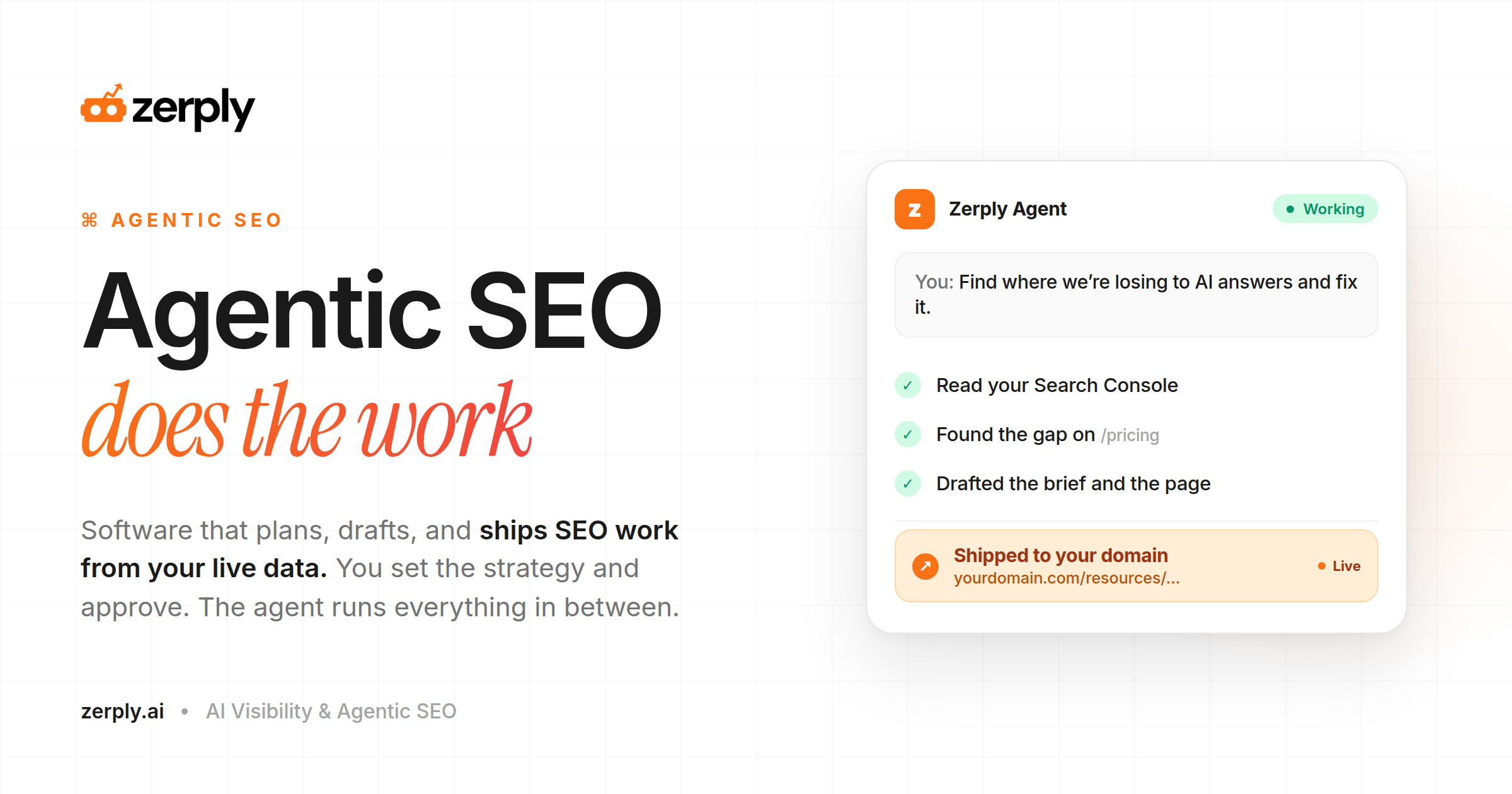
An agentic SEO platform is software that can plan, execute, validate, and monitor multi-step SEO workflows using live data, with human oversight at the right control points.
That definition matters because most AI SEO tools stop too early.
Traditional SEO tools identify issues and opportunities. AI writing tools generate drafts. Workflow tools help teams assign tasks. Reporting tools show what happened after the fact.
An agentic SEO platform connects those steps into one operating flow. It can identify an opportunity, create a brief, generate or update content, suggest metadata, recommend internal links, support schema improvements, route work for approval, publish approved changes, and monitor performance after the update.
That does not mean every action should be fully autonomous. It means the system can carry work forward without requiring a human to manually restart the process at every step.
Search Engine Land describes agentic SEO as the use of AI agents to autonomously execute complex SEO workflows with human oversight and validation, rather than simply generating content from prompts. That distinction is the heart of the category.
A writing assistant helps produce text. An agentic SEO platform helps operate the workflow.
Why Does This Category Exist Now?
The old SEO stack was built for analysis. It was not built for speed of implementation.
That worked when SEO was mostly about rankings, monthly reporting, and incremental content production. It works less well in a search environment where pages need to be refreshed faster, technical issues affect crawlability across multiple surfaces, and brands need to understand not only how they rank in Google but also how they appear in AI-generated answers.
AI search has changed the visibility problem. Similarweb reports that 35% of U.S. consumers use AI search at the product discovery stage, compared with 13.6% who still start with traditional search. At the evaluation stage, the gap is 32.9% for AI search versus 15% for traditional search.
That means the buyer journey is no longer limited to a user searching a keyword, clicking a result, and evaluating a website. Increasingly, AI systems summarize, compare, recommend, and cite brands before the user ever visits a page.
SEO teams now need to optimize for traditional search, AI visibility, structured content, machine readability, and continuous performance improvement. Doing that with a fragmented stack creates operational debt.
This is where agentic SEO platforms create value. They reduce the distance between insight and action.
The Real Difference: Recommendations Versus Execution
The biggest difference between a traditional SEO tool and an agentic SEO platform is not the interface. It is the level of execution.
A traditional SEO tool might tell you that a page has declining impressions, missing schema, weak internal links, and outdated content. That is useful. But the work still has to be translated into a plan, assigned, written, reviewed, published, and measured.
An agentic SEO platform should be able to move the work forward.
For example, if a page is ranking in positions 8 to 15 for high-intent keywords, the system should be able to pull the relevant Search Console queries, analyze the competing pages, identify missing sections, draft updated copy, recommend metadata improvements, suggest internal links from existing pages, prepare structured data enhancements, and route the update for human approval.
Once approved, it should help publish the change and track whether the page improves.
That is the operational leap. It is not “AI wrote a blog post.” It is “the SEO workflow moved from detection to implementation with less manual coordination.”
Fountain City’s practitioner guide frames this as the difference between tool-level automation and system-level automation. Tool-level automation speeds up individual tasks, while system-level automation changes what the team spends its time on by coordinating research, production, optimization, and monitoring across the SEO lifecycle.
That is the standard buyers should use. If a platform only generates content, it may be useful, but it is not a full agentic SEO platform.
What “Agentic” Should Actually Mean
The word “agentic” is already being overused. Many vendors use it as a more exciting way to say “AI-powered.” Buyers should be more demanding.
A real agentic system has four qualities.
First, it works from live data. It should connect to performance signals such as Google Search Console, analytics, keyword data, content inventory, and site health inputs. Without live data, the system is prioritizing from generic assumptions rather than your actual search performance.
Second, it manages workflow state. This means the system knows what step a task is in, what data was used, what output was created, who needs to approve it, and what should happen next. Workflow state is what separates a repeatable SEO operation from a series of one-off prompts.
Third, it can take action inside defined constraints. That may mean creating briefs, updating drafts, preparing metadata, adding internal link recommendations, publishing to a CMS, or sending approved changes into a workflow. Autonomy does not have to mean uncontrolled publishing. It should mean controlled execution.
Fourth, it includes validation and governance. The more a system can do, the more important approval gates, audit logs, version history, permissions, and rollback paths become.
If those elements are missing, the platform may still be AI-assisted, but it is not truly agentic.
Where Agentic SEO Platforms Create the Most Value
Agentic SEO platforms are most valuable when the work is repetitive, data-heavy, and commercially important.
Content refreshes are a strong example. Many teams have pages sitting just outside top positions. They know those pages need updates, but the workflow is slow. An agentic platform can detect the opportunity, analyze the queries, recommend improvements, draft the update, and move it into review.
Internal linking is another high-value use case. Most sites have internal link opportunities that are never implemented because finding the right source pages, anchor text, and destination pages takes time. A good platform can analyze site content, identify relevant link opportunities, and prepare recommendations at scale.
Metadata optimization is also well suited to agentic execution. Pages with high impressions and low CTR can be flagged, rewritten, tested, and monitored. The same applies to schema support, FAQ improvements, content gap planning, and on-page optimization.
The broader opportunity is AI visibility. As AI systems become a discovery layer, SEO teams need to understand whether their brand is mentioned, cited, and represented accurately in AI responses. Similarweb’s agentic search framework explains that AI agents increasingly find, analyze, corroborate, and act on brand information across multiple sources before a user sees a recommendation.
That changes what SEO teams need to measure. Rankings still matter, but they are no longer the full picture. Teams also need visibility into AI mentions, citations, sentiment, and competitive share of voice.
Why Tool Fatigue Is the Hidden Cost?
Many marketing teams are not short on software. They are overloaded by it.
A modern SEO stack might include one tool for keyword research, another for crawling, another for content optimization, another for briefs, another for AI writing, another for project management, another for publishing, another for rank tracking, another for reporting, and another for AI visibility.
The monthly subscription cost is only part of the problem. The larger cost is coordination.
Every disconnected tool creates a handoff. Every handoff creates delay. Every delay creates the chance that the work never ships.
This is why the agentic SEO platform category is not just about AI. It is also about operating model consolidation.
The goal is not to replace every specialist tool in every scenario. Enterprise teams may still need advanced crawlers, BI systems, or custom workflows. But for many marketing teams, SEO execution has become too fragmented. The winning platform is the one that reduces operational drag while preserving quality and control.
That is the reason platforms like Zerply are built around a unified workflow: SEO research, content strategy automation, agentic drafting and publishing, Google Search Console integration, technical alignment, and AI visibility tracking in one place.
The commercial value is not “faster content.” It is fewer disconnected handoffs between insight and impact.
What CMOs, SEO Directors, and Agency Owners Should Care About?
Different buyers evaluate agentic SEO platforms through different lenses.
A CMO should care about efficiency, consolidation, and measurable business outcomes. The question is whether the platform reduces tool sprawl, improves content velocity, increases organic contribution, and gives leadership clearer visibility into what changed and why performance moved.
An SEO Director should care about data quality, workflow depth, and governance. The question is whether the system works from real performance data, supports technical and content workflows, preserves editorial quality, and gives the SEO team control over what gets published.
An agency owner should care about repeatability and margin. The question is whether the platform can support multiple clients, standardize delivery, reduce manual production overhead, and keep approvals clean across accounts.
This distinction matters because the wrong platform can create more work. If the system generates output but does not fit the team’s review process, CMS workflow, brand standards, or reporting needs, it becomes another tool to manage.
The right platform should match the team’s operating model.
What Features Matter Most?
The most important feature is not the most impressive demo. It is whether the platform can execute reliably inside your real workflow.
Live data integration should be the first requirement. A platform should be able to connect to Google Search Console and use actual query, page, and performance data to prioritize work. Without this, the recommendations are likely to be generic.
Content inventory awareness is also important. The system should understand what already exists on your site, which pages support which topics, where internal links can be added, and where content gaps exist.
Native publishing support matters because copy-paste workflows create friction. If a platform can move approved content into a CMS or publishing environment, it shortens the path from draft to live page.
Schema and machine-readable content support are increasingly important. MarTech argues that brands need to become machine-readable through structured entity layers, schema, and consistent data that AI systems can interpret accurately. For SEO teams, this means structured data is no longer just a rich results tactic. It is part of making the brand understandable to AI systems.
AI visibility tracking should also be part of the evaluation. If AI-generated answers influence discovery and evaluation, teams need to know how often their brand is mentioned, cited, and compared against competitors.
Finally, governance cannot be optional. A serious platform should support role-based permissions, approval workflows, audit logs, version history, rollback paths, and clear deployment constraints. The more direct the execution, the more important the control layer.
Autonomous Does Not Mean Uncontrolled
A common concern is that agentic SEO means letting AI make uncontrolled changes to a website. That should not be the model.
Good autonomy means the system can execute defined tasks inside approved boundaries. Humans should still own strategy, positioning, factual validation, and final approval for sensitive changes.
For example, an agentic platform may draft a content refresh, prepare metadata, suggest internal links, and recommend schema improvements. But the SEO lead or editor should approve the final update before it goes live, especially on high-value commercial pages.
This is not a weakness. It is how the workflow should work.
The best model is human-led, AI-executed. Humans set the strategy, approve the standards, and make judgment calls. The platform handles repetitive research, drafting, optimization, coordination, and monitoring.
That balance is what makes agentic SEO practical for serious marketing teams.
When a Traditional SEO Tool May Still Be Enough?
Not every team needs an agentic SEO platform immediately.
If your site is small, your content velocity is low, your workflow is simple, and your bottleneck is strategy rather than execution, a traditional SEO tool plus selective AI assistance may be enough.
If you only need occasional keyword research, a content brief, or a one-off audit, full workflow automation may be more than you need.
But if your team has a growing content operation, multiple stakeholders, recurring refresh needs, slow implementation cycles, or several tools that do not talk to each other, the economics change.
At that point, the issue is no longer whether another SEO tool can find more opportunities. The issue is whether your team can act on the opportunities already found.
That is where agentic platforms become worth evaluating.
How to Evaluate an Agentic SEO Platform?
A strong evaluation should focus less on AI claims and more on workflow proof.
Ask whether the platform acts on live performance data or only generates generic recommendations. Ask whether it connects to Google Search Console, your CMS, and your content inventory. Ask where approval gates exist for content, metadata, schema, and publishing. Ask whether every change can be traced through logs and version history. Ask whether the platform supports both SEO performance and AI visibility measurement.
The most important question is simple: can this platform help us ship better SEO work faster without losing control?
If the answer is yes, the platform is solving a real business problem. If the answer is no, it may only be adding another interface to an already crowded stack.
Why Zerply Fits This Shift?
Zerply is built for teams that want SEO work to move from research to execution without stitching together a dozen disconnected tools.
It combines SEO research, agentic drafting, content strategy automation, publishing workflows, Google Search Console integration, technical SEO checks, and AI visibility tracking in one platform. That matters because modern SEO is no longer just about finding keywords or writing content. It is about continuously identifying opportunities, creating the right content or update, publishing with control, and measuring visibility across both Google and AI-driven discovery.
For marketing managers, Zerply helps reduce tool fatigue. For SEO teams, it creates a more connected workflow from insight to action. For agencies, it supports repeatable execution across clients without turning every deliverable into a manual coordination exercise.
The goal is not to remove humans from SEO. The goal is to remove the operational drag that prevents good SEO work from shipping.
The Best Agentic SEO Platform Is the One That Executes With Control
Agentic SEO platforms are becoming important because SEO teams need more than dashboards and drafts. They need systems that help them execute.
A true agentic SEO platform works from live data, manages workflow state, supports multi-step execution, includes governance, and measures outcomes after changes go live. It helps teams move faster while keeping humans in control of strategy, quality, and brand judgment.
The old SEO stack was built to surface opportunities. The next SEO operating model is built to act on them.
As search expands from rankings into AI answers, citations, structured data, and machine-readable brand presence, teams that unify execution and measurement will have an advantage. They will not just know what needs to be done. They will be able to get it done faster, with fewer handoffs and clearer accountability.
If your SEO team is already buried under tools, reports, drafts, and delayed implementation, the question is no longer whether agentic SEO is coming. It is whether your current workflow can keep up.
Zerply gives marketing teams a practical way to start: connect live SEO data, generate and optimize content workflows, publish with control, and track visibility across Google and AI search from one platform.
Start with a 7-day free trial and see how much faster your SEO workflow can move when research, drafting, publishing, and AI visibility tracking finally work together.
Frequently Asked Questions
What is an agentic SEO platform?
An agentic SEO platform is software that can plan, execute, validate, and monitor multi-step SEO workflows using live data and human-approved controls. Unlike traditional SEO tools that only surface recommendations, an agentic SEO platform helps move work from insight to action across research, content creation, optimization, publishing, and performance tracking.
How is an agentic SEO platform different from an AI writing tool?
An AI writing tool mainly helps generate content. An agentic SEO platform manages a broader workflow. It can use search performance data, identify opportunities, create briefs, draft or refresh content, suggest metadata and internal links, route work for approval, support publishing, and monitor results after changes go live.
Does agentic SEO mean AI publishes content automatically?
Not necessarily. A strong agentic SEO platform should include human approval gates, audit logs, permissions, version history, and rollback options. The goal is not uncontrolled automation. The goal is controlled execution, where AI handles repetitive and data-heavy tasks while humans remain responsible for strategy, quality, and final approval.
Who should use an agentic SEO platform?
Agentic SEO platforms are most useful for marketing teams, SEO leaders, and agencies that already have recurring SEO work but struggle to get it implemented quickly. They are especially valuable for teams managing content refreshes, keyword opportunities, internal linking, metadata updates, AI visibility tracking, and multi-client or multi-site workflows.
When is a traditional SEO tool enough?
A traditional SEO tool may be enough if your site is small, your content velocity is low, and your main need is occasional keyword research or auditing. If your team already knows what needs to be done but execution is slowed by fragmented tools, manual handoffs, and delayed publishing, an agentic SEO platform becomes more valuable.
What features should I look for in an agentic SEO platform?
The most important features include live data integration, Google Search Console support, content inventory awareness, workflow automation, approval controls, CMS or publishing integrations, audit logs, schema support, and AI visibility tracking. The platform should help your team execute SEO work faster without sacrificing governance or brand quality.
How does agentic SEO help reduce tool fatigue?
Agentic SEO reduces tool fatigue by connecting research, drafting, optimization, publishing, and reporting inside a unified workflow. Instead of moving data and tasks between multiple disconnected tools, teams can manage more of the SEO lifecycle from one platform, reducing coordination costs and improving execution speed.
Why does AI visibility matter for SEO teams?
AI visibility matters because users increasingly discover and evaluate brands through AI-generated answers, not only through traditional search results. SEO teams now need to know whether their brand is being mentioned, cited, and represented accurately in AI platforms such as ChatGPT, Perplexity, Gemini, Claude, and Google AI experiences.
How does Zerply fit into the agentic SEO platform category?
Zerply combines SEO research, content strategy automation, agentic drafting, publishing workflows, Google Search Console integration, technical SEO checks, and AI visibility tracking in one platform. It is designed to help marketing teams move from SEO insight to execution while maintaining human oversight and control.
What is the best way to start with agentic SEO?
The best way to start is with one high-friction workflow, such as content refreshes, metadata optimization, internal linking, or AI visibility tracking. Starting with a focused use case helps teams evaluate whether the platform improves speed, quality, and measurable SEO outcomes before expanding automation across the full workflow.
Written by
Founder at Zerply.ai & Wittypen
Anshul is the founder of Zerply.ai and previously built Wittypen, a content marketplace powering SEO growth for 1,000+ businesses. Over the last decade he has worked hands-on with B2B SaaS and tech teams to turn search data into compounding organic growth. At Zerply he shares practical playbooks on AEO, AI visibility, and modern SEO that come directly from experiments, wins, and failures in real projects.