How To Build an AI Search Prompt Tracking Strategy For Your Brand

Someone on your team has probably said some version of this already: “We need to track how we show up in AI search.”
Fair. Buyers are asking ChatGPT, Perplexity, Gemini, Claude, and Google’s AI surfaces before they ever land on your website. They’re comparing vendors, asking for recommendations, checking pricing, and forming shortlists inside answers you don’t fully control.
Then comes the hard part. You open a prompt tracking workflow, see a blank field, and have to decide what to track.
The good news is that you’re not starting from zero.
Your keyword clusters, Google Search Console queries, sales call notes, competitor pages, and customer language already contain most of your AI search prompt tracking strategy. You don’t need to invent a prompt set from scratch. You need to translate the demand map you already have.
AI search prompt tracking means monitoring how AI assistants answer a fixed, repeated set of questions your buyers care about, so you can see whether your brand appears, how it’s described, which sources get cited, and which competitors show up instead.
This post shows you how to build that set. We’ll use Wren, a fictional B2B SaaS company that sells SEO reporting software for agencies, as the running example.
Anywhere you see Wren’s category, swap in your own.
Why Prompts And Keywords Rhyme
Prompts and keywords are related, but they don’t behave the same way.
Keyword tracking gives you a ranked list of links. You can see whether your page ranks first, fifth, or fiftieth. There’s a search volume estimate, a target URL, a SERP, and a fairly familiar set of actions to improve performance.
Prompt tracking gives you something different. An AI assistant produces one synthesized answer. It may name three tools, cite two sources, summarize a category, and skip your brand completely. There is no page two. For that question, you are either in the conversation or absent from it.
That changes how you measure visibility.
| Keyword rank tracking | AI search prompt tracking |
|---|---|
| Ranked list of links | One synthesized answer |
| Position 1 to 100 | Included, cited, described, or absent |
| Keyword volume estimate | No clean per-prompt volume yet |
| Your page ranks | The model chooses brands and sources |
| Measured by position and traffic | Measured by inclusion, citation, sentiment, and share of voice |
| Moved by on-page SEO, links, and authority | Moved by content, entities, citations, third-party sources, and brand context |
This is the trust-building part that too many posts skip: prompt tracking won’t give you clean traffic or revenue numbers per question. It’s brand intelligence. It tells you where your brand stands in AI-generated conversations, who is being recommended instead of you, how you’re positioned, and what content or citation gaps to fix next.
The discipline still feels familiar. You’re mapping demand, intent, competitors, and buyer questions. The output changed from ranked links to named brands inside answers.
That’s why your keyword work is such a useful head start.
Translate Keywords Into Prompts
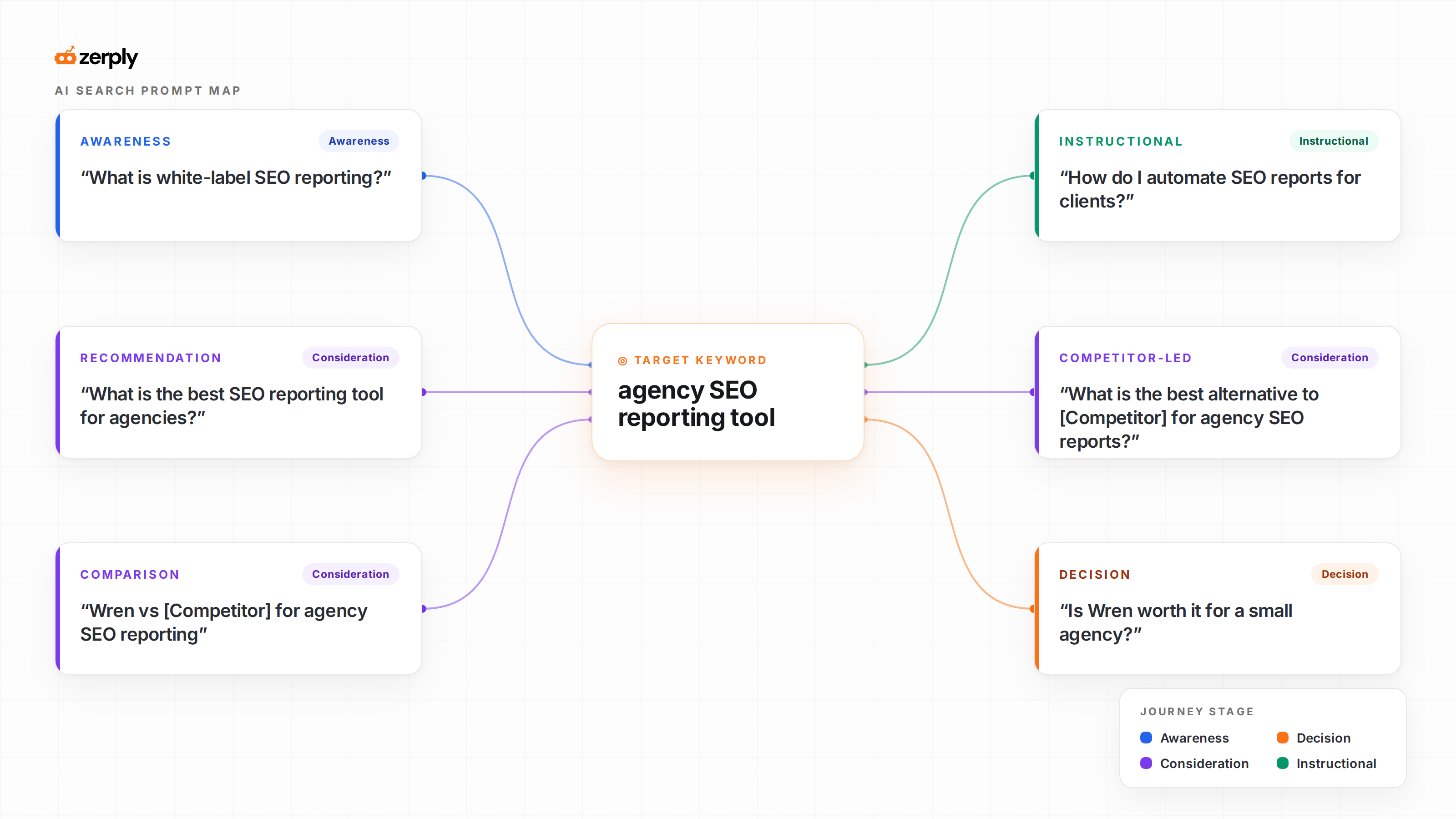
The blank page is the real problem. Which AI search prompts should you track? Start with the keyword clusters you already trust.
Use what we’ll call the fan-out method: take one keyword, then expand it across persona, intent, journey stage, and context until it becomes a small prompt cluster.
The simple formula is:
The job your product does + the person asking + the stage of the journey + an optional context = a prompt worth testing.
For Wren, the seed keyword might be “agency SEO reporting tool.” That keyword already contains a job, a category, and a buyer. Now fan it out into prompts a real person might ask an AI assistant.
| Lens | Prompt |
|---|---|
| Persona and recommendation | “What is the best SEO reporting tool for agencies?” |
| Persona and comparison | “Wren vs [Competitor] for agency SEO reporting” |
| Instructional | “How do I automate SEO reports for clients?” |
| Awareness | “What is white-label SEO reporting?” |
| Decision | “Is Wren worth it for a small agency?” |
| Competitor-led | “What is the best alternative to [Competitor] for agency SEO reports?” |
One keyword produced six useful prompts. A keyword cluster with 10 to 15 seed terms can produce 40 to 60 candidate prompts before pruning.
That doesn’t mean you should track all of them.
A strong starting set is usually representative, not exhaustive. For many brands, 20 to 40 prompts can cover the core topics, personas, and funnel stages well enough to expose the real gaps. Start smaller if you need to. A focused set you review every week is better than a giant list nobody trusts.
Prune your candidate prompts using three filters.
First, use strategic priority. Track the prompts tied to the products, personas, and use cases that matter this quarter.
Second, use competitive intensity. Include prompts where competitors are likely to appear, especially if those competitors already dominate your category.
Third, use product fit. Don’t track prompts for problems you can’t credibly solve yet. Those belong in your market research backlog, not your visibility dashboard.
For Wren, the first tracked set might focus on agency reporting, white-label dashboards, rank tracking reports, automated client reporting, and competitor alternatives. That gives the team enough coverage to see where Wren appears, where it gets ignored, and which content gaps matter.
The Four Prompt Categories
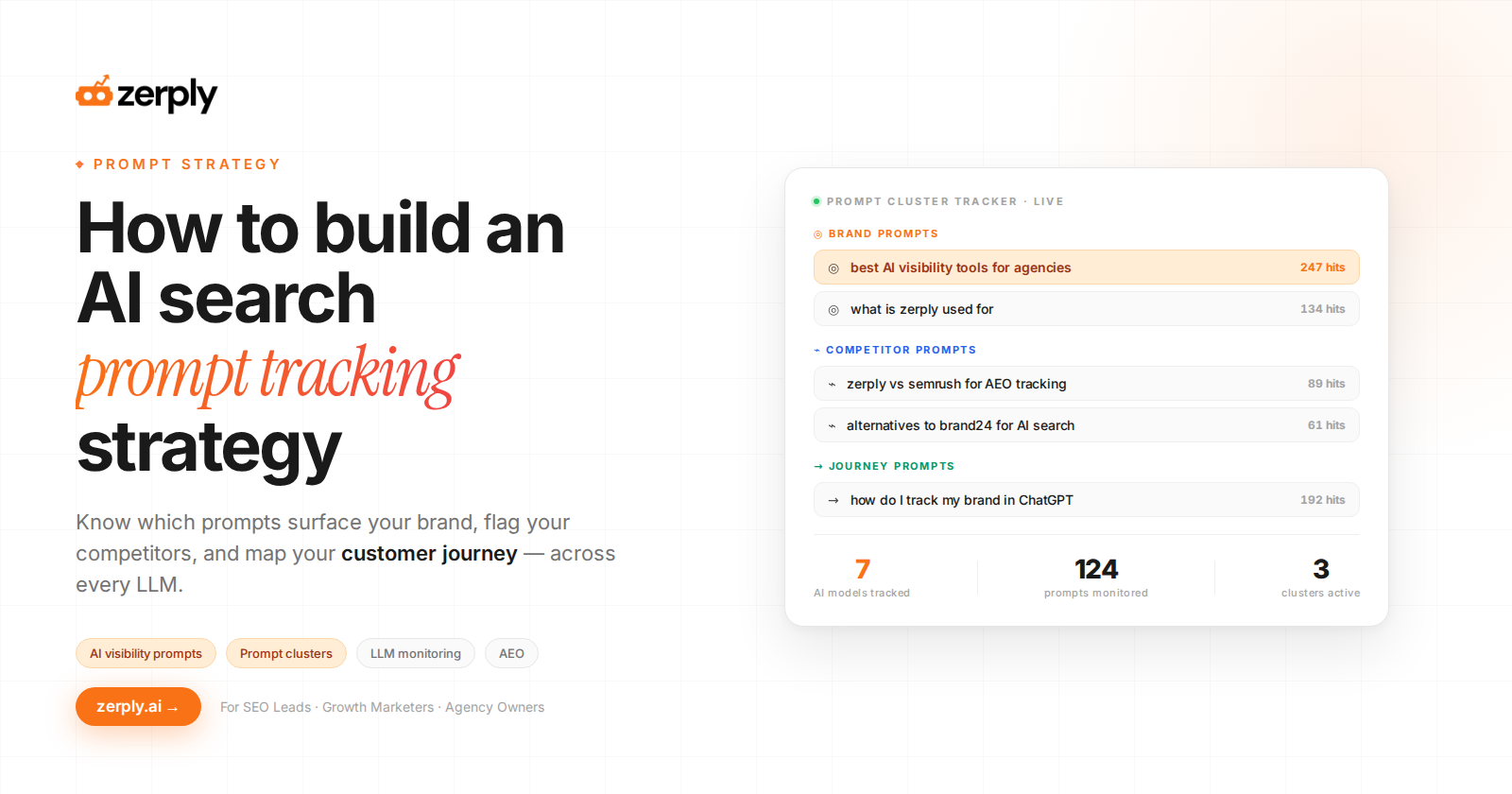
Your tracking set has four jobs. It needs to show how AI assistants describe your brand, how they recommend products in your category, how they position competitors, and where you appear across the customer journey.
Treat these as lenses on one prompt set, not four separate spreadsheets.
Brand Prompts
Brand prompts include your company name in the question.
For Wren, examples include “Is Wren good for SEO agencies?”, “Wren pricing,” “Wren reviews,” “Wren vs [Competitor],” and “How does Wren work?”
These prompts tell you what AI assistants say when someone already knows you. That makes them useful for reputation, sentiment, positioning, and accuracy.
A wrong description in a brand prompt is a problem you want to catch early. Maybe the AI says you only serve enterprise teams, when your best customers are small agencies. Maybe it names an old feature set. Maybe it recommends a competitor in the same answer.
Track brand prompts in their own cluster.
When your brand name appears in the question, your visibility is naturally higher. Mixing brand prompts into category metrics can make your overall inclusion rate look healthy while hiding the unbranded prompts where new buyers are actually forming shortlists.
Product And Category Prompts
Product and category prompts don’t mention your brand. They describe the job your product does.
For Wren, examples include:
- “Best agency SEO reporting tool”
- “How to automate client SEO reports”
- “White-label rank tracking software”
- “Best SEO dashboard for agencies”
- “What is white-label SEO reporting?”
This is the hardest bucket to win and often the most valuable. These are the prompts buyers ask before they know your company exists.
When competitors appear here and you don’t, you’ve found a real content and authority gap.
Pay special attention to instructional prompts. “How do I automate SEO reports for clients?” may sound less commercial than “best SEO reporting tool,” but AI assistants often cite helpful instructional content. Those citations can shape which brands feel credible later in the journey.
For SEO teams, this is where traditional keyword strategy and AI visibility strategy connect most clearly. The page that targets “automated SEO reports for clients” can also become the page an AI assistant cites when answering the prompt version of that question.
Competitor Prompts
Competitor prompts name a rival, compare rivals, or ask for alternatives.
For Wren, examples include “best alternative to [Competitor],” “[Competitor A] vs [Competitor B],” “is [Competitor] worth it for agencies?”, and “how to switch from [Competitor] to another SEO reporting tool.”
These are late-stage prompts.
The buyer knows the category, understands the problem, and is narrowing the shortlist. For an agency owner or growth marketer, these prompts are close to pipeline because they reveal who gets considered when a buyer is ready to act.
A practical ceiling helps here. Track your five most important competitors first. That usually gives enough coverage to understand the market without turning the set into noise.
Competitor prompts also expose positioning problems. Maybe AI assistants consistently call your rival “best for agencies” and your brand “best for freelancers.” That’s a message gap, not just a content gap.
Customer Journey Prompts
Customer journey prompts cut across the other buckets, mapping directly to how AI answer engines change customer decision-making at each stage.
Awareness prompts ask broad questions like “what is white-label SEO reporting?” or “how do agencies report SEO results to clients?” Consideration prompts include “best SEO reporting tools for agencies” and “SEO dashboard tools compared.” Decision prompts ask “is Wren worth it?”, “Wren pricing,” or “best [Competitor] alternative.”
This stage tagging matters because a brand can look strong at the top of the funnel and vanish when buyers ask for recommendations. Without journey tags, that pattern gets buried.
A single prompt can hold multiple labels. “Best agency SEO reporting tool for a growing agency” is a product prompt, a consideration-stage prompt, and a persona-specific prompt. That overlap is normal. The cluster model is how you keep it usable.
Build Clusters, Not Lists
A flat list of 40 prompts becomes messy fast. Individual AI answers can vary from run to run. One answer may name you, the next may skip you, and a third may cite a third-party listicle that barely mentions your product.
Clusters smooth that noise.
A prompt cluster is a group of related AI visibility prompts mapped to a topic, persona, intent, or journey stage. It’s the unit you report on because it gives you something stable enough to act on.
For Wren, the prompt set might become three clusters:
| Cluster | Example prompts | What it tells you |
|---|---|---|
| Agency workflow prompts | “How do I automate SEO reports for clients?” “Best SEO dashboard for agencies” | Whether Wren is visible around the core workflow |
| White-label reporting prompts | “What is white-label SEO reporting?” “Best white-label SEO reporting software” | Whether Wren owns category education and shortlist formation |
| Competitive comparison prompts | “Best alternative to [Competitor]” “[Competitor] vs Wren” | Whether Wren appears in late-stage vendor evaluation |
Now the reporting gets more useful. “Wren appears in 14 of 30 prompts” is a scoreboard. “Wren is strong in awareness prompts for white-label reporting but absent from decision-stage competitor prompts” is a strategy.
Use four axes to build clusters:
- Topic
- Persona
- Intent
- Journey stage
These are the same axes you’d use for serious keyword clustering, which is the point. Your prompt clusters should mirror your keyword clusters, content pillars, and buyer segments.
That keeps the system familiar for SEO leads and useful for growth teams. It also makes ownership clearer. The product marketing team may own competitor clusters. Content may own instructional clusters. SEO may own category clusters. Growth may care most about decision-stage coverage.
Choose Platforms And Cadence
Don’t track every AI surface on day one. Start with the platforms your buyers are likely to use when researching your category.
For many B2B teams, the first set should include ChatGPT, Perplexity, and Google AI surfaces.
ChatGPT captures broad assistant behavior.
Perplexity is useful because it is citation-heavy and often used for research.
Google AI Overviews and AI Mode matter a lot because they sit close to traditional search behavior, which makes them especially relevant to SEO teams.
From there, expand based on your audience.
Claude may matter more for technical or strategy-heavy buyers.
Gemini may matter in Google-heavy workflows.
Copilot may matter for enterprise teams.
Grok may matter for certain real-time or social-adjacent topics.
Cadence depends on how important the prompt is. Track your most strategic prompts daily, especially category, competitor, and decision-stage prompts. Track long-tail prompts weekly or monthly.
Active testing matters here. Passive monitoring can be useful, but querying the same fixed prompt set on a schedule is what creates comparable data. Without that repeatable set, you’re collecting interesting screenshots instead of building a measurement practice.
Refresh the prompt set regularly. Your product changes, buyer language changes, competitors reposition, and models update. A prompt set built six months ago may still contain useful questions, but it probably misses new objections, new features, and new category language.
Measure What Replaces Ranking
Prompt tracking needs its own measurement vocabulary. Trying to force keyword metrics onto AI answers leads to bad reporting.
Start with inclusion rate, also called answer share. This measures how often your brand appears across the tracked set. It’s more useful than raw mention count because it normalizes visibility across the prompts you chose to monitor.
Next, track share of voice. This compares your inclusion rate with your named competitors across the same prompt set.
For Wren, the team might see that it appears in 35 percent of agency reporting prompts, while Competitor A appears in 70 percent.
That gap is a clear strategic signal.
Citation share is different from being mentioned. An assistant can name your brand without citing your domain. It can also cite a third-party article that mentions your competitor instead. Citation share tells you whether your site, your competitors’ sites, or neutral third-party sources are shaping the answer.
Sentiment tells you how the AI describes your brand. Positive, neutral, and negative scoring is enough for most teams at the start. The important part is catching inaccurate or damaging descriptions early.
Position within the answer also matters. Being named first in a recommendation list carries more weight than being listed fifth with a vague description. Treat answer position as directional, not absolute, but don’t ignore it.
Finally, report coverage by cluster. This is the strategic layer. Aggregate inclusion rate may look fine while one high-value cluster is completely empty. For a growth marketer, the cluster view connects visibility to funnel stage. For an agency owner, it makes client reporting clearer. For an SEO lead, it turns AI visibility into a content roadmap.
There is one vanity trap you need to be aware of, that's raw mention count.
It gets especially misleading when brand prompts are mixed into the same metric as unbranded category prompts. If the question says “Is Wren worth it?”, Wren will probably appear. That doesn’t mean Wren is winning “best SEO reporting tool for agencies.”
Keep the metric tied to the job. Prompt tracking tells you where you stand in AI answers, how competitors are framed, and which gaps deserve content, PR, and positioning work. Don’t ask it to behave like last-click attribution.
From Gap to Published Page
A dashboard doesn’t improve visibility by itself. The action loop does.
The loop is simple: diagnose the gap, write the brief, build the asset, earn citations, and re-measure.
Say Wren tracks the prompt “best agency SEO reporting tool for growing agencies” across ChatGPT, Perplexity, and Google AI surfaces. Two competitors appear in nearly every answer. Wren appears once, with no citation.
That is the gap.
The content brief should target the prompt cluster, not just one phrase. It might call for a definitive guide to agency SEO reporting software, a comparison page, or a use-case page for growing agencies. The brief should specify the question the page needs to answer, the entities to cover, the competitors to discuss, the schema to include, and the proof points the model can understand.
The page itself needs to be clear, structured, and citable.
A vague product page won’t usually win an AI answer. A page that directly explains who the product is for, when it’s a fit, how it compares, what workflows it supports, and what evidence backs the claims has a better shot.
Then comes the step many teams skip: citation earning.
AI assistants often rely on sources they already trust for a topic. That means your own page may not be enough.
Look at the domains getting cited for the cluster. They may be software review sites, industry blogs, comparison pages, analyst-style guides, or community discussions. Pursue contributions, mentions, listings, partnerships, and links where they make sense.
This is where prompt tracking becomes more than monitoring. The gap tells you what to build. The citations tell you where authority is forming. The re-measure step tells you whether your work changed the answer.
In Zerply, that loop can live in one workflow: AI Visibility Tracking surfaces the gap, the Agent helps draft a brief grounded in live search data, and Foundry can publish the page to your domain. The point isn’t more dashboards. It’s a shorter path from “we’re missing” to “we shipped the page and can see whether it worked.
Seven Mistakes That Break Strategy
| Mistake | Fix |
|---|---|
| Tracking a flat list of 60 prompts with no structure. | Cluster prompts by topic, persona, intent, and journey stage so the data becomes reportable. |
| Mixing brand prompts into category metrics. | Keep brand prompts separate so your inclusion rate doesn’t get inflated by questions that already name you. |
| Treating prompt tracking as attribution. | Use it for brand intelligence, content gaps, competitor positioning, and citation strategy. |
| Tracking every platform at once. | Start with the two or three AI surfaces your buyers are most likely to use. |
| Setting the prompt set once. | Refresh it as your product, category language, competitors, and buyer questions change. |
| Publishing content without earning citations. | Identify the third-party domains AI assistants cite and work to appear in those sources. |
| Stopping at the dashboard. | Turn every important gap into a brief, page, citation plan, and re-measure cycle. |
The common pattern is easy to spot. Teams fail when prompt tracking becomes passive reporting. The value appears when it changes what you publish, how you position, and where you earn authority. If any of these look familiar, it is worth cross-checking against the broader list of common LLM visibility tracking mistakes SMBs run into.
Start With What You Have
You were never starting from zero.
Your keyword clusters already show how buyers search. Your GSC queries show the language they use. Your sales calls show the objections, comparisons, and jobs that matter. Your competitors show the prompts they’re already winning.
AI search prompt tracking turns that material into a repeatable visibility system. Translate your keyword clusters into prompt clusters. Separate brand, product, competitor, and journey-stage prompts. Track the right platforms on a steady cadence. Measure inclusion, share of voice, citations, sentiment, position, and cluster coverage. Then close the loop from gap to published page.
The brands that own AI answers two years from now won’t be the ones that guessed at prompts. They’ll be the ones that connected keyword strategy, content strategy, and prompt-level visibility early.
See how every AI talks about your brand. Daily.
Try Zerply for free.
Written by
Founder at Zerply.ai & Wittypen
Anshul is the founder of Zerply.ai and previously built Wittypen, a content marketplace powering SEO growth for 1,000+ businesses. Over the last decade he has worked hands-on with B2B SaaS and tech teams to turn search data into compounding organic growth. At Zerply he shares practical playbooks on AEO, AI visibility, and modern SEO that come directly from experiments, wins, and failures in real projects.