Search isn't dying. Clicks are.

There are two opposite takes on Google I/O 2026 making the rounds right now.
One camp sees declining click charts and concludes that SEO is dead. The other says nothing meaningful has changed, that good content still wins the way it always has. After reviewing the I/O announcements, comparing them against third-party research, and pressure-testing the numbers against what I have seen in live organic programs, I do not think either story is right.
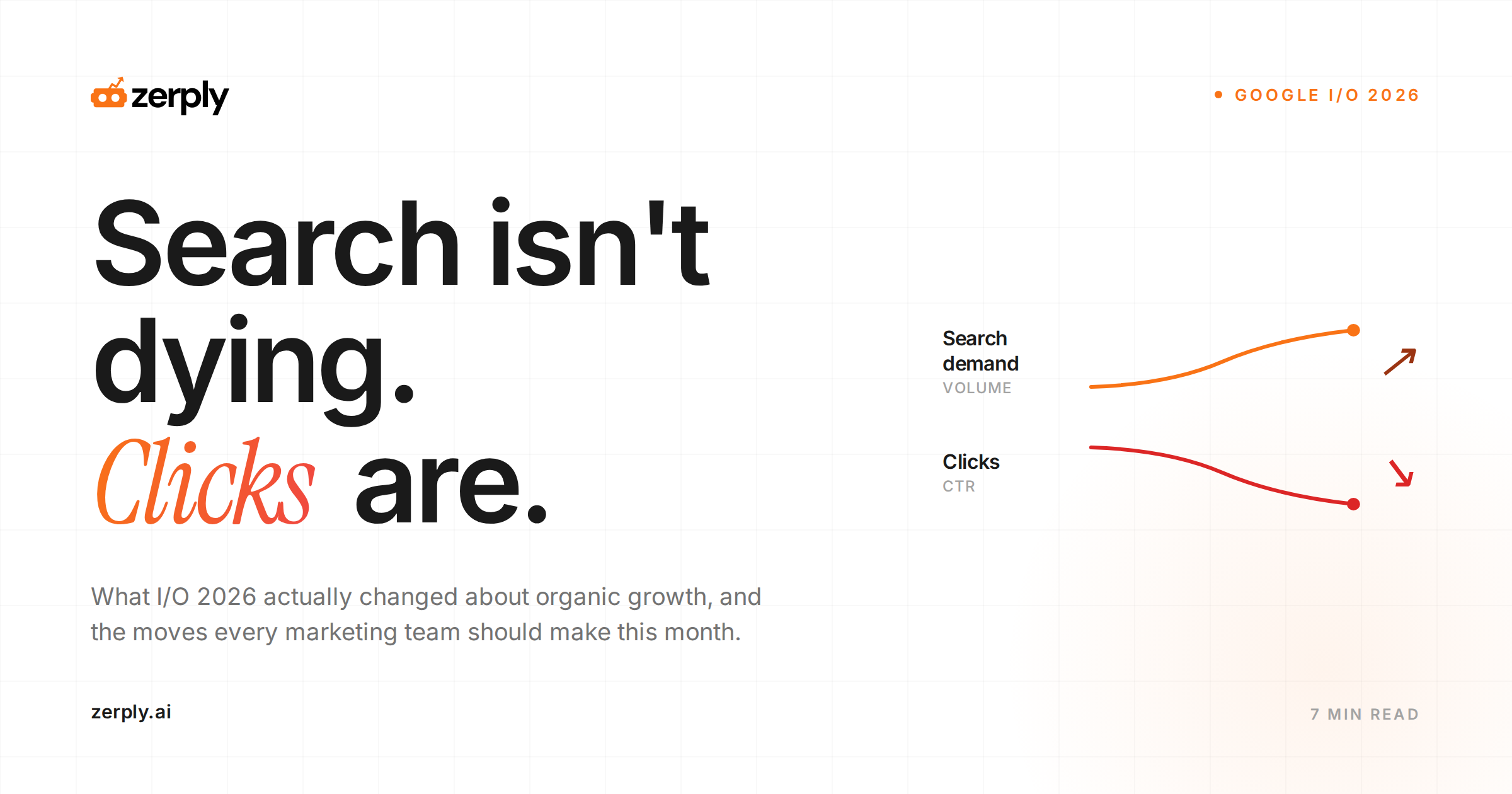
What I see is simpler, and more important. Search demand is growing. Click volume is shrinking. Those two trends are happening at the same time, and teams that treat them as the same thing will make the wrong strategic calls.
That distinction matters now because search behavior has already changed. People are still asking Google more questions. They are just getting more of the answer before they ever visit a site.
I wrote this from the perspective of someone who looks at search performance in the real world, where rankings, traffic, branded demand, and conversion rarely move as neatly as the slides suggest. Here is what changed at I/O, what the data actually supports, and what I would do this month to adjust an organic strategy to the way people now research.
A billion people search differently
The headline from I/O 2026 was easy to remember: AI Mode has passed 1 billion monthly active users globally, and Google said query volume has been growing rapidly since launch. The more meaningful story sits underneath that headline.
Google also shared that the average AI Mode query is 3x longer than a traditional search, that follow-up queries in AI Mode are up by more than 40% month over month in the US, and that more than 1 in 6 AI Mode searches now include multimodal input such as text, images, voice, or screenshots. Those details matter because they reveal a behavioral shift, not just product adoption.
People are moving away from the old search habit of typing a short phrase, scanning links, and choosing a result. They are asking layered questions, refining the answer in place, and adding context that never would have fit inside a traditional query.
That pattern changes how organic discovery works.
In practice, buyers are no longer always entering a query and choosing from a list of links. More often, they are working through a thread. They ask a broad question, inspect the synthesis, then narrow the problem with follow-ups. The first useful answer may come before the first website visit.
That does not mean the keyword-to-page model stops mattering. It means it maps less cleanly to how people now gather information. The strategic question is no longer just, "Can we rank?" It is also, "Will we be part of the answer before the click?"
The click economy is breaking
This is the part many people reduce to a lazy "SEO is over" story.
The actual picture is narrower and more serious.
On queries where AI features appear, SISTRIX found that the click-through rate for the top organic result can fall from around 27% to as low as 11% depending on the result type and SERP layout (SISTRIX). SparkToro and Datos estimated that 58.5% of Google searches in the US ended without a click in 2024, with zero-click behavior continuing to shape search economics (SparkToro). Meanwhile, the Reuters Institute reported that Google search referrals to publishers in its sample were down 33% year over year, based on Chartbeat data across thousands of news sites (Reuters Institute).
These studies use different methods, different datasets, and different definitions. That is exactly why I take them seriously. When multiple sources with different lenses point in the same direction, the trend is usually real.
And the trend is this: search activity is not collapsing. Click distribution is.
I have seen the same pattern inside organic reporting. Impressions can hold up. Rankings can stay stable. Traffic still softens. A few years ago, that combination looked unusual. Now it is increasingly common.
Search is not dying. The click is.
That distinction matters because it changes what you optimize for. People are still researching through Google and adjacent AI tools. In many categories, they are doing more research than before. The difference is that the interface is resolving more of the information need on its own. By the time someone reaches your site, they are often further along and fewer in number.
This is where dashboards start to mislead teams. Healthy impressions and respectable rankings can create the illusion that the funnel is intact. Then traffic decouples from visibility, pipeline softens, and nobody can explain why. The answer is usually not that demand disappeared. It is that the click lost its old role as the default handoff between question and answer.
Visibility replaces ranking
This is the strategic shift I think many teams still underestimate.
Traditional SEO treated ranking as the main proof of discoverability. That is no longer enough. In an AI-shaped search environment, ranking still matters, but visibility inside the answer matters more.
Several early studies point in that direction. Seer Interactive found that brands cited in AI-generated summaries can earn significantly more clicks per impression than brands that rank without being explicitly referenced in the answer layer (Seer Interactive). Other industry analyses have reported similar patterns, even if the exact percentage varies by keyword set and methodology.
I would not present any single number as universal because category, intent, and SERP composition all change the result. But the strategic lesson is already clear: being present in the results is no longer the same as being part of the answer.
I have reviewed enough AI Overview and answer-engine outputs to see the pattern clearly. Two pages can both rank. One gets cited because it defines the topic cleanly, answers the exact question directly, and gives the model something easy to extract. The other technically appears on the page but contributes almost nothing commercially.
That creates a new layer of organic work.
Traditional SEO still depends on relevance, authority, crawlability, and ranking potential. Citation visibility adds another requirement. Your content has to be structurally clear, factually specific, current enough to trust, and written in a way that supports extraction.
A lot of marketing content was built for a different reading environment. It opens too slowly, buries the answer, overexplains the category, and treats persuasion as more important than orientation. Human readers may tolerate that. AI summarization systems usually will not.
This is why I think the next phase of search strategy is less about publishing more content and more about making existing content easier to cite, easier to trust, and easier to use.
Attribution is breaking too
The reporting problem is just as important as the traffic problem.
A typical buyer journey now often starts in an AI interface. Someone asks ChatGPT to map the category, uses Perplexity or Claude to compare options, then searches Google for the two or three brands that survived that first pass. They click a branded result, visit the site, and convert.
Inside analytics, that journey may show up as direct traffic or branded search. The real evaluation work happened earlier, but your reporting never saw it.
That distortion matters because it changes how demand looks on paper. Teams can see branded search rising and still fail to understand what is feeding it. Their CRM credits the final touch. Their dashboards tell a cleaner story than reality.
GoodFirms reported that only 14% of marketing teams say they track AI search visibility in a structured way (GoodFirms). That figure feels directionally right to me because most teams still do not have a disciplined process for monitoring whether their brand is mentioned in AI answers, how often they are cited, or which prompts trigger their inclusion.
The most useful proxy I keep coming back to is branded search paired with direct traffic.
When an AI tool surfaces your brand during research, people often open Google and search your name, or they come to your site later without clicking the original source. That does not give you perfect attribution. But it does give you a workable signal. Over time, the relationship between AI mentions, branded impressions, and direct traffic can tell you whether AI visibility is creating downstream demand or just generating noise.
The broader strategic point is this: attribution is now lagging behavior. If you wait for perfect source data, you will react too late.
What I would do this month
These are the first three actions I would take, in this order.
1. Build a real baseline.
Start with 25 to 50 prompts that reflect how buyers actually research the category. Include category questions, comparison prompts, implementation concerns, pricing and procurement language, and the practical questions sales hears in early calls. Then run those prompts across ChatGPT, Gemini, Perplexity, and Claude, and log every brand mention and citation in a spreadsheet.
This is not complicated work, but it is strategic work. Most teams discover very quickly that they are less visible in AI-mediated research than they assumed.
2. Rework the pages that already matter.
Start with the 10 to 20 pages that already drive meaningful organic traffic or support commercial intent. Tighten the opening definitions. Add direct answers to recurring buyer questions. Use FAQ sections where they genuinely help. Add comparison tables where the format improves clarity. Check schema, publication freshness, and whether the page reflects how buyers phrase the problem now.
This matters because freshness and extractability increasingly shape whether a page gets reused in AI answers. A page that ranked well for classic search can still underperform in AI-mediated discovery if it is hard to parse, too generic, or clearly dated.
3. Track branded demand against mentions.
Pull branded impressions from Google Search Console and direct traffic from GA4 every month, then compare those trend lines against the AI mention data from step one. The goal is not a perfect attribution model. The goal is an operating signal.
When mentions rise and branded demand rises with them, AI visibility is likely helping create downstream interest. When mentions rise without movement in branded search, you may be showing up in lower-intent research. When branded demand rises without mention growth, another channel is probably doing the work.
None of this requires new software. A spreadsheet, your existing analytics stack, and a recurring review cadence are enough to produce a clearer picture than many teams have today.
The honest summary
My read is straightforward. Search remains one of the most important distribution systems ever built, and buyer attention inside search environments is still growing. What has weakened is the old relationship between searching and clicking.
That is why teams need to hold two ideas at once. Ranking still matters because visits from search still matter. But visibility inside AI-generated answers matters more than many teams realize, because it increasingly shapes who enters the consideration set before a site visit ever happens.
The deeper shift is strategic, not tactical. Search is moving from a navigation layer to an evaluation layer. That means organic strategy has to move with it. The winners will not just be the brands that rank. They will be the brands that become easy to cite, easy to trust, and easy to remember when the click comes later instead of first.
I am building Zerply around that gap because I think the measurement problem is real and underserved. Even so, the tool is secondary to the habit. I would rather see a team start with a spreadsheet, a serious prompt list, and 1 disciplined hour a week than wait for perfect infrastructure. That is enough to see the shift clearly, and enough to start responding with judgment instead of panic.
Written by
Founder at Zerply.ai & Wittypen
Anshul is the founder of Zerply.ai and previously built Wittypen, a content marketplace powering SEO growth for 1,000+ businesses. Over the last decade he has worked hands-on with B2B SaaS and tech teams to turn search data into compounding organic growth. At Zerply he shares practical playbooks on AEO, AI visibility, and modern SEO that come directly from experiments, wins, and failures in real projects.