Answer Engine Optimization Best Practices: A 2026 Checklist for AI Citations

Search visibility now includes a second layer: whether your content gets cited inside AI-generated answers. For SaaS teams, that changes the operating model, as a page can lose clicks while gaining influence, branded discovery, and assisted conversion value.
That shift is already measurable.
AI Overviews reduce outbound organic clicks by about 38%, according to Ahrefs’ analysis of AI Overview impact on click-through rates.
Zero-click searches rose from 54% to 72%, based on SparkToro and Datos clickstream research covering recent search behavior shifts.
AI referral traffic converts around 10 to 16% versus 2 to 5% for traditional organic, a range supported by multiple vendor benchmarks summarized in your source materials and recent martech reporting, as per HubSpot.
The practical response is to keep SEO foundations strong and add answer engine optimization best practices that make your content easier to retrieve, verify, summarize, and cite.
What Answer Engine Optimization Means
Answer engine optimization is the practice of structuring content so AI systems and search engines can easily extract, verify, summarize, and cite it in answer-driven interfaces. In plain terms, how to do answer engine optimization starts with making each section directly answerable, machine-readable, and trustworthy.
Answer engine optimization adds a practical layer to SEO.
The goal is to help search engines and AI systems pull clean, reliable answers from your pages and attribute them back to your brand.
That definition matters because AEO lives inside the same publishing system as SEO.
Strong AEO pages answer the query fast, then support the answer with context, evidence, and structure. Weak pages often hide the useful material beneath long framing, branded headings, or vague copy that forces an AI system to infer too much.
SEO and AEO Together
SEO and AEO work best together. As Google’s AI optimization guidance makes clear, generative search features still rely on core search ranking and quality systems, which means already strong pages have the best shot at downstream citation visibility.
| Area | SEO | AEO |
|---|---|---|
| Primary goal | Rank and earn visits | Get extracted, summarized, and cited |
| User interaction | Click-through to page | Answer may appear before the click |
| Content structure | Broad relevance and depth | Direct answers plus stand-alone sections |
| Measurement | Rankings, traffic, conversions | Citations, mentions, assisted conversions, referral quality |
| Technical SEO | Foundational | Still foundational |
| Authority signals | Links, trust, topical relevance | Same signals plus extractability and attribution clarity |
The clearest framing is this: SEO gets you into the retrieval set, while AEO improves your odds of being used inside the answer.
That is why answer-first writing, structured data, and factual density matter alongside technical SEO.
Why this matters
The 2026 shift is operational, not theoretical. Educational queries are increasingly resolved on the results page or inside AI interfaces, so content teams need visibility models that account for influence even when click volume softens.
The numbers create urgency. As per Ahrefs, AI Overviews reduce outbound organic clicks by about 38%, and zero-click searches climbed from 54% to 72%. At the same time, AI referral traffic converts at roughly 10 to 16%, compared with 2 to 5% for traditional organic, which means the smaller traffic pool can still be high value.
For SaaS and martech teams, that changes content priorities. You still need demand capture, and you also need branded inclusion in AI-generated answers, cleaner attribution signals, and reporting that connects visibility to pipeline impact.
The AEO Checklist That Moves Citations
The fastest gains usually come from page architecture, not from publishing more content.
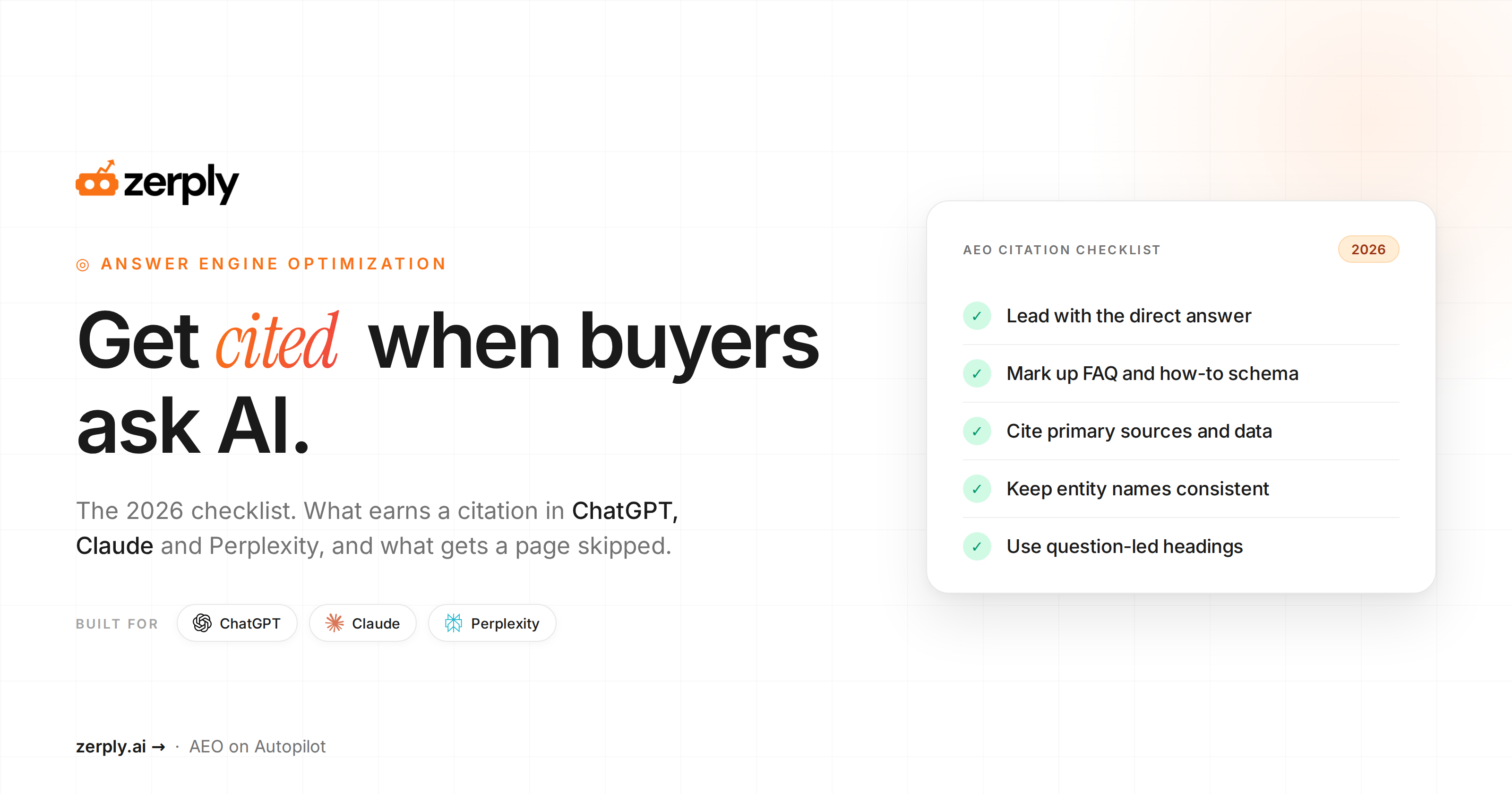
Citation-friendly pages tend to share a few repeatable traits: direct answers, clear structure, machine-readable signals, and recent factual maintenance.
As such, the AEO checklist below prioritizes the elements that improve extractability and trust without creating a separate workflow for every page type.
High-impact patterns
A practical AEO checklist should help teams decide what to fix first.
The table below groups items by relative impact so editorial, SEO, and content ops teams can sequence work without turning every page into a full rebuild.
| Item | Impact | Why it matters |
|---|---|---|
| Answer-first opening under each heading | High | Gives AI systems a clean passage to extract |
| 40 to 60 word definitions | High | Improves snippet and citation readiness |
| Self-contained sections | High | Lets a single section stand alone in answers |
| Factual density with source-backed claims | High | Increases verification confidence |
| Definition plus Micro-FAQ pattern | High | Helps answer follow-up questions on-page |
| Question-led subheads | Medium | Aligns with natural-language query intent |
| Lists and tables for comparisons | Medium | Improves scannability and extraction |
| Author, publisher, and date clarity | Foundational | Supports trust and content maintenance |
| Schema matched to page purpose | Foundational | Helps machines interpret the page correctly |
One pattern deserves close attention.
Concise definitions and extractable structure, coupled with supplied benchmark and a definition plus Micro-FAQ pattern.
That makes it a high-leverage edit for glossary pages, tactical posts, and product education content.
Structure for extraction
At the page level, answer-first formatting means the first one or two sentences under a heading should resolve the heading directly.
After that, expand with context, examples, comparisons, or steps that deepen the answer instead of delaying it.
Keep each section narrow enough to be quoted on its own.
A heading like “How AEO helps SaaS demand generation” gives an AI system a better retrieval target than a branded or abstract subhead that hides the actual intent.
Lists and tables help when they genuinely simplify comparison. They are useful because they reduce ambiguity, and the goal is still readability for humans. Buried answers remain one of the common failure patterns in AI citation optimization.
Trust and machine readability
Trust signals need visible and machine-readable support, since strengthening entity trust is what ultimately decides whether AI answer engines treat your brand as a credible source. Relevant schema types often include Article, FAQPage, HowTo, Organization, Person, and Breadcrumb.
Schema only helps when it matches the page’s visible content and intent. A page marked as FAQPage should actually contain FAQ content. A HowTo page should present a real sequence. Misaligned markup creates noise and weakens confidence.
Alongside schema, keep brand and product naming consistent, identify the author and publisher clearly, and maintain datePublished and dateModified where they are justified.
Clean HTML access and crawlability still matter because AI systems cannot cite content they cannot reliably retrieve.
AEO Citation Readiness Score
A useful AEO checklist should tell you whether a page is ready for citation work before the rewrite starts.
Zerply’s AEO citation readiness score is a practical self-assessment framework for that step. It helps teams separate structural blockers from editorial opportunities so they can fix the issues that move citation likelihood first.
Score each criterion from 0 to 3, then total the page score out of 24.
- 0 = missing or actively blocking citation potential
- 1 = partial implementation with clear gaps
- 2 = solid baseline with room to improve
- 3 = strong execution and ready to scale
Scoring table
| Criteria | What good looks like | Score guidance | What to fix first |
|---|---|---|---|
| Crawler access and indexation | Important pages are crawlable, indexed, render cleanly, and expose answer content in HTML | 0 if blocked, noindexed, or poorly rendered. 1 if indexation is inconsistent. 2 if accessible with minor issues. 3 if cleanly indexed and fully retrievable | Remove crawl barriers, confirm rendering, check canonical signals, and validate indexation in Google Search Console and Bing Webmaster Tools |
| Answer-first structure | Each section opens with a direct answer, concise definition, or clear recommendation | 0 if answers are buried. 1 if only the intro is direct. 2 if several sections are extractable. 3 if the page is consistently answer-first throughout | Rewrite the first two sentences under priority headings and tighten vague subheads |
| FAQ and schema alignment | FAQ content exists where useful and structured data matches the visible page type | 0 if schema is missing or misleading. 1 if markup exists with weak alignment. 2 if relevant schema is present and mostly accurate. 3 if FAQ, Article, HowTo, and entity markup are tightly matched to content | Remove mismatched schema, add FAQ only where the page truly answers follow-up questions, and validate markup |
| Factual density and citations | Claims are specific, current, and supported with credible sources or first-party evidence | 0 if the page makes broad claims without support. 1 if some facts are cited. 2 if key claims are backed. 3 if the page is dense with verifiable, current, well-scoped evidence | Add source-backed claims, tighten vague language, and replace generic statements with concrete data or examples |
| Entity and author trust | Brand, product, author, and publisher signals are clear and consistent | 0 if authorship is missing and entities are inconsistent. 1 if trust signals are thin. 2 if author and publisher are clear. 3 if entity naming, author pages, and publisher details are consistent sitewide | Add author bylines, improve bio and organization details, and standardize product and brand naming |
| Freshness | Definitions, examples, comparisons, and timestamps reflect the current market or product reality | 0 if the page is outdated. 1 if the date is fresh but the content is stale. 2 if core facts are current. 3 if the page shows substantive upkeep where needed | Refresh aging examples, revise comparisons, update screenshots, and change visible dates only after real edits |
| Platform coverage | The page is prepared for Google, Bing-driven search, and Perplexity-style retrieval behavior | 0 if platform differences are ignored. 1 if only Google is considered. 2 if Google and Bing basics are covered. 3 if indexing, recency, and fact support are tuned across platforms | Verify Bing indexing, review recency-sensitive pages, and strengthen fact support on pages likely to surface in Perplexity |
| Measurement | Citation tracking, mention monitoring, and conversion reporting are in place | 0 if success is measured only by clicks. 1 if manual checks exist. 2 if citations or mentions are tracked. 3 if query-level visibility, referrals, and assisted outcomes are monitored together | Add citation tracking, segment by page type, and connect visibility data to conversions and refresh history |
Score bands
| Total score | Readiness level | Interpretation | Priority action |
|---|---|---|---|
| 0 to 8 | Low | The page has eligibility or trust gaps that limit citation potential | Fix access, indexing, schema alignment, and answer placement before deeper rewrites |
| 9 to 16 | Medium | The page has a usable base but weak extractability or inconsistent trust signals | Tighten structure, add support for claims, and improve entity clarity |
| 17 to 24 | High | The page is well positioned for citation testing and refresh cycles | Benchmark citations, monitor changes by platform, and refine the sections that earn mentions |
This framework works best when applied to existing high-impression URLs first.
In Zerply, teams can use the score as a repeatable page triage model, then benchmark citations and source visibility after each refresh.
That keeps AEO tied to measurable workflow decisions instead of broad page audits that never convert into action.
How To Build Pages AI Systems Cite
AEO works best when applied to the right page types. You do not need every URL on the site to be citation-optimized to the same degree. Focus on pages that answer recurring questions, frame category understanding, or support mid-funnel evaluation.
That approach keeps the workflow manageable and lets you learn which formats earn citations before expanding the program.
Page types that fit
Several SaaS page types tend to perform well in answer environments:
- Glossary pages Useful for definitions, category explanations, and entity clarity. They are strong candidates for concise answers and follow-up FAQs.
- Product education pages These work for “how it works,” use case, and methodology queries where a direct answer needs supporting product context.
- Comparison pages Best for evaluation intent, especially when structured with balanced criteria, tables, and explicit definitions.
- Documentation Effective for implementation and troubleshooting queries, where precision and step order matter.
- Tactical blog posts Strong for workflows, checklists, and process-driven questions that need depth after the initial answer.
One page can serve both traditional search and AI answers. The winning structure is usually concise answer blocks up top with layered depth below, rather than thin snippets with no supporting detail.
A practical workflow
This answer engine optimization tutorial works well as a repeatable sequence for existing content, especially on sites with a strong content base but uneven citation visibility.
- Select answer-intent queries Start with queries that imply definitions, comparisons, steps, or direct recommendations.
- Audit current ranking and citation candidates Review pages already earning impressions, because they often need restructuring more than replacement.
- Rewrite sections in answer-first format Add direct openings, clean definitions, and narrow subheads.
- Add schema and metadata Match markup to the actual page type and visible content.
- Strengthen supporting authority Improve internal pathways to related educational pages and product context. For teams centralizing this workflow, Zerply AI fits naturally where SEO research, drafting, and publishing need to stay connected.
- Refresh facts where the page has aged Update definitions, examples, comparisons, and timestamps only when there is a real substantive change.
- Validate rendering and indexation Confirm the important content is accessible in HTML and properly indexed.
That sequence keeps AEO tied to existing SEO operations instead of creating a parallel process that content teams struggle to maintain.
In practice, this AEO checklist is most effective when teams apply it first to existing high-impression pages rather than spreading effort evenly across the entire site.
Platform differences
Platform behavior changes the optimization emphasis. The fundamentals stay the same, but retrieval tendencies influence what deserves extra attention, especially since Google AI Overviews pull from a different pool of signals than ChatGPT Search or Perplexity.
| Platform | Retrieval tendency | What it tends to favor | Recommended focus |
|---|---|---|---|
| Google AI Overviews | Draws from Google’s index | Pages already ranking with authority | Preserve ranking strength, improve extractable structure |
| ChatGPT Search | Relies heavily on Bing indexation | Accessible pages discoverable through Bing | Verify Bing indexing and webmaster setup |
| Perplexity | Strong recency and fact usage signals | Fresh, fact-dense, well-scoped pages | Maintain updates and support claims clearly |
Execution should follow platform reality.
- Google optimization starts with ranking strength and authoritative coverage.
- ChatGPT Search requires operational attention to Bing.
- Perplexity rewards pages that stay current and dense with useful facts.
Technical Signals and Freshness
Editorial improvements only work when the page is technically eligible for retrieval. Crawlability, rendering, indexation, and freshness are basic requirements for citation potential.
These are not glamorous fixes, and they often determine whether a strong answer gets seen at all.
Indexation and access
Pages must be crawlable, render cleanly, and expose important content in accessible HTML. Keep XML sitemaps current, avoid blocking relevant crawlers in robots.txt, and check that key answer content is not trapped behind scripts, tabs, or interfaces that fail to render consistently.
Technical barriers reduce citation odds quickly. Heavy JavaScript dependency, partial paywalls, and inaccessible content layers can all make strong information effectively invisible to retrieval systems.
Freshness that helps
Freshness matters when the topic changes, the market evolves, or the examples age out. As such, updated content is more likely to remain useful, and AI systems appear more willing to cite material that reflects current facts.
A date change without meaningful revision is weak practice. Update the definition, workflow, screenshots, examples, feature comparisons, and cited claims where needed. Then show a visible last-updated signal only when the revision is substantive.
Common mistakes
The same errors appear across underperforming AEO pages:
- Treating AEO as separate from SEO basics
- Publishing long intros that delay the answer
- Using schema that does not match the page
- Ignoring Bing while targeting ChatGPT Search visibility
- Measuring success only through clicks
- Refreshing dates without refreshing facts
Each one is fixable, and together they create pages that are hard to retrieve, hard to trust, or hard to cite.
Measure AEO Beyond Clicks
AEO reporting should answer a business question: where is your brand being used as a source, and does that visibility contribute to qualified outcomes? Click data still matters, and it is no longer enough on its own.
That broader model helps teams protect content investment even when top-of-funnel traffic patterns change.
The right metrics
Start with five KPI groups: citation frequency, brand mention share, query-level AI visibility, assisted conversions, and AI referral engagement.
Those metrics reflect whether the page is being surfaced, cited, and connected to actual business value.
The conversion piece matters more than many teams expect. Your supplied benchmark shows AI referral traffic converting at around 10 to 16%, versus 2 to 5% for traditional organic.
A traffic dip on informational content does not automatically mean an influence loss.
A simple model
A durable reporting model combines Search Console performance, Bing Webmaster checks, AI citation tracking, page-level conversion data, and refresh history.
HubSpot’s AEO strategy guidance supports this broader measurement approach by emphasizing visibility and business outcomes over traffic alone.
Segment results by page type and query intent. That lets you see whether glossary pages earn citations but low conversion impact, while tactical pages and comparison content drive stronger assisted pipeline.
For teams that need this in one operating layer, Zerply’s AI Visibility Tracking fits naturally into the workflow by monitoring AI share of voice, citations, and source-level visibility alongside GSC-connected SEO operations. That makes it easier to spot where a refresh, rewrite, or indexing fix will actually move outcomes.
How Zerply Helps You With Answer Engine Optimization
Zerply supports answer engine optimization by connecting research, content operations, technical checks, and visibility reporting in one workflow. For teams already managing SEO programs, that reduces the handoff friction that often slows AEO execution.
Unified research
AEO starts with the right query set. Zerply helps teams research informational, comparison, and workflow-driven topics that are likely to surface in AI answers as well as traditional search. Because the research layer connects with Google Search Console data, teams can prioritize pages that already have impression history and improve those assets before creating net-new content.
That workflow is especially useful when the goal is to learn how to do answer engine optimization at scale. Instead of treating AEO as a separate content stream, teams can identify which existing pages need stronger definitions, tighter sectioning, or fresher evidence.
Drafting and publishing
Zerply also supports agentic drafting and publishing workflows, which helps content teams move from research to edited output without leaving the operating system they use for SEO work. That matters for AEO because answer-first content often requires precise rewrites across headings, summaries, FAQs, and comparison sections.
The practical value is consistency. Teams can update existing assets, draft new answer-first sections, and publish improvements while keeping the page structure aligned with search intent and editorial standards.
Schema-aware execution
Schema and page structure need to match visible content. Zerply supports schema-aware workflows so teams can build or revise content with markup requirements in mind, rather than treating schema as a disconnected technical task after publication.
That improves implementation discipline on pages where FAQ, HowTo, Article, Organization, or Person markup supports machine readability.
It also helps reduce the common failure case where pages carry structured data that does not reflect what a user actually sees.
AI visibility tracking: Measurement is where many AEO programs stall. Zerply helps by tracking AI visibility across ChatGPT, Claude, Gemini, and Perplexity so teams can see where brand mentions, citations, and source inclusion are appearing over time.
Competitor monitoring: AEO performance is relative as well as absolute. Zerply gives teams a way to monitor competitor mentions and citations across answer engines, which helps clarify who is being used as a source for priority queries and where your brand is absent.
Reporting that connects: Reporting needs to connect visibility data with business outcomes. Zerply brings together Search Console inputs, AI visibility tracking, citation monitoring, and content workflow history so teams can evaluate what changed, where it changed, and whether it affected qualified traffic or assisted conversions.
AEO gets easier once you stop treating it like a mystery channel. The mechanics are clear: make answers easier to extract, keep pages trustworthy and current, and measure visibility where AI interfaces actually surface your brand.
Check out Zerply today.
FAQ
What are the best practices for answer engine optimization?
The core best practices for answer engine optimization are strong SEO foundations, answer-first formatting, concise definitions, self-contained sections, accurate schema, entity consistency, and meaningful content refreshes. Measurement should include citations and conversion quality, not just clicks.
How is AEO different from SEO?
SEO focuses on ranking and earning visits from search results. AEO focuses on making content easy for AI systems and search engines to extract, summarize, and cite inside answer-driven interfaces.
How do you do answer engine optimization for SaaS content?
Prioritize glossary pages, product education, comparison content, documentation, and tactical posts. Then rewrite key sections with direct answers, add matched schema, verify Google and Bing indexation, and maintain freshness on high-value pages.
Which platforms matter most for AI citations?
Google AI Overviews, ChatGPT Search, and Perplexity are the main operational priorities here. Google tends to favor already ranking pages, ChatGPT Search depends heavily on Bing indexation, and Perplexity responds strongly to recency and factual density.
How should teams measure AEO performance?
Track citation frequency, brand mention share, AI visibility by query, assisted conversions, AI referral engagement, and page refresh history. That gives a better picture of influence than sessions alone.
If you want a practical starting point, benchmark a set of priority pages in Zerply during the 7-day free trial. Score each page with the AEO citation readiness framework, track citation and mention visibility across answer engines, and use the first benchmark to decide which pages need rewrites, refreshes, or indexing fixes first.
Written by
Founder at Zerply.ai & Wittypen
Anshul is the founder of Zerply.ai and previously built Wittypen, a content marketplace powering SEO growth for 1,000+ businesses. Over the last decade he has worked hands-on with B2B SaaS and tech teams to turn search data into compounding organic growth. At Zerply he shares practical playbooks on AEO, AI visibility, and modern SEO that come directly from experiments, wins, and failures in real projects.