How to Make Existing SEO Content Citation-Ready for AI Answers

AI answer engines changed the target for content teams. A page can rank well, hold traffic, and still fail to earn an AI citation because the answer is buried, unsupported, stale, or hard to extract.
That is why the existing SEO content refresh workflow now has to serve two goals at once: maintain search performance and improve passage-level citation eligibility.
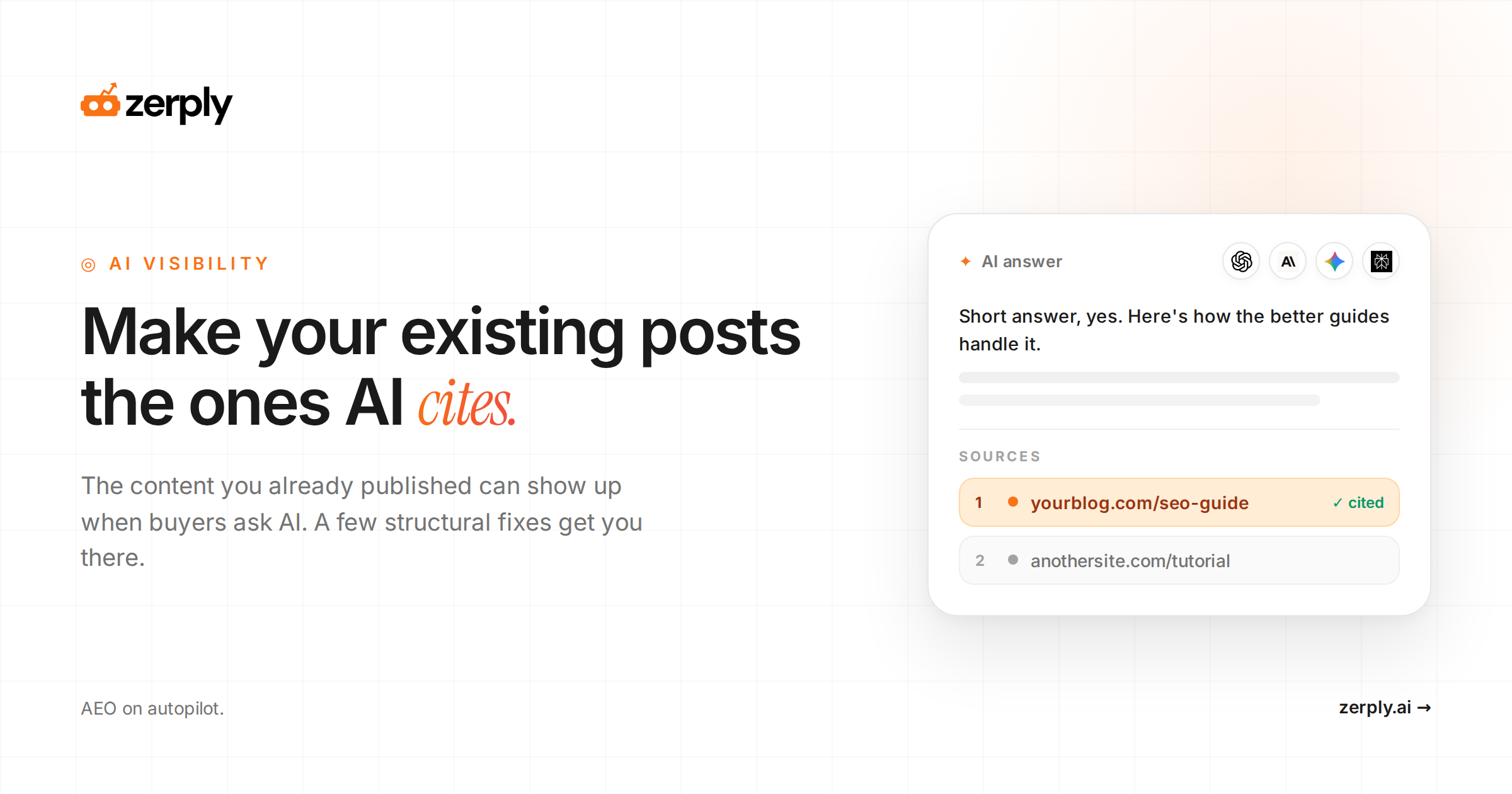
Citation-ready content comes from refreshing existing pages so each section answers one query clearly, supports claims with evidence, and publishes with clean machine-readable signals.
The practical workflow is CITE-FIT for page prioritization and AERO for execution: Audit extractability, Engineer answer blocks, Reinforce with evidence, Operationalize machine signals, and Observe and iterate.
Why Ranking #1 Falls Short
Ranking first still helps discovery, but it does not guarantee citation in AI answers because models select passages, not just pages.
Extraction quality, evidence density, freshness, and source trust now influence whether a section is reused in ChatGPT, Perplexity, Gemini, or AI Overviews.
Ahrefs found that only 12% of AI-cited URLs appear in Google’s top 10, while 80% do not rank in the top 100.
SEOClarity also reports that the #1 organic result has a 33.07% AI citation rate, which means first place still matters but leaves room for other sources to enter the answer set.
This shift is already affecting traffic economics.
Fuel Online reports that 92% of enterprise brands are invisible to ChatGPT and that CTR for the #1 result has dropped 65.3% since AI Overviews.
BrightEdge adds another layer, saying that the top 1% of domains receive 64% of citations, while 96.8% of cited domains see no week-over-week change, which suggests citation share can become concentrated and sticky once patterns set in.
For content teams, the conclusion is operational. Ranking is a discovery signal. Citation readiness determines whether the answer engine can extract, trust, and reuse the section.
What Citation-Ready Actually Means
Citation-ready content is content organized so a single section can be extracted, attributed, and reused as part of an AI answer. The useful unit is often a 50 to 150 word passage with a direct answer, evidence, and enough context to stand alone.
Citation-ready content is built for passage-level reuse. The particular model often pulls from an H2 section, FAQ response, list, table, or short explanatory paragraph rather than from the page as a whole. That is why answer-first content matters. The best sections lead with the answer, then add proof, examples, or constraints in a compact structure.
Research backs that format. Ekamoira found that self-contained 50 to 150 word chunks earn 2.3x more citations.
Hashmeta reports that sections with three or more data points see 2.5x higher citation rates.
The Princeton GEO paper found that adding statistics can lift visibility by 15% to 40% and expert quotes can add another 30% to 40% depending on the prompt and source pattern.
A citation-ready section usually includes:
A heading scoped to one question
A direct answer in the first 40 to 60 words
Specific claims instead of broad summaries
Named entities, statistics, or examples
Traceable sourcing and clear authorship
Clean HTML that can be rendered and parsed reliably
That is the core of AEO content optimization and LLM citation readiness. SEO still supports discovery. Citation-ready content is not just page-level relevance. It is passage-level usability.
Why Refresh Beats Net-New
Refreshing existing pages usually beats publishing net-new content because mature URLs already have authority, links, query history, and internal relevance.
A targeted rewrite can improve AI citation optimization faster than launching a new page with no trust or visibility baseline.
Existing SEO content gives teams a head start. Ranking pages already have some combination of authority, impressions, and topical fit. They are easier to upgrade for AI answers than brand-new URLs that need discovery, indexing, and trust building before they can compete.
This matters because AI citations skew toward owned sources. Yext found that 86% of AI citations come from brand-managed sources, which means strong first-party content still does a large share of the work, provided that work reinforces entity trust rather than just publishing volume. The opportunity is often hidden inside underperforming sections on pages that already rank or already collect impressions without clicks.
Refreshing also aligns better with editorial efficiency. Teams can improve the answer block, replace stale sources, add expert commentary, tighten the heading structure, and validate schema in one workflow.
That creates stronger AI citation optimization without expanding the content library unnecessarily.
Use refreshes first when the page has:
Existing rankings or impressions
Strategic topic coverage
Outdated answer blocks
Thin evidence or weak attribution
Mixed intent that can be separated with structural edits
A clear tie to leads, pipeline, or product education
This is where Zerply’s AI visibility tracking becomes useful. It helps teams identify which topics already appear in AI answers, which pages have citation upside, and where a refresh should be prioritized before a new page is commissioned.
The CITE-FIT Score
CITE-FIT is a page prioritization scoring model for citation-ready content refreshes. It helps teams identify which existing pages deserve AEO work first by combining visibility gaps, topical strength, freshness, and business value into one repeatable review.
CITE-FIT should be used before rewriting. Score pages first, then move into section-level edits.
This prevents teams from spending time on pages with weak strategic value or poor fit for AI answer extraction.
CITE-FIT signals
CTR decay: Pages losing clicks while holding rank may be exposed to AI answer substitution and deserve answer-first refreshes.
Impressions without clicks: Strong impressions with weak clicks often indicate query visibility without passage relevance or insufficient answer clarity.
Topical authority: Pages on subjects where the domain already has depth, internal links, and supporting coverage are easier to strengthen.
Entity richness: Named products, people, organizations, frameworks, locations, and supporting terminology improve extractability and attribution.
Freshness gap: Pages with stale references, old dates, or outdated examples often lose citation eligibility, especially on fast-changing topics.
Intent fit for AI: Definitions, how-to content, FAQs, comparisons, checklists, and explainers tend to map well to AI answer formats.
Traffic-to-revenue tie: Prioritize pages that influence product education, lead generation, conversion support, or strategic category visibility.
A simple 1-to-5 score per factor is enough to sort the queue. Pages with high authority and strong AI intent but weak freshness or low extractability are often the fastest wins.
The AERO Refresh Loop
AERO is the operating model for converting existing SEO content into citation-ready content. The workflow is Audit extractability, Engineer answer blocks, Reinforce with evidence, Operationalise machine signals, and Observe and iterate after publication.
AERO turns citation readiness into a repeatable refresh system rather than a one-off rewrite project.
1. Audit extractability
Review the page section by section. Check whether each H2 answers one query, whether the first lines contain a direct response, and whether the block can stand on its own outside full-page context.
Pull sections into a blank document and test whether they still make sense after the surrounding copy is removed.
2. Engineer answer blocks
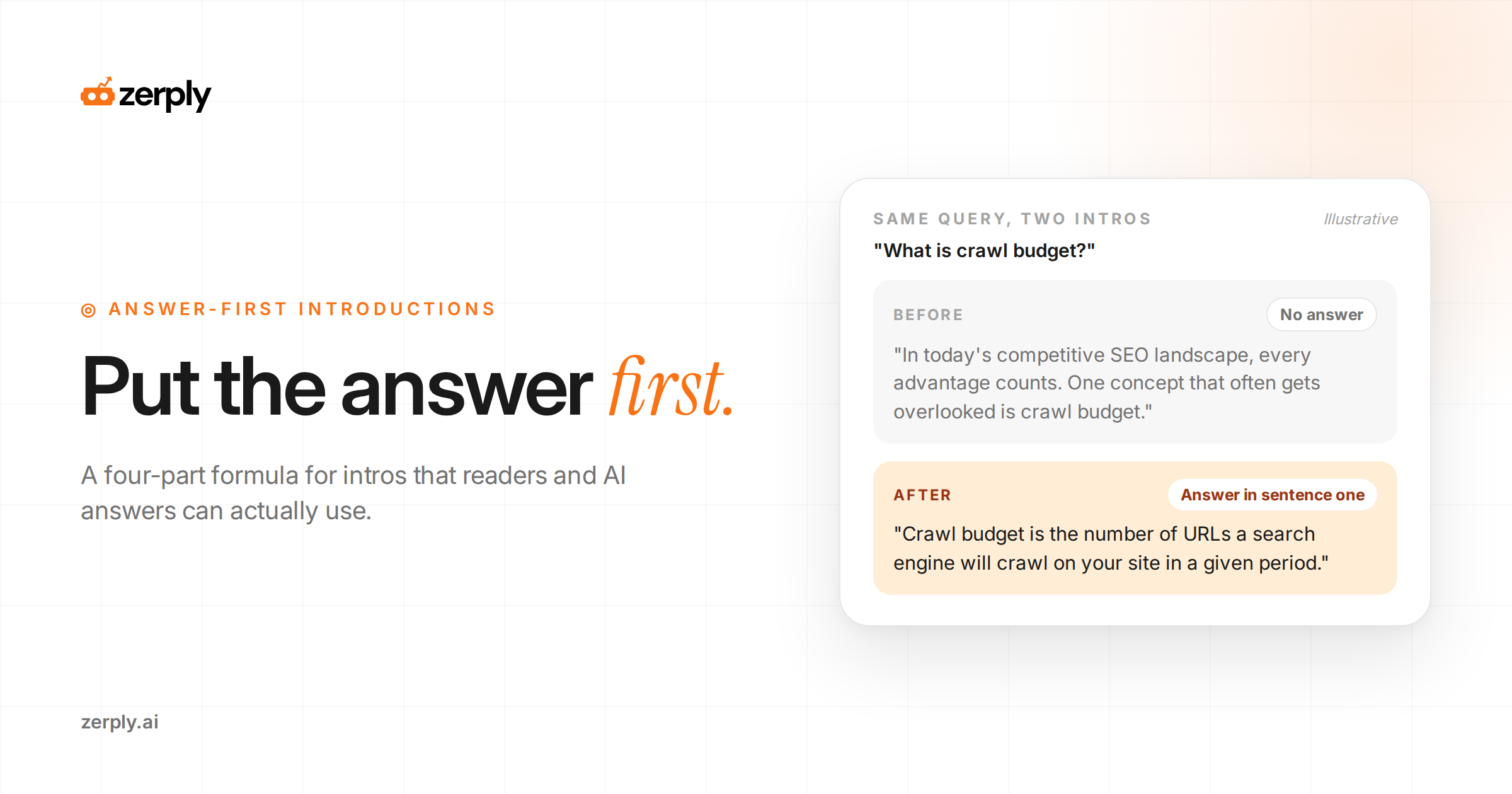
Add a 40-word answer block at the top of major sections. Keep the scope tight. A strong answer block should define, explain, or compare in a way the model can quote directly. This is the core of answer-first content.
3. Reinforce with evidence
Add named studies, statistics, expert commentary, examples, and source links close to the claims they support. The Princeton GEO research suggests statistics and expert quotes materially improve citation likelihood.
Hashmeta’s finding on three-plus data points supports the same editorial direction.
4. Operationalise machine signals
Validate article schema, authorship, publisher identity, datePublished, and dateModified. Keep critical copy in crawlable HTML. Match visible update dates with schema and make sure FAQs are visible before applying FAQPage markup.
Perplexity data from Discovered Labs shows that content updated within the last 30 days receives 3.2x more citations, which makes freshness implementation part of the citation workflow, not a cosmetic publishing step.
5. Observe and iterate
Track which pages, prompts, and passage formats gain reuse after the refresh. Monitor citation share, source patterns, and AI visibility trends, paying attention to citation velocity as a leading indicator of whether the refresh is gaining traction.
This is where Zerply can streamline the workflow by connecting refresh decisions toAI visibility tracking instead of separating audit, editing, and reporting across multiple tools.
Tailoring By Platform
AI platforms share the same citation foundations, but they do not always prefer the same formats.
The refresh should adapt section structure to platform behavior while keeping the core editorial pattern stable: direct answer first, evidence next, machine-readable publishing signals throughout.
ChatGPT often favors concise explanatory passages and trusted brand-managed sources.
Perplexity tends to reward recently updated, evidence-backed sections with visible citations.
Google AI Overviews often pull compact passages that align closely with query intent and existing search relevance.
Gemini and other assistants also respond well to pages with clear entities, definitions, and scoped subtopics.
Use platform-aware formatting:
Definitions: One-paragraph glossary-style answers under a precise heading
Comparisons: Compact tables with explicit criteria and tradeoffs
How-to queries: Outcome sentence first, then ordered steps
FAQs: Direct one-paragraph answers before deeper explanation
Commercial education: Clear product or category explanations with named entities and evidence
This is still one workflow. The variation happens in section format, not in the underlying standard for LLM citation readiness.
How Zerply Simplifies Your Citation-Ready Content Workflow
Making existing SEO content citation-ready is not just an editorial exercise. It requires a repeatable workflow that connects performance data, content structure, AI visibility, technical readiness, and publishing execution.
Zerply fits into this workflow by helping SEO Managers and Content Leads move from manual refresh decisions to an automated, measurable system.
Zerply helps identify which existing pages deserve attention first. Instead of relying only on intuition or old traffic reports, teams can use Zerply alongside Google Search Console data to spot pages with ranking momentum, impression growth, CTR decay, and strategic topic relevance.
For teams building into a standing workflow, Zerply offers AI visibility tracking to connect page-level refreshes with citation outcomes. A 7-day free trial is a practical way to test whether your current library already has hidden citation upside.
Frequently Asked Questions (FAQs)
What is citation-ready content?
Citation-ready content is content structured so an AI system can extract a section, trust the claim, attribute the source, and reuse it in an answer. The strongest passages are self-contained, answer-first, evidence-backed, and easy to parse.
How is AEO content optimization different from SEO?
SEO improves discoverability in search results. AEO content optimization improves the chances that a specific passage is selected for an AI answer. The two workflows should support each other, but they solve different retrieval problems.
Why is my #1-ranked page not getting cited by ChatGPT?
High rank does not guarantee strong extraction. The answer may be buried, too vague, unsupported, stale, or split across several sections. Ahrefs and SEOClarity data both show that AI citation behavior does not map cleanly to traditional ranking position.
How often should I refresh content for AI citation optimization?
Refresh cadence should match topic volatility. Fast-changing topics often need monthly review. Stable educational pages can follow a quarterly schedule. Perplexity data showing stronger citation rates for content updated within 30 days makes freshness a meaningful input on active topics.
What schema do I need for LLM citation readiness?
Start with valid Article schema including headline, author, publisher, datePublished, and dateModified. Add FAQPage only when the FAQ is visible on the page. Schema supports machine readability, but it does not replace editorial clarity.
Can I make a page citation-ready without rewriting the whole thing?
Yes. Many pages improve with section-level edits rather than full rewrites. Adding direct answer blocks, updating outdated claims, strengthening evidence, and fixing headings often produces meaningful gains without rebuilding the entire asset.
How do I measure if my refresh worked?
Measure AI citation frequency, prompt-level share of voice, sections reused most often, and changes after content updates. Rankings and traffic still matter, but they do not fully show whether the page became more usable inside AI answers.
What is answer-first content and is it the same as citation-ready content?
Answer-first content leads with a direct response before adding detail. It is a core technique inside citation-ready content, but it is only one part of the full standard. Citation readiness also requires evidence, attribution, freshness, entity clarity, and machine-readable publishing signals.
Written by
Founder at Zerply.ai & Wittypen
Anshul is the founder of Zerply.ai and previously built Wittypen, a content marketplace powering SEO growth for 1,000+ businesses. Over the last decade he has worked hands-on with B2B SaaS and tech teams to turn search data into compounding organic growth. At Zerply he shares practical playbooks on AEO, AI visibility, and modern SEO that come directly from experiments, wins, and failures in real projects.