Claude Fable 5 for Marketers: 5 Jobs and How to Use It

Anthropic released Claude Fable 5 on June 9, 2026. The benchmark coverage went up within the hour, and most of it speaks to engineers. This piece covers the marketing side: what the model changes about day-to-day SEO and content work, the specific jobs you can now run with it, and how to get access while the launch pricing still applies.
The short version is that the amount of work you can delegate in one go has gone up. Earlier models lost the thread on long tasks, so a project meant breaking the work into twenty or thirty prompts and assembling the output yourself. Fable 5 plans the stages, tracks its own progress against the goal, and keeps working for hours or days inside an agent setup. The practical effect for a marketing team is that several jobs move from hands-on to delegated.
What Claude Fable 5 is
Fable 5 is the first model Anthropic has made publicly available from its highest tier, the class that sits above the Opus family. Anthropic describes it as built for long-running, multi-step work that previously required a person checking in every few minutes. It accepts text, images, and files, holds a one-million-token context window, and corrects its own errors through verification loops as it works.
Four of its capabilities matter most for marketing teams.
It sustains long jobs without drifting off task. It reads exact figures from charts and tables inside files rather than treating them as images. It keeps working notes across a job and uses them later. And it reviews its own output before returning it. Each of these was a ceiling on earlier models, and together they expand the set of marketing tasks you can hand over and review once.
What you can do with Fable 5 as a marketer
Five jobs where the model now does the heavy lifting. Each includes the prompt to run, written so you can adapt the bracketed parts to your own site.
1. Build a full content cluster
A topic cluster involves SERP research, a brief for each article, the drafts themselves, and an internal link map across a dozen or more pages. On earlier models, the planning lived in your head and you ran each stage manually because the model would lose the structure partway through. Fable 5 holds the plan and runs the stages in order.
Build a 15-article content cluster around [head keyword].
Research the live SERPs for each subtopic, write a brief per
article, draft all 15, and map the internal links between them.
Flag any subtopic where the search intent is unclear.
The output is a finished cluster you review at the end rather than fifteen separate threads you manage in parallel. This is the same workflow Zerply's AI agents handle inside the product, where they monitor the site, detect content gaps, and draft against them on a schedule.
2. Analyze your dashboards from screenshots
Reading performance data used to mean exporting a CSV, cleaning it, and retyping figures into a prompt, because the model could only see a chart as an image. Fable 5 reads the actual numbers inside a PDF or screenshot, so raw exports become usable input on their own.
Here is 90 days of Search Console exported as PDF, plus three
GA4 screenshots. Tell me which pages dropped, by how much, and
what the declining pages have in common. Rank the fixes by
likely traffic recovered.
The model returns the specific drops, groups the affected pages by what they share, and orders the fixes by likely impact. For a one-off analysis, the screenshot route works well. For recurring reads, a live connection is better, which is why Zerply's SEO chat connects directly to Google Search Console and GA4 and queries the live account instead of a static file.
Run a recurring competitor watch
Standing tasks used to reset every session, so a weekly check meant re-describing the same competitor pages from scratch each time. Fable 5 keeps a memory across a long-running job, so a recurring task accumulates context instead of starting over.
Check these three competitor pricing pages every Monday. Keep a
running log. Each week, report only what changed since last week:
new plans, price moves, copy edits, new feature mentions.
By the fourth week the report describes what moved rather than restating the page. Persistent memory is what makes anything on a cadence worth automating.
Build an interactive page in one prompt
An interactive asset such as an ROI calculator or a comparison widget used to require an engineering sprint or a long series of corrections. Anthropic's launch partners report that builds which once took a hundred prompts now complete in one.
Build an ROI calculator for my pricing page. Inputs: team size,
hours saved per week, average hourly cost. Output: monthly
savings and payback in months. Match these fonts and colors
[paste brand tokens]. Give me a single embeddable file.
The result is a working file ready to embed. Publishing it is the next step, and Zerply's Foundry handles that part by pushing pages to a subpath on your own domain, where they inherit your existing authority rather than starting cold on a subdomain.
Have it review its own draft
AI drafts have tended to arrive confident and partly wrong, leaving the marketer to act as the quality check. Fable 5 validates its own work as it goes and revises the weaker sections before the draft reaches you.
Here is my target keyword and the top three URLs ranking for it.
Draft a page that could outrank them. Then score your own draft
against those three on depth, structure, and coverage, and
rewrite whatever falls short of the best one.
The version you receive has already been measured against the pages currently ranking and rewritten where it fell short. The editing work starts from a stronger draft.
A note on cost
Fable 5 suits large, high-value jobs more than quick edits. On the API it runs $10 per million input tokens and $50 per million output tokens, which is double the price of Opus 4.8. The sensible pattern is to route the long, delegable work to Fable 5 and keep a cheaper, faster model available for rapid back-and-forth. Matching the model to the task is most of the cost control.
How to access Claude Fable 5
There are two routes, depending on whether you work in the Claude apps or build on the API. Paid subscription plans include Fable 5 at no extra cost through June 22, 2026, so the launch window is the least expensive time to evaluate it.
In Zerply
If you run your SEO and content work through Zerply, Fable 5 is already available as a model option, no separate Anthropic plan required.
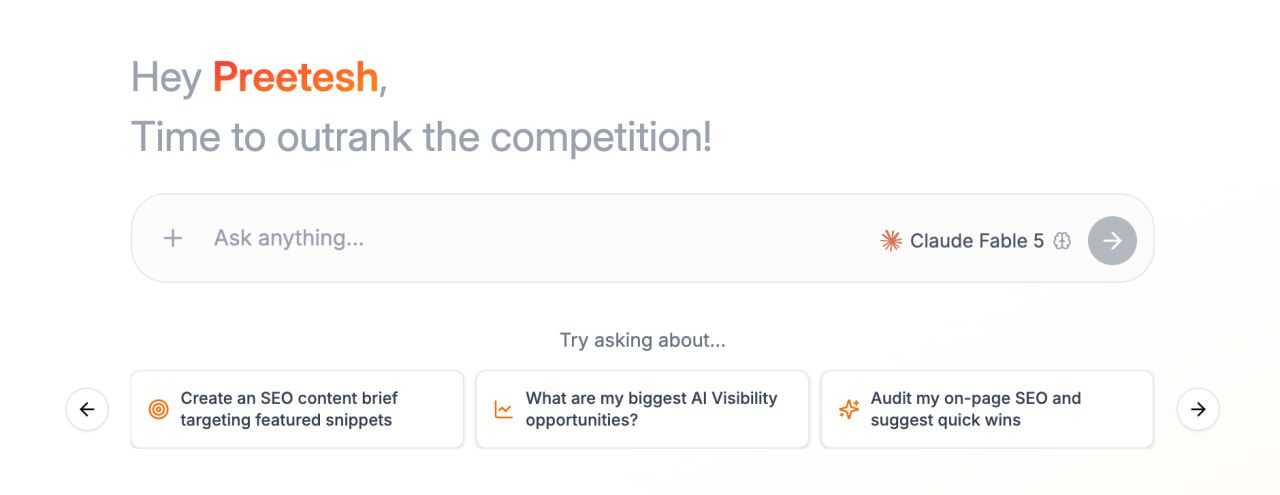
- Open the agent. Start a session with the Zerply SEO agent or a writing task.
- Open the model selector. It sits in the agent's chat interface, where you choose which model runs the job.
- Select Claude Fable 5. Pick it from the list alongside GPT, Claude, and Gemini. The agent will run that task on Fable 5, grounded in your connected Search Console data.
- Switch per job. Use Fable 5 for the long, multi-step work like cluster builds and self-reviewed drafts, and a faster model for quick edits, without leaving the thread.
In the Claude apps
- Open Claude. Go to claude.ai on the web, or open the desktop or mobile app, and sign in.
- Open the model selector. It appears at the top of the chat window and shows the current model name.
- Select Claude Fable 5. Choose it from the list. New chats will run on Fable 5 until you switch back.
- Check your plan window. Pro, Max, Team, and seat-based Enterprise plans include Fable 5 at no extra cost from June 9 through June 22, 2026. From June 23, continued use draws on usage credits.
On the API
- Use the model ID. Call the model with the string
claude-fable-5through the Claude API, or the Messages API on AWS, Google Cloud, or Microsoft Foundry. - Account for the price. Billing is $10 per million input tokens and $50 per million output tokens, with a 90% discount on cached input. Route routine work to a cheaper model and reserve Fable 5 for demanding jobs.
- Enable data retention if required. Using Fable requires 30-day data retention for safety monitoring, and some clouds require you to opt in through a data-retention setting before the model will run.
- Configure the fallback. Queries flagged by cybersecurity or biology safeguards route to Opus 4.8. The apps handle this automatically. On the API, set up Anthropic's Fallback API so flagged requests still resolve, and note that rerouted requests are not billed at Fable prices.
Pricing, the free-access window, and plan inclusions can change during a launch week. Confirm the current terms on Anthropic's pricing page and in your account before committing to anything that bills by the token.
Where Fable 5 fits in your stack
A stronger model is half the work. It still answers from general knowledge until you connect it to your own data, and a well-made draft that stays in a chat window earns no citations. The distance between a capable draft and a published page is what determines whether your brand appears when buyers ask an AI assistant.
Closing that distance is what Zerply is built for, and Fable 5 now runs inside it. The platform tracks how ChatGPT, Perplexity, Claude, and Gemini describe your brand through AI visibility tracking, lets you ask questions grounded in your live Search Console through the agent, and publishes the resulting pages to your own domain through Foundry. You pick the model per job from the same selector that holds GPT, Claude, and Gemini, so the cluster builds and self-reviewed drafts described above run on your real site data rather than generic knowledge. Monitor, plan, publish, in one workspace.
The model supplies the reasoning. Your Search Console and your domain are what turn it into traffic.
See what AI says about your brand
Track how ChatGPT, Claude, Gemini, and Perplexity talk about you. Ask the agent questions grounded in your real Search Console data. Publish the fix to your own domain. One workspace.
Start your 7-day free trial → · See pricing
No credit card required. Cancel anytime.
FAQs
What is Claude Fable 5?
Claude Fable 5 is an AI model Anthropic released on June 9, 2026, in a tier above the Opus family. It is built for long-running work that previously needed frequent human check-ins. It plans an approach, runs for hours or days inside an agent setup, reads charts and tables inside files, keeps notes across a job, and reviews its own output before returning it.
How do I access Claude Fable 5?
You can use Claude Fable 5 in three places. In Zerply, select Claude Fable 5 from the agent's model selector, alongside GPT, Claude, and Gemini, and it runs grounded in your connected Search Console data. In the Claude apps, select Claude Fable 5 from the model selector on web, desktop, or mobile, where paid plans (Pro, Max, Team, and seat-based Enterprise) include it at no extra cost from June 9 through June 22, 2026, after which it moves to usage credits. On the API, call the model with the ID claude-fable-5.
How much does Claude Fable 5 cost?
On the API, Claude Fable 5 costs $10 per million input tokens and $50 per million output tokens, with a 90% discount on cached input. That is double the price of Opus 4.8, so it suits large, high-value jobs more than quick edits.
Is Claude Fable 5 good for SEO and content work?
Yes, particularly for the heavy, multi-step parts. It can build a full content cluster in one run, analyze Search Console and analytics exports from screenshots, run a recurring competitor watch using memory across sessions, and review its own drafts against the pages already ranking. Turning that work into traffic still requires grounding in your real site data and a way to publish, which is the loop Zerply runs.
Written by
Founder, Zerply.ai & Wittypen
Preetesh Jain is the Founder of Zerply.ai and Wittypen. He specializes in SEO, Answer Engine Optimization (AEO), AI search visibility, content marketing, and product development. Through his work building AI-powered marketing platforms, he helps businesses improve their organic presence across Google, ChatGPT, Perplexity, Claude, and other emerging discovery channels. He regularly writes about AI search, organic growth, content strategy, and the future of digital marketing.