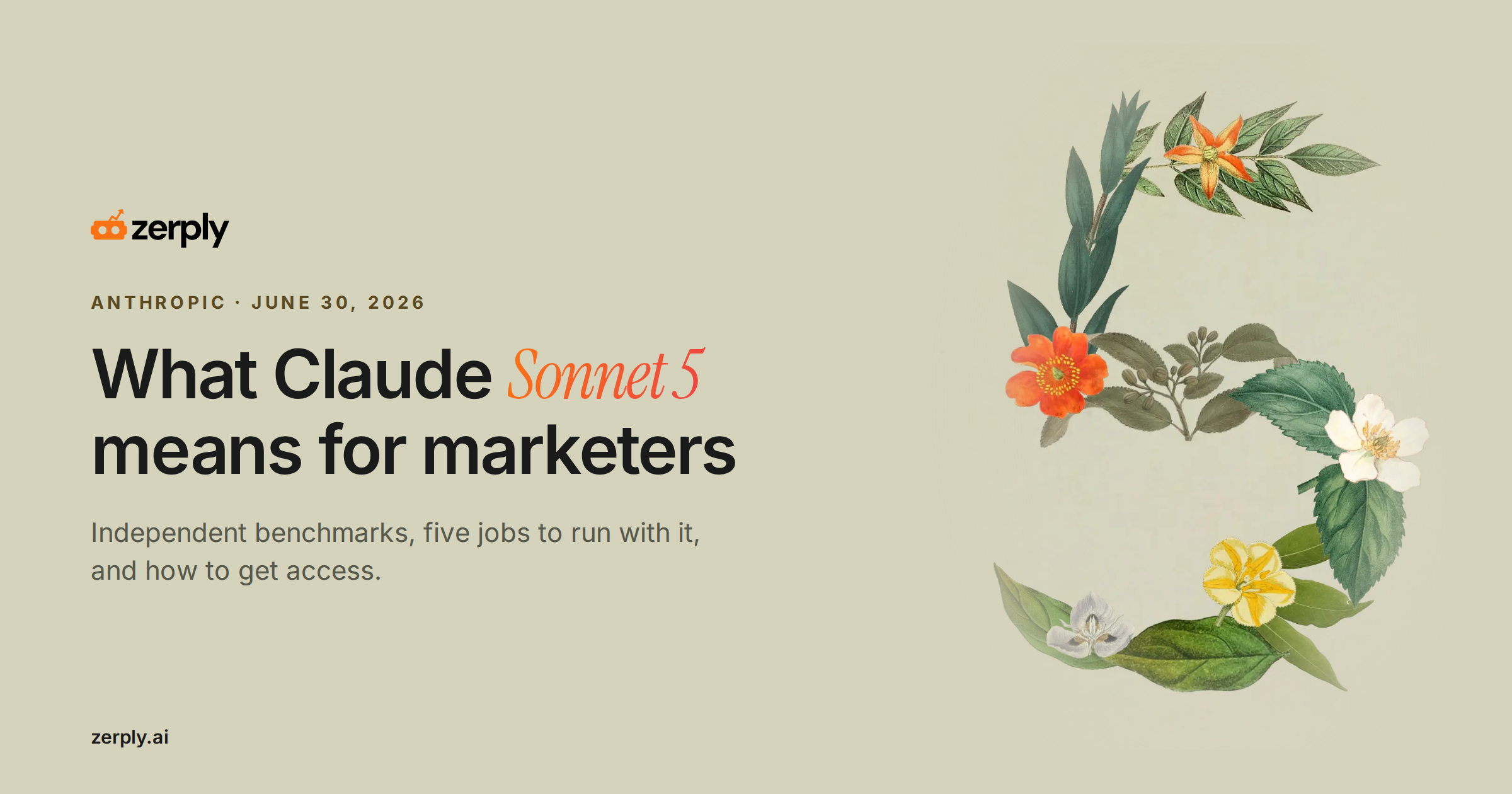
What Claude Sonnet 5 means for marketers, and how to use it

Anthropic released Claude Sonnet 5 on June 30, 2026. Within a day, independent developers, cost trackers, and at least one enterprise software company had already run their own tests.
Sonnet 5 is now the default model on Claude.ai for Free and Pro plans, and it's selectable on Max, Team, and Enterprise. Teams already talking to Claude for research, drafts, or analysis are likely on it without changing anything. That access story matters as much as the benchmarks, since most marketing teams will meet this model without deciding to.
This piece covers what independent testing shows, five jobs worth running on Sonnet 5, and how to access it, in Zerply, in the Claude apps, and on the API.
What is Claude Sonnet 5
Sonnet 5 is an upgrade to Sonnet 4.6, built to be Anthropic's most agentic Sonnet-class model so far. It plans a task, drives tools like a browser or a terminal, and carries a job through multiple steps without losing track of the goal. Anthropic reports its agentic and knowledge-work scores now sit close to Opus 4.8, at roughly a quarter of the per-token cost.
Three changes matter most for marketing and content work.
It uses tools directly, including a live browser, rather than only reasoning over text you paste in. It holds a one-million-token context window, so long documents, transcripts, and multi-file research fit in a single job. And it finishes multi-step tasks end to end more reliably than its predecessor, which matters for anything with more than one stage, like updating a record and then acting on the update.
Key statistics and benchmarks
Anthropic's own numbers are one data point. Within a day, four independent sources added others worth weighing before you build on this model.
| Source | What it tested | Finding |
|---|---|---|
| Anthropic | Agentic coding benchmark | Sonnet 5 scored 63.2 percent, against Opus 4.8's 69.2 percent and Sonnet 4.6's 58.1 percent |
| Atomic Chat | Independent build test, three physics-based coding prompts, four models | Sonnet 5 matched Opus 4.8 and GPT-5.5 on output quality, at $0.15 in total token cost against GPT-5.5's $0.94 |
| Artificial Analysis | Cost per task, Intelligence Index | $2.29 per task at standard pricing, roughly double Sonnet 4.6 and 15 percent above Opus 4.8, driven by heavier token use per task |
| Box (Aaron Levie) | Enterprise document reasoning, Complex Work Eval | Gained on Sonnet 4.6 by 4.7 points in Energy, 4.4 in Retail, and 2.6 in Professional Services |
Coding output at a lower token cost
Developer account Atomic Chat ran a small, unscientific test: the same three prompts, each asking for a physics-based crash scene built in HTML5 canvas, across Sonnet 5, Opus 4.8, Sonnet 4.6, and GPT-5.5. Sonnet 5 matched the other three models on output quality, beat Opus 4.8 on one test and GPT-5.5 on another, and used fewer tokens than any of them across all three runs. The tester's own caveat is worth keeping alongside the win: Sonnet 5's outputs still need better detail and graphics polish, even where the underlying physics held up.
Cost per task tells a different story
Benchmark tracker Artificial Analysis measured the same launch from a different angle and reached a less flattering number. On its Intelligence Index, Sonnet 5 costs $2.29 per completed task at standard pricing, close to double what Sonnet 4.6 costs and about 15 percent more than Opus 4.8. The gap has nothing to do with the per-token price, which is lower than Opus. It comes from Sonnet 5 using more tokens to reach an answer. Anthropic's introductory pricing, $2 and $10 per million tokens through August 31, cuts that cost by roughly a third, which matters for anyone deciding whether to test now or wait.
Enterprise document work gets more reliable
Box CEO Aaron Levie shared results from the company's Complex Work Eval, a benchmark built on real enterprise document tasks rather than synthetic prompts. Sonnet 5 gained the most ground on Sonnet 4.6 in Energy, Retail, and Professional Services, sectors where the underlying data tends to be messy and unstructured. In one financing due diligence test, the model computed leverage ratios directly from a raw balance sheet and flagged all three loan covenants as violated, including one the source document itself failed to disclose. In a separate cost analysis, it caught a broken reference cell in the spreadsheet before the error could compound into a wrong total.
How early testers are reading it
Reactions from early testers ran hopeful. AI educator Vaibhav Sisinty summarized the launch as the point where a mid-tier model starts doing flagship-tier work, citing autonomous execution and the lower price as the biggest changes. That enthusiasm is worth reading against the Artificial Analysis finding above. Cheaper per token does not automatically mean cheaper per finished task, and the two are easy to conflate in a launch week.
What Sonnet 5 can do for marketers
Five jobs where the model's specific strengths translate into real time saved. Adjust the bracketed parts to your own accounts and tools.
1. Put competitor research on autopilot
Sonnet 5 can open a live page and read it directly, rather than working from a screenshot you captured and pasted in. Anthropic names competitive analysis as one of the model's core use cases for this kind of browser-driven work.
Open these five competitor pricing pages. Log every plan name,
price, and listed feature into a table. Compare it against what
we offer at [your pricing URL] and flag anything new since your
last check.
Pair this with a scheduled run through Anthropic's Managed Agents, and the check happens weekly on its own. You get a standing competitor watch instead of a task you remember to run.
2. Produce high-volume content for less
Anthropic's own benchmarks put Sonnet 5 at or above Opus 4.8 on some knowledge-work tasks, at a fraction of the price. For anything you run at volume, batch product descriptions, ad variant sets, or meta descriptions, Sonnet 5 is now the sensible default rather than a compromise.
Write 40 meta descriptions for these 40 URLs, each under 155
characters, matching this format: [paste example]. Flag any URL
where the page content doesn't give you enough to write an
accurate one.
Turning generation on for a full site's worth of pages used to mean weighing quality against the bill. That tradeoff is smaller now.
3. Turn transcripts into clean drafts
Sonnet 5 is built to take unstructured source material, a call recording or a webinar transcript, and return a structured draft rather than a loose summary.
Here's the raw transcript from last week's customer call. Turn
it into a case study draft: the challenge, the solution, the
result, with one pull quote worth leading on.
The output isn't a finished piece. It starts from structure instead of a blank page, which is where most of the drafting time usually goes.
4. Hand it a multi-step task
Earlier models often completed the first half of a multi-step job and stopped. Anthropic cites an internal test where Sonnet 5 was given a two-part task, updating account records and then sending a follow-up communication based on the update, and it completed both parts without a check-in. That kind of follow-through is the difference between an agent you supervise and one you delegate to.
Update this list of accounts in our CRM to reflect their new
plan tier, then draft the tier-change email for each segment
and queue it for review.
Run this on a task you'd normally split into two separate requests and compare how much you have to check afterward.
5. Build an agent that escalates
This one is for teams building their own AI tooling rather than using a prompt directly. Anthropic designed Sonnet 5 to run as an "executor" that consults a stronger model, Opus 4.8, only at key decision points, a plan revision or a judgment call, while it handles the routine steps itself.
Configuration pattern: run the agent's day-to-day steps
(research, drafting, data pulls) on Sonnet 5. Route only the
final quality check or ranking decision, for example scoring a
draft against the pages currently ranking, to Opus 4.8.
The result is close to frontier-model judgment at the moments that matter, without paying frontier rates for every step along the way. Anyone running a standing content or research agent should copy this architecture.
A note on cost
The per-token price is roughly a quarter of Opus 4.8's rate, but per-token isn't the full cost story. See the independent cost-per-task numbers earlier in this piece before assuming the switch is a straight discount for your workload.
How to access Claude Sonnet 5
Three routes, and the fastest one requires nothing at all.
In Zerply
Claude Sonnet 5 is now live in the Zerply agent’s model selector alongside GPT, Claude, and Gemini. Given its price to quality fit for high volume work, it’s a strong default for recurring jobs like competitor watches, batch content, and draft cleanup, all grounded in your connected Search Console data instead of generic training.
- Open the agent chat.
- Use the model selector inside the agent’s chat interface to choose which model runs the job.
- Pick Claude Sonnet 5 from the list with GPT, Claude, and Gemini. The agent will run that task on Sonnet 5, using your live Search Console data as the source.
- Switch model per job, running Sonnet 5 on the heavier, multi step jobs and a faster model on quick edits, without breaking the thread.
In the Claude apps
- Open Claude. Go to claude.ai on web, or open the desktop or mobile app.
- Check your plan. If you're on Free or Pro, you're already on Sonnet 5. No selection needed.
- Select it manually on Max, Team, or Enterprise. Open the model selector at the top of the chat window and choose Claude Sonnet 5 from the list.
- Use Claude Code for coding-agent work. Sonnet 5 is available there too, with the effort level defaulting to high for agentic tasks.
On the API
- Use the model ID. Call the model with the string
claude-sonnet-5through the Claude API, or on Amazon Web Services, Google Cloud, or Microsoft Azure. - Confirm the pricing. $2 per million input tokens and $10 per million output tokens through August 31, 2026, then $3 and $15. Prompt caching and batch processing bring further savings on repeat or non-urgent work.
- Update your sampling calls. Sonnet 5 no longer accepts non-default
temperature,top_p, ortop_kvalues, and extended thinking is replaced by aneffortparameter that controls how hard the model works on a given task. Requests using the old parameters will return an error. - Migrate existing workloads with the claude-api skill. If you're moving prompts and settings over from an earlier model, Claude Code's
/claude-api migratecommand handles the update automatically.
Pricing and plan inclusions can shift after a launch. Confirm current terms on Anthropic's pricing page before committing production spend.
Where Sonnet 5 fits in your stack
A cheaper, more reliable model changes what you can afford to automate, not what the automation is for. Sonnet 5 still answers from general training data until you connect it to your own site, and a finished draft sitting in a chat thread earns no citations on its own. The step that turns a good model into traffic is still the same one: grounding it in real data and getting the result published.
That's the loop Zerply runs. AI visibility tracking shows how ChatGPT, Claude, Gemini, and Perplexity currently describe your brand. The agent works from your live Search Console data rather than a generic prompt, and you choose the model behind it. Foundry publishes the result to a subpath on your own domain, so it builds on the authority you already have. Monitor, plan, publish, one workspace.
The model got faster and cheaper this week. The work of grounding it in your own site and getting it live is still the part that decides whether it moves your numbers.
See what AI says about your brand
Track how ChatGPT, Claude, Gemini, and Perplexity talk about you. Ask the agent questions grounded in your real Search Console data. Publish the fix to your own domain. One workspace.
Start your 7-day free trial → · See pricing
No credit card required. Cancel anytime.
Common questions
What is Claude Sonnet 5?
Claude Sonnet 5 is an AI model Anthropic released on June 30, 2026, an upgrade to Sonnet 4.6 built for coding, agentic tasks, and professional knowledge work. It plans multi-step tasks, uses tools like a browser or terminal directly, and completes long jobs more reliably than earlier Sonnet models. It's the default model for Claude's Free and Pro plans and is selectable on Max, Team, and Enterprise.
How do I access Claude Sonnet 5?
On Claude's Free or Pro plan, you're using it by default with no action needed. On Max, Team, or Enterprise, select Claude Sonnet 5 from the model selector on web, desktop, or mobile. On the API, call the model with the ID claude-sonnet-5 through the Claude Platform, AWS, Google Cloud, or Microsoft Azure. It's coming to Zerply's model selector as well, alongside GPT, Claude, and Gemini.
How much does Claude Sonnet 5 cost?
On the API, $2 per million input tokens and $10 per million output tokens through August 31, 2026, then $3 and $15 afterward. That's roughly a quarter of Claude Opus 4.8's rate, though Sonnet 5's updated tokenizer means the same text can use up to 1.35x more tokens than on Sonnet 4.6.
Is Claude Sonnet 5 cheaper to run than Opus 4.8?
Per token, yes. At standard pricing, Sonnet 5 costs $3 and $15 per million input and output tokens against Opus 4.8's $5 and $25. Per finished task, independent benchmark tracker Artificial Analysis found the opposite: Sonnet 5 averaged $2.29 per completed task on its Intelligence Index, about 15 percent more than Opus 4.8, because Sonnet 5 uses more tokens to reach an answer. Anthropic's introductory pricing through August 31 narrows that gap by roughly a third. Test the model against your own workload before assuming a lower list price means a lower bill.
What's the difference between Claude Sonnet 5 and Claude Opus 4.8?
Sonnet 5 closes most of the performance gap to Opus 4.8 on agentic and knowledge-work benchmarks while costing a fraction as much per token. Opus 4.8 still leads on the hardest, most accuracy-sensitive tasks. A common pattern is running routine work on Sonnet 5 and routing only the highest-stakes decisions to Opus 4.8 as an advisor.
Is Claude Sonnet 5 good for marketing and content work?
Yes, particularly for high-volume and multi-step jobs. It handles batch content generation at a lower cost than Opus, turns unstructured material like call transcripts into structured drafts, drives browser-based research for competitor tracking, and completes multi-step tasks like a CRM update followed by an email draft without stalling partway through. As with any model, the output only becomes traffic once it's grounded in your own data and published, which is the part Zerply handles.
Written by
Founder at Zerply.ai & Wittypen
Anshul is the founder of Zerply.ai and previously built Wittypen, a content marketplace powering SEO growth for 1,000+ businesses. Over the last decade he has worked hands-on with B2B SaaS and tech teams to turn search data into compounding organic growth. At Zerply he shares practical playbooks on AEO, AI visibility, and modern SEO that come directly from experiments, wins, and failures in real projects.