Why Competitors Show Up in AI Answers When Your Brand Doesn’t

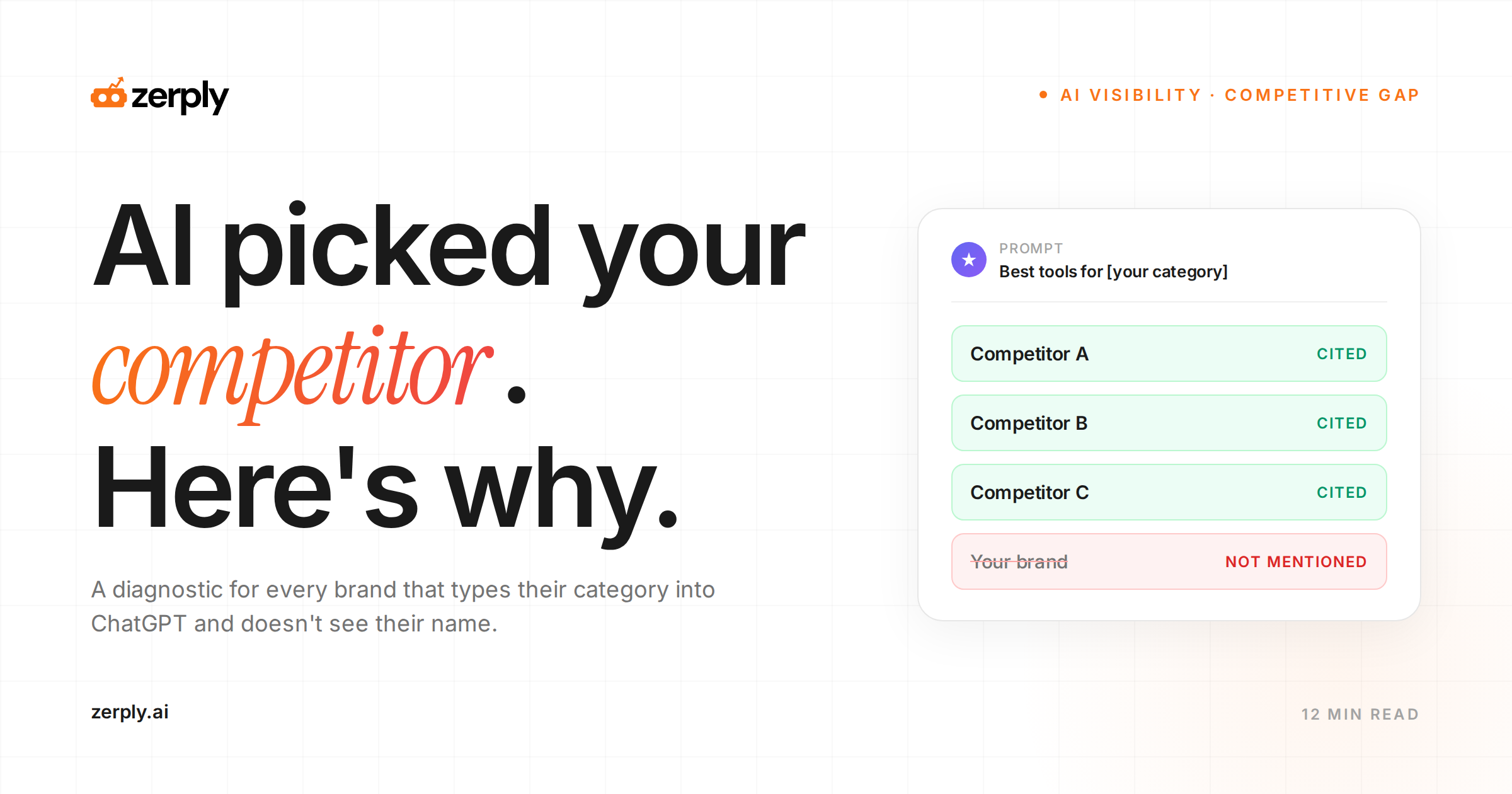
Someone on your leadership team just typed “best your category tool” into ChatGPT.
Three competitors came back by name.
Your brand did not.
Now there is a Slack message with your name on it:
“Why are they showing up in AI and we aren’t?"
Here is the short answer you can paste into that thread:
AI answer engines choose brands using evidence that goes beyond traditional rankings. Your competitor may have stronger third-party mentions, clearer category positioning, better review coverage, cleaner comparison pages, or content that is easier for AI systems to extract.
That answer is useful for about ten seconds
Then the real question starts.
Which signal are you missing, for which prompt, and in which engine?
And this has a not-so-simple answer.
They can see the visibility gap, but they cannot explain it. They know a competitor is appearing in ChatGPT, Perplexity, or Google AI answers. They do not know whether the cause is off-site authority, entity confusion, weak content structure, stale information, sentiment, or platform-specific sourcing behavior.
So this article is a diagnostic.
You will learn how to find the prompts where competitors beat you, trace each gap to a likely root cause, and turn competitor AI visibility into a clear worklist.
Why Competitor AI Visibility Doesn't Follow SEO Rules
Traditional SEO trained us to look for positions.
- Which URL ranks?
- Which page is above us?
- Which competitor has more links?
- Which result owns the featured snippet?
AI answers change the shape of the problem.
A search result page gives the user a ranked set of links. An AI answer engine retrieves or recalls information, writes one response, and names a small group of brands inside that response.
Sometimes it cites sources.
Sometimes it does not.
Sometimes it mentions a brand without recommending it.
Sometimes it uses one brand’s content while giving another brand the commercial credit.
That last scenario is especially painful.
Your page can help generate the answer while your competitor gets the buyer’s attention.
The practical question shifts from “How do we rank higher?” to “What evidence does the model have that we belong in this answer?”
Some of that evidence can come from your site.
Much of it comes from elsewhere: review platforms, comparison articles, Reddit discussions, Quora answers, industry roundups, earned media, analyst-style coverage, and product mentions.
Together, those signals shape how AI systems understand a market.
This is why a brand can perform well in Google search and still vanish from ChatGPT competitor mentions.
The systems overlap, but they reward different signals. A strong organic page can still fail in AI answers when it is too promotional, hard to quote, weak on independent validation, or disconnected from the way buyers ask category questions.
That is the core reframe behind competitor AI visibility.
Your competitor is appearing because the system has enough evidence to include them.
Are You Cited, Mentioned, or Recommended?
Before diagnosing why a competitor appears and you do not, separate three outcomes that often get bundled together.
- A citation means your URL appears as a source. The AI used your page as supporting material
- A mention means your brand name appears in the answer text. The user sees you
- A recommendation means the AI actively presents your brand as a good choice
That is the commercial outcome.
These outcomes create very different problems.
A brand with no citations or mentions may have an off-site authority issue, an entity issue, a crawlability issue, or a training-data problem.
A brand that gets cited without being named may have useful content, while still lacking a strong association with the buying decision.
A brand that gets mentioned without being recommended may be known, but not trusted enough for endorsement.
The hardest version is when your URL gets cited and a competitor gets recommended.
Your content helped. Their brand won.
That usually points to a positioning gap.
The AI found information on your site, but stronger market validation, clearer category framing, or better comparison evidence somewhere else.
In that situation, publishing more general blog content will not solve the issue.
The fix is sharper category positioning, better comparison coverage, and stronger evidence that your brand belongs in the recommendation set.
This is why citation tracking alone can mislead you.
You need to know whether your brand is cited, named, recommended, and described accurately.
Why Competitor LLM Visibility Varies by Engine
A competitor rarely wins every AI surface for the same reason.
They may appear in ChatGPT because the model already associates them with the category.
They may win in Perplexity because trusted third-party pages mention them.
They may surface in Google AI Overviews because their content is easier to ground, extract, and connect to related questions.
That is why a single prompt check gives a weak read.
A brand can show up in Perplexity and vanish in ChatGPT. It can appear for definition prompts and lose commercial prompts. It can be cited in a Google AI answer while never being recommended by name.
ChatGPT can lean on training-data recall, then use web search when the answer needs freshness or browsing is active.
A newer or less-discussed brand may struggle in non-browsing responses, even after publishing new content. Recovery usually depends on stronger web visibility, more consistent off-site mentions, clearer entity signals, and time.
Perplexity relies heavily on live retrieval.
It pulls sources, reranks them, and cites a compact set of pages. That makes trusted third-party coverage, original research, expert commentary, review platforms, and direct answers especially important.
Google AI Overviews and AI Mode use retrieval-augmented generation and query fan-out.
In plain language, one user question can trigger several related sub-queries before the answer is assembled. A page may need to cover the main query and the adjacent questions that help ground the response.
Pages that feel promotional or vague can lose ground, even when they have organic visibility.
Claude, Gemini, and Copilot can combine training recall and retrieval depending on the mode.
The broader point is simple: competitor LLM visibility has to be measured by engine, prompt type, and answer context.
There is also a measurement caveat worth saying plainly.
Nobody outside these platforms has full access to the algorithms. There is no mature equivalent of search volume for AI prompts. Tools rely on synthetic prompt sets, and responses vary between runs.
That does not make AI visibility guesswork.
It means measurement needs discipline.
- Use consistent prompt sets
- Repeat important prompts
- Track trends over time
- Keep the comparison set open, so every brand named by the AI is counted instead of only the competitors you already had in mind
Use The Diagnostic Matrix
A causes list can tell you what might be wrong.
A diagnostic matrix tells you what to do next.
When a competitor appears in an AI answer, inspect the symptom first.
Look at who is named, whether sources are shown, which source is cited, how the brand is framed, and whether your own pages appear anywhere in the answer path.
Then map that symptom to a likely root cause.
The first bucket, off-site authority, deserves special attention.
AI systems often rely on what the wider web says about a brand. Your own site explains your product. The rest of the web helps establish whether the claim is believable.
That can be uncomfortable for marketing teams because it moves part of the work outside owned channels.
Review sites, communities, roundups, analyst-style pages, partner content, and category discussions all become part of the visibility system.
Entity clarity matters just as much.
An AI answer engine needs to understand what your brand is, who it serves, which use cases it owns, and how it differs from alternatives.
Inconsistent descriptions across your website, product profiles, review listings, and third-party articles create uncertainty.
Extractability is the owned-content side of the problem.
A page that hides the answer behind a long intro, abstract messaging, or loose narrative gives retrieval systems less to work with. A page with direct answers, clear definitions, specific sections, and FAQ structure is easier to quote.
Positioning gaps show up when your content is trusted, yet your brand does not get the recommendation.
That usually means the page explains the category better than it explains your place in it.
Technical gaps are quieter.
Bot access, rendering, performance, and freshness can all affect whether pages get retrieved and trusted. These issues may not be the main cause, but they can block otherwise strong content.
Run The Diagnostic
You can run a basic version manually.
That is often useful before buying or configuring anything, because it forces the team to see the gap clearly.
The process has three parts:
- Measure Your Baseline
Start with prompts that mirror how buyers research your category.
Do not limit testing to branded prompts. A branded prompt tells you whether the system recognizes your name. It does not tell you whether your brand appears during evaluation.
Use category prompts, comparison prompts, problem-led prompts, and use-case prompts.
A software company might test questions like “top platforms for use case,” “alternatives to competitor,” “tools for persona,” and “how to solve problem.”
Run the same set across the engines that matter to your buyers.
For many B2B teams, that means ChatGPT, Perplexity, Claude, Gemini, and Google AI experiences.
Track five metrics.
AI Share of Voice shows your percentage of brand mentions across the full prompt set. Treat it as a share metric rather than a direct replacement for rankings.
Mention rate shows how often you appear at all.
Mention position shows whether your brand is introduced early or buried later in the answer.
Sentiment captures the language attached to your brand. “Good for small teams” creates a different impression than “limited for enterprise.”
Citation accuracy checks whether the answer describes your product correctly. Visibility can hurt when the model repeats outdated features, wrong pricing, or old positioning.
Repeat important prompts three to five times.
Responses vary.
Keep the Share of Voice denominator open by counting every brand the AI names. A fixed competitor list can make the report look tidy while hiding real market movement.
For more context on the metric, see Zerply’s AI Share of Voice glossary:
- Find The Mention Gap
Once the baseline is captured, isolate the prompts where competitors appear and your brand does not.
That set is your AI mention gap.
It shows which buyer questions you are losing, which competitors are being reinforced, and which sources shape the answer.
It also creates a practical worklist.
- A cited roundup that includes two competitors and excludes you becomes an outreach target
- A review platform that keeps appearing in Perplexity becomes a reputation target
- A competitor comparison page that appears in Google AI answers becomes a content-structure target
- A repeated ChatGPT mention with no visible source becomes an entity target
This is the point where the work becomes concrete.
The ask changes from “improve AI visibility” to “get included in these sources, rewrite this page, clarify this use case, and correct this outdated description.”
- Diagnose Each Gap
A third-party citation where your brand is absent points to off-site authority.
A competitor named without a visible source points to entity strength or training recall.
Your page cited while a competitor gets recommended points to positioning.
A competitor page pulled instead of yours points to extractability.
Wild variation between engines points to platform-specific evidence.
Here is a simple example.
Imagine a project management SaaS brand tests the prompt “tools for remote marketing teams.”
- ChatGPT names three competitors and leaves the brand out
- Perplexity names two of the same competitors and cites a roundup, a Reddit thread, and a review platform
- Google AI Overview includes a competitor’s comparison page and ignores the brand’s category page
A broad read would say the brand needs better AI visibility.
A diagnostic read is more useful.
- Perplexity points to an off-site authority gap because the cited sources already cover the market and exclude the brand
- Google points to an extractability gap because the competitor’s comparison page is easier to use in the answer
- ChatGPT may point to an entity gap because the model already associates the competitors with that use case
The resulting worklist is specific: pursue inclusion in the cited roundup, improve review-platform presence, publish a comparison page for remote marketing teams, and standardize how the brand is described across third-party profiles.
That is the difference between a vague visibility problem and a solvable diagnosis.
Avoid The Common Traps
Several assumptions from traditional SEO can send the team in the wrong direction.
The first trap is expecting Google rankings to guarantee AI visibility.
Organic rankings can help when AI systems retrieve from the live web. A high-ranking page can still be too promotional, too shallow, or too hard to extract for an AI answer.
The second trap is treating this as a publishing-volume issue.
More content helps when the missing signal is topical depth or answer structure. It will not fix weak review presence, thin third-party coverage, unclear entity signals, or poor sentiment.
The third trap is assuming AI answers are random.
Individual responses vary, but repeated patterns are measurable. The same competitors, sources, and framings appearing across related prompts should be treated as a signal map.
The fourth trap is trying to solve the issue through self-description alone.
A brand can claim category leadership on its own site. AI systems still look for corroboration from the wider web.
The fifth trap is treating every AI engine as one channel.
ChatGPT, Perplexity, Google AI answers, Claude, Gemini, and Copilot can each reward a different mix of evidence. A blended score can hide the reason one engine works and another fails.
The final trap is tracking citations without context.
Citation, mention, recommendation, sentiment, and accuracy all matter. A source link alone does not tell you whether the answer helps your brand win demand.
Waiting Raises The Cost
AI answer visibility can compound.
When an engine repeatedly finds the same trusted sources for a category question, those sources can influence related questions.
When the same competitor appears across “top platform,” “alternative to,” “software for use case,” and “which tool should I use” prompts, they start to feel like the default option.
The gap can still be closed.
Early fixes are often straightforward: improve review presence, clean up entity signals, restructure key pages, earn inclusion in cited sources, publish comparison assets, and correct outdated descriptions.
Over time, the web can thicken around the competitor’s position.
More pages mention them. More answers repeat the same framing. More buyers see the same names before they ever reach a search results page.
That is why AI Share of Voice belongs in the CMO dashboard.
The methodology is still younger than SEO reporting, and AI answers vary, but the commercial risk is clear. When buyers use AI systems for vendor research, absent brands lose consideration before the shortlist forms.
The encouraging part is that the gap can be measured.
You can identify where competitors appear, why they appear, and which signal your brand needs to build next.
Where Zerply Fits
A manual diagnostic is useful once.
It breaks down when you need to monitor hundreds of prompts, multiple competitors, several engines, changing answers, sentiment shifts, and citation patterns over time.
Zerply tracks AI Share of Voice, sentiment, citation frequency, and competitor benchmarking across ChatGPT, Perplexity, Claude, Gemini, and Google AI experiences.
It shows where competitors appear, where your brand is missing, which sources influence answers, and whether the model describes you accurately.
Zerply’s AI Visibility Tracking gives you the competitive view: who wins the answer, how often, and in what context.
Zerply’s AI Traffic Analytics shows which AI bots crawl which pages, so teams can connect visibility outcomes to infrastructure-level behavior without relying on tags.
Monitoring is only part of the workflow.
The real advantage is moving from diagnosis to execution.
Once the gap is clear, Zerply helps turn it into strategy, content, and published fixes through its agents and Foundry publishing workflow.
The work does not stop at “your competitor is winning.” It moves toward “this is the likely cause, this is the fix, and this is how to ship it.”
Explore Zerply’s AI Visibility Tracking and AI Traffic Analytics.
FAQ
Why Does My Competitor Appear In ChatGPT?
Your competitor appears in ChatGPT because the model has stronger evidence that they belong in the answer.
That evidence may come from training data, third-party mentions, review platforms, comparison pages, community discussions, or clearer entity signals.
The fix depends on the symptom.
A third-party citation points to an off-site authority gap. A source-free mention points to entity strength or training recall. A citation for your page paired with a recommendation for them points to positioning.
Do Google Rankings Affect AI Visibility?
Google rankings can help when AI systems retrieve from the live web.
They do not guarantee inclusion, mention, or recommendation in AI answers.
AI systems also look at extractability, corroboration, entity clarity, sentiment, and answer fit. A page can perform well in organic search and still fail to become part of the AI response.
What Is AI Share Of Voice?
AI Share of Voice is your share of brand mentions across a defined set of AI prompts, compared with every brand named in the answers.
It helps teams see whether they are gaining or losing visibility against AI search competitors.
The metric works best when the prompt set reflects buyer behavior, the denominator stays open, and results are tracked over time.
How Do I Check Competitor Visibility?
Build a prompt set that reflects real buyer questions, then run it across ChatGPT, Perplexity, Claude, Gemini, and Google AI experiences.
Record which brands are cited, mentioned, recommended, and described positively or negatively.
Then isolate prompts where competitors appear and your brand does not.
That list becomes your AI mention gap.
Is LLM Visibility The Same Everywhere?
No. Competitor LLM visibility can vary by engine because each platform uses a different mix of training recall, live retrieval, reranking, query expansion, and citation behavior.
A single ChatGPT check can miss what is happening in Perplexity or Google AI answers.
Measure by engine and diagnose gaps separately.
How Long Does Fixing This Take?
The timeline depends on the root cause.
Owned-page extractability fixes can move faster because your team controls them. Off-site authority, entity clarity, review presence, and training-data gaps usually take longer.
The fastest path is to diagnose before executing.
Once the symptom is clear, the fix becomes much more targeted.
Find Your AI Visibility Gap
When competitors appear in ChatGPT, Perplexity, and Google AI answers while your brand is missing, guessing wastes time.
Run the diagnostic. Find the prompts. Trace the root cause. Fix the signal.
Zerply can show where competitors are winning, what AI systems say about your brand, and which visibility gaps to close first.
Written by
Founder at Zerply.ai & Wittypen
Anshul is the founder of Zerply.ai and previously built Wittypen, a content marketplace powering SEO growth for 1,000+ businesses. Over the last decade he has worked hands-on with B2B SaaS and tech teams to turn search data into compounding organic growth. At Zerply he shares practical playbooks on AEO, AI visibility, and modern SEO that come directly from experiments, wins, and failures in real projects.