What Content Gets Cited by AI Search? Formats, Patterns, and Examples

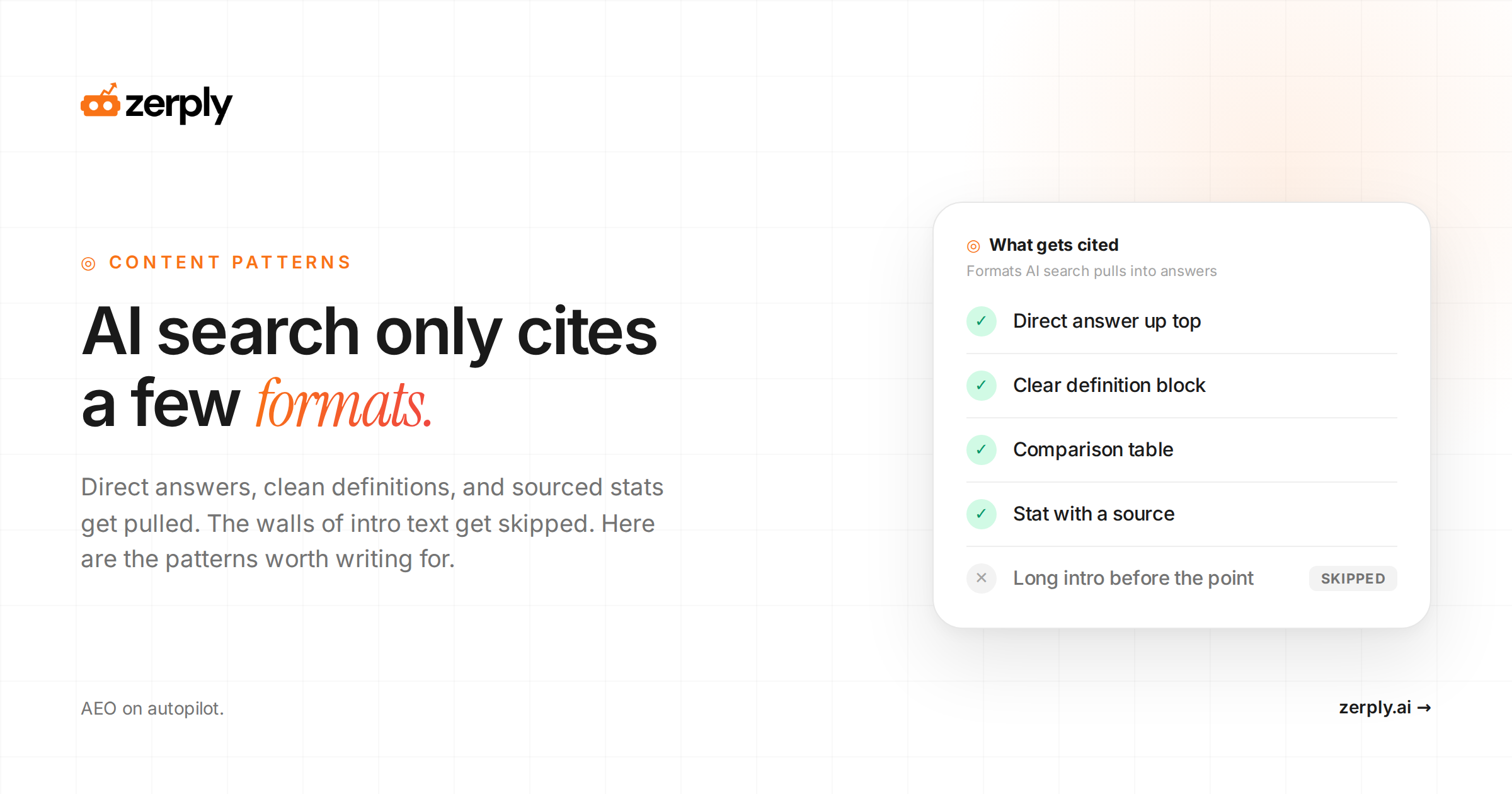
AI search engines cite content that is clear, structured, specific, and easy to reuse inside an answer.
The formats that perform best are listicles, comparison pages, FAQs, original research, comprehensive guides, documentation, and product pages.
As such, ranking still matters, but visibility now also depends on whether ChatGPT, Perplexity, Gemini, Claude, or Google’s AI experiences mention and cite your brand.
The strongest AI answer sources share a pattern.
They answer real prompts directly, use clear entities, include evidence, structure information into extractable blocks, and give AI systems enough context to cite them with confidence.
What AI Search Cites: Content Cited By AI
AI search engines cite pages that help them answer a prompt accurately.
A citeable passage usually does four things: it answers one clear question, names the relevant entity, includes specific evidence or context, and can stand alone when extracted from the page.
That is why certain formats work better than others.
| Content format | Why AI cites it | Strong use case |
| Listicles | Clear entities and ranked items | Discovery and recommendations |
| Comparisons | Criteria, tradeoffs, and verdicts | Vendor selection and “X vs Y” prompts |
| FAQs | Direct question-answer pairs | Long-tail informational queries |
| Original research | Unique, attributable data | Authority and evidence-led answers |
| Guides | Deep coverage in modular sections | Educational queries |
| Documentation | Precise functional answers | Product and implementation prompts |
| Product pages | Features, pricing, use cases | Commercial prompts |
| Forums | Lived experience and opinions | Troubleshooting and subjective queries |
The format is the container. The citation advantage comes from relevance, clarity, authority, and evidence.
Additionally,
- listicles accounted for 21.9% of cited references in one analysis of AI search results across ChatGPT, Perplexity, and Google AI Mode, ahead of articles at 16.7% and product pages at 13.7% according to Searchless.ai’s summary of Wix research.
- one study found citation rates of about 67% for data-rich guides, 61% for comparison matrices and product reviews, and 58% for FAQ-heavy content, rising to about 71% when FAQ schema was implemented properly according to Presence AI.
- structure affects citation potential as well. Clear H2 and H3 hierarchy, comparison tables, explicit answers, FAQs, and visual data all correlate with higher citation likelihood as per Presence AI.
- schema helps when it supports strong content. An analysis of 1,465 AI-cited pages found that 68% used schema markup, and cited pages were about twice as likely to use structured data as the web average according to Trakkr Research.
- prompt-content alignment is the core driver. A statistical analysis of 2 million AI citations found that pages matching the language and concepts of buyer prompts were cited more often, while AI-perceived domain authority carried more weight than any single page feature according to Discovered Labs.
Why Formats Win
AI systems retrieve and assemble information in fragments.
Where a human reader may follow a long argument across a page, an answer engine often needs a paragraph, table row, definition, FAQ answer, or numbered item it can reuse.
That retrieval behavior favors content with clean boundaries.
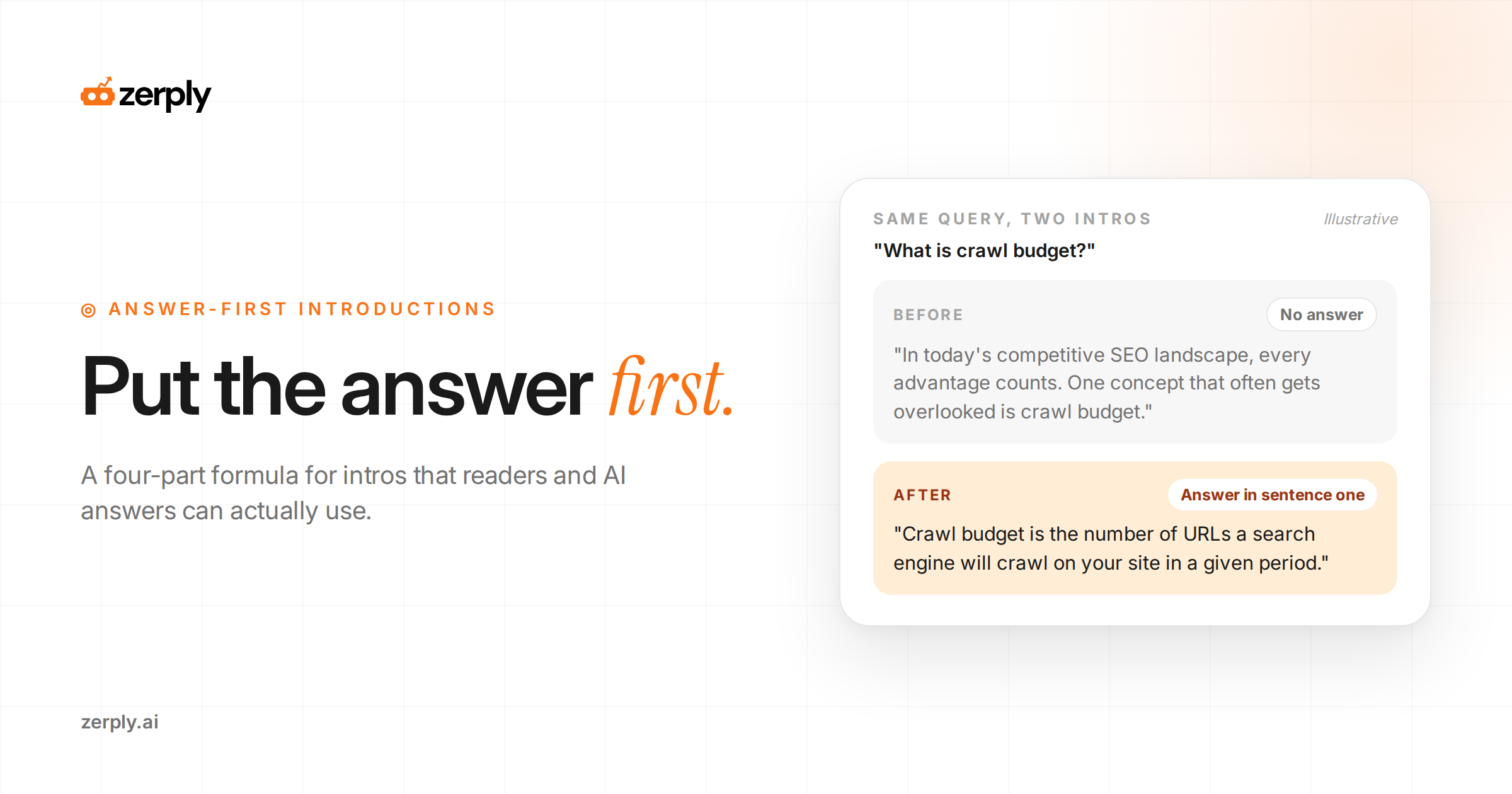
A list item is easier to extract than a dense essay paragraph. A comparison table is easier to parse than a vague review. A FAQ answer is easier to reuse than a section that hides the answer after a long setup.
Research also supports this.
Pages with clear H2 and H3 hierarchy earned about 3.2 times more citations than poorly structured content, while tables and comparison data earned about 2.8 times more citations than text-only pages according to Presence AI.
Additionally, explicit price information and recent timestamps also improved first-citation odds, while formatting-only edits had limited impact according to an arXiv study on competitive GEO.
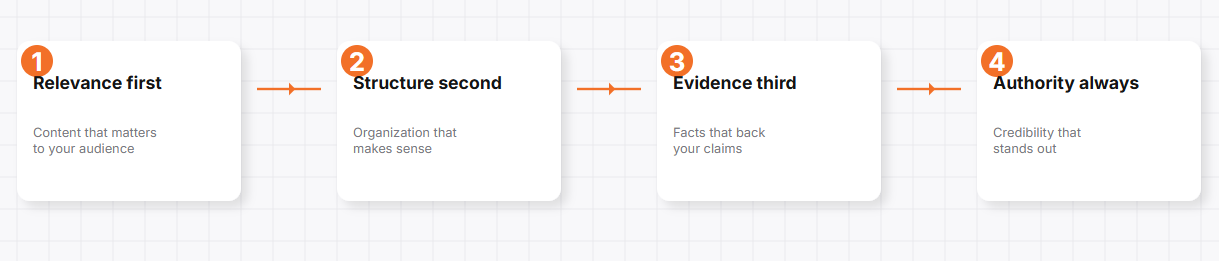
The rule is simple: relevance first, structure second, evidence third, authority always.
The Formats AI Cites
Here are a few of the formats AI cites happily:
1. Listicles
Listicles perform well because they convert a broad topic into extractable units. Each item gives the model an entity, a reason for inclusion, and supporting context.
A strong listicle for AI citation should include:
- A direct answer in the introduction.
- A summary table near the top.
- Consistent criteria for every item.
- Specific entities, examples, and use cases.
- Short sections that make sense outside the full article.
A weak listicle gives opinions. A strong listicle behaves like a structured dataset with editorial judgment.
For example, “12 AEO content formats ranked by AI citation potential” is more useful to an AI system than “How to improve AI visibility.”
2. Comparison pages
Comparison content aligns with how buyers use AI search.
Presence AI reported comparison matrices and product reviews at about a 61% citation rate according to Presence AI.
Discovered Labs also found that pricing pages and comparison content earned disproportionate citations because they match high-intent buyer prompts.
Strong comparison pages should:
- Define evaluation criteria early.
- Include a summary table before detailed analysis.
- Explain ideal use cases for each option.
- Mention pricing or plan differences where relevant.
- Use consistent criteria across products.
A citeable comparison row is specific:
| Weak row | Strong row |
| Has AI features | Tracks brand mentions, citations, sentiment, share of voice, and competitor presence across AI platforms |
| Good for SEO | Connects search performance, keyword research, content planning, and AI visibility tracking |
| Easy publishing | Supports drafting, editing, approval, and WordPress publishing from one workflow |
Specific rows give AI systems entities and functions they can reuse.
3. FAQ content
FAQ content mirrors AI prompts.
The question becomes the retrieval target, and the answer becomes the reusable passage.
Presence AI found FAQ-heavy content at about a 58% citation rate, rising to about 71% with proper schema.
Trakkr found that pages with FAQPage schema averaged about 45% more citations than pages without FAQ signals, while noting that the sample was small and correlation does not prove causation.
A strong FAQ answer should be two to four sentences, direct, and complete enough to stand alone.
Weak answer:
“AI cites helpful content with good structure.”
Stronger answer:
“AI search engines often cite structured, answer-first content such as listicles, comparison pages, FAQs, original research, documentation, and product pages. These formats work because they give LLMs clear fragments that can be retrieved, verified, and reused inside generated answers.”
4. Original research
Original research is powerful because it creates facts competitors cannot easily copy.
AI systems need evidence to support claims, and proprietary data gives them an attributable source.
Useful research does not need to start as a large industry report.
A strong research page should include:
- The question studied.
- Dataset size and collection method.
- Dates covered.
- Exclusions and limitations.
- Charts or tables.
- Plain-language takeaways.
- Citeable summary statements.
For example, a study on “AI citation patterns across 100 SaaS prompts” could support answers about AEO, AI visibility, LLM source selection, and content strategy.
One good dataset can create citation surface area across many prompts.
5. Comprehensive guides
Guides still earn citations when they are dense, structured, and evidence-backed. Length helps only when it adds useful answers.
Presence AI found that comprehensive guides with data and tables had about a 67% citation rate, the strongest format in its analyzed set. The same research noted that a 2,500-word data-rich comparison could outperform a 5,000-word opinion piece by about 3.4 times.
A guide built for AI citation should include a direct definition near the top, clear sections, tables, examples, citations, and FAQs.
A guide on AI visibility tracking, for example, should cover what it measures, how it differs from rank tracking, which platforms matter, which metrics to monitor, how competitor benchmarking works, and how to improve citation share.
6. Documentation
Documentation is often overlooked in AEO strategy, but it can be highly citeable because it answers precise functional questions.
Examples include:
- “Does this platform support Google Search Console integration?”
- “How do I add FAQ schema?”
- “Can I track AI mentions by competitor?”
- “How do I publish content to WordPress?”
Strong documentation uses task-based pages, clear steps, updated screenshots, product entities, feature names, and short explanations of edge cases.
It can be cited directly for implementation prompts and indirectly strengthen topical authority.
Additionally, documentation should connect to blog content, comparison pages, product pages, and help center content. That creates a stronger entity graph around the brand.
7. Product pages
Product pages matter because AI search increasingly handles commercial prompts.
In the Wix research summarized by Searchless.ai, product pages accounted for 13.7% of cited references.
A product page can become an AI answer source when it includes:
- Clear feature descriptions.
- Use-case language.
- Pricing or plan context where appropriate.
- Integrations.
- FAQs.
- Product schema.
- Customer proof or review signals.
A vague product statement gives AI systems little to use. A specific statement is more citeable.
Weak version:
“Automate your SEO workflow.”
Stronger version:
“Zerply connects Google Search Console data with SEO research, AI visibility tracking, content strategy automation, agentic drafting, and WordPress publishing in one workflow.”
8. Forum content
Forum content appears in AI answers because it captures real user experience.
Reddit, Quora, Stack Exchange, and niche communities often contain complaints, preferences, workarounds, and comparisons that brand pages avoid.
The Wix dataset summarized by Searchless.ai placed forum and community content at 10.4% of cited references.
Semrush also found that Reddit and Wikipedia remained prominent AI citation sources, although their share shifted across platforms over time.
For brands, the practical use of forum data is content planning.
Repeated questions in communities often reveal prompts worth answering through FAQs, documentation, comparisons, and research pages.
Common Citation Patterns
Strong AI answer sources usually have the same core signals.
- Answer-first writing: The page answers the main question before adding background.
- Entity clarity: The page names products, platforms, features, industries, dates, metrics, and methods.
- Structured evidence: Tables, citations, statistics, definitions, and examples make claims easier to verify.
- Freshness signals: Visible publish dates, updated dates, and current examples help, especially for topics that change quickly.
- Schema support: Article, FAQPage, Product, HowTo, and Organization schema can help systems interpret content when implemented accurately.
- Topical authority: A cluster of related pages gives AI systems more reason to trust a domain on a subject.
The GEO-16 study found that metadata and freshness, semantic HTML, and structured data were among the strongest page-quality signals associated with citation likelihood.
Additionally, Discovered Labs also found that AI-perceived domain authority had far greater influence than any single page feature.
Citation Readiness Score
Use this scorecard before publishing or refreshing a page.
| Factor | Score | What to check |
| Prompt alignment | 0 to 4 | The page answers real prompts users ask AI systems. |
| Answer-first structure | 0 to 3 | The introduction and sections give direct answers early. |
| Extractable fragments | 0 to 3 | Tables, sections, FAQs, and list items can stand alone. |
| Entity clarity | 0 to 3 | Products, platforms, metrics, dates, and methods are named clearly. |
| Evidence quality | 0 to 3 | Claims are supported by data, sources, examples, or methodology. |
| Freshness | 0 to 2 | Dates, examples, and references are current. |
| Structured data | 0 to 2 | Relevant schema is accurate and focused. |
A page scoring 16 to 20 is strong enough to compete as an AI answer source.
A score of 11 to 15 means the page needs better evidence, structure, or examples.
A score below 11 usually means the page is too vague or disconnected from real prompts.
Examples of Citeable Fragments
Here are a few examples of citeable fragments:
1. Example one
Prompt: “What content formats get cited by AI search?”
Weak fragment:
“AI search likes helpful content that is easy to read.”
Citeable fragment:
“AI search engines often cite listicles, comparison pages, FAQ sections, original research, comprehensive guides, documentation, and product pages. These formats work because they give LLMs clear answer fragments, named entities, structured evidence, and source context.”
2. Example two
Prompt: “Does schema help AI citations?”
Weak fragment:
“Schema is important for SEO and may help AI understand your page.”
Citeable fragment:
“Schema markup can help AI systems interpret page entities, question-answer pairs, product details, and article metadata. Trakkr’s analysis of AI-cited pages found that 68% used schema markup, although schema works best when paired with topical relevance and clear content structure.”
3. Example three
Prompt: “How should I structure a comparison page for AI search?”
Weak fragment:
“Use comparison tables and explain the differences clearly.”
Citeable fragment:
“A comparison page for AI search should define evaluation criteria near the top, include a summary table before detailed analysis, explain the best-fit use case for each option, and include current pricing or plan information where relevant.”
The difference is precision.
Citeable fragments give AI systems a direct answer, context, and evidence.
How Engines Differ
AI platforms use different retrieval and citation patterns, so content should optimize for durable signals across systems.
| Platform | Citation tendency | Content implication |
| ChatGPT | Favors authoritative, structured, entity-rich sources | Build clear guides and comparisons |
| Perplexity | Often emphasizes recency and explicit source links | Keep content updated and well cited |
| Gemini | Benefits from Google ecosystem signals and schema | Strengthen SEO, schema, and entity clarity |
| Google AI Mode | Closely tied to search-quality signals | Optimize for SEO and AEO together |
| Claude | Often favors comprehensive, current content | Refresh guides and include recent examples |
Source ecosystems also shift.
Semrush found that Reddit and Wikipedia declined sharply in ChatGPT citations after mid-September 2025, while domains such as Medium, Forbes, and LinkedIn rose.
Monitoring matters because AI visibility can change by platform and over time.
Build Citation-ready Content: Get Zerply
Building content for AI citations is difficult because teams need more than strong writing.
The main hurdles are fragmented workflows, unclear prompt priorities, inconsistent AI visibility data, and no easy way to connect content updates with citation outcomes.
Zerply helps turn AI citation work into one repeatable workflow:
- Find the right prompts to target: AI citation tracking frameworks recommend monitoring stable prompt sets across engines like ChatGPT, Perplexity, Gemini, and Claude, then logging mentions, citations, sentiment, competitors, and cited URLs according to HubSpot, AnswerManiac, and Citare. Zerply helps teams connect these AI visibility signals with content strategy.
- Build around citeable formats: Citation-ready pages need answer-first sections, FAQs, comparison tables, entity-rich copy, schema, freshness signals, and credible evidence. Zerply supports SEO research, content strategy automation, and agentic drafting in one workflow.
- Use search data to prioritize updates: Zerply aligns with Google Search Console workflows, helping teams identify pages that already show demand and can be refreshed for AI citation potential.
- Publish without workflow drag: Zerply supports drafting and publishing workflows, including WordPress-oriented publishing, so teams do not have to move between separate tools for research, writing, editing, and publishing.
- Measure AI visibility after publishing: Zerply tracks brand and competitor presence across AI systems including ChatGPT, Claude, Gemini, and Perplexity. This helps teams see which prompts mention or cite their brand, where competitors appear, and whether content improvements increase AI visibility.
In short, Zerply helps SEO teams plan, create, publish, and measure citation-ready content from one operating layer, instead of stitching together separate tools for research, writing, CMS publishing, and AI visibility tracking.
FAQ
What content gets cited by AI?
AI search engines often cite structured, answer-first content such as listicles, comparison pages, FAQs, original research, comprehensive guides, documentation, and product pages. These formats provide clear fragments that can be retrieved, verified, and reused inside generated answers.
Which format gets cited most?
In the Wix research summarized by Searchless.ai, listicles had the highest share of AI citations at 21.9%, followed by articles at 16.7% and product pages at 13.7%. Other studies show strong performance for data-rich guides, comparisons, and FAQ-heavy content.
Does schema help AI citations?
Schema can help AI systems interpret page structure, entities, question-answer pairs, product details, and article metadata. Trakkr found that 68% of AI-cited pages used schema markup.
How long should citeable content be?
There is no fixed word count. AI-cited pages averaged about 2,289 words, while data-rich content can outperform longer opinion-led content according to Trakkr Research and Presence AI. Answer density matters more than length.
Do AI citations drive traffic?
AI citations can drive referral traffic, but their broader value is brand visibility. A cited brand can influence awareness, trust, and vendor shortlists even when the user does not click immediately.
How do I check AI citations?
Track a stable set of buyer prompts across ChatGPT, Perplexity, Gemini, Claude, and Google’s AI experiences. Record brand mentions, citations, sentiment, competitors, and cited URLs over time.
Written by
Founder at Zerply.ai & Wittypen
Anshul is the founder of Zerply.ai and previously built Wittypen, a content marketplace powering SEO growth for 1,000+ businesses. Over the last decade he has worked hands-on with B2B SaaS and tech teams to turn search data into compounding organic growth. At Zerply he shares practical playbooks on AEO, AI visibility, and modern SEO that come directly from experiments, wins, and failures in real projects.