AI visibility is now reportable in Google and Bing. Here's what the data actually tells you.

Until recently, measuring AI visibility was mostly guesswork.
If you wanted to know whether ChatGPT, Copilot, or Google's AI features were surfacing your content, your options were limited: manually testing prompts, relying on third-party tools, or making educated assumptions based on traffic patterns. That's starting to change.
Google launched a dedicated Generative AI report in Search Console on June 3, 2026. Microsoft introduced a similar AI Performance report in Bing Webmaster Tools earlier this year. For the first time, major search platforms are giving publishers direct visibility into how their content appears inside AI-generated answers.
The bigger story isn't the reports themselves. It's what they represent. AI visibility is becoming a measurable marketing channel. For years, marketers optimized for rankings, impressions, and clicks. Now there's a new layer to understand: how often AI systems choose your content as part of the answer.
Here's what's included in Google's and Bing's new reports, what marketers can learn from the data today, and where the biggest measurement gaps still exist.
Why This Launch Matters
For most of the past two years, AI search has been a black box. Brands could see traffic fluctuations. They could spot referral visits from AI platforms. They could occasionally find their content cited in AI-generated answers. But there was no official reporting that showed how often it was happening. That made AI visibility difficult to measure and even harder to explain to stakeholders.
These new reports change that. While they don't provide a complete picture, they give marketers something they've never had before: first-party visibility data from the platforms themselves. That means AI search can start moving from speculation to reporting.
What Google's Generative AI report covers
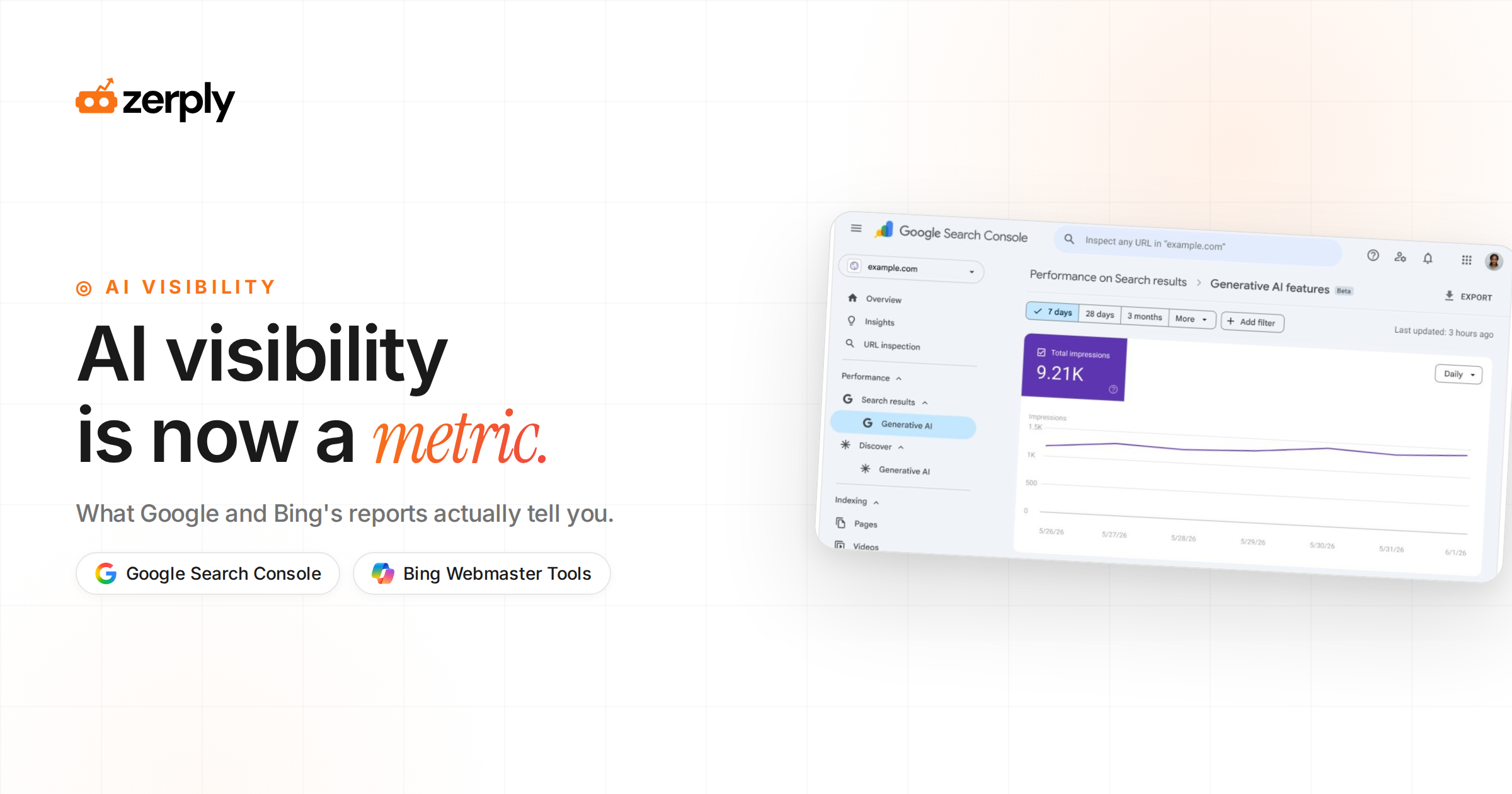
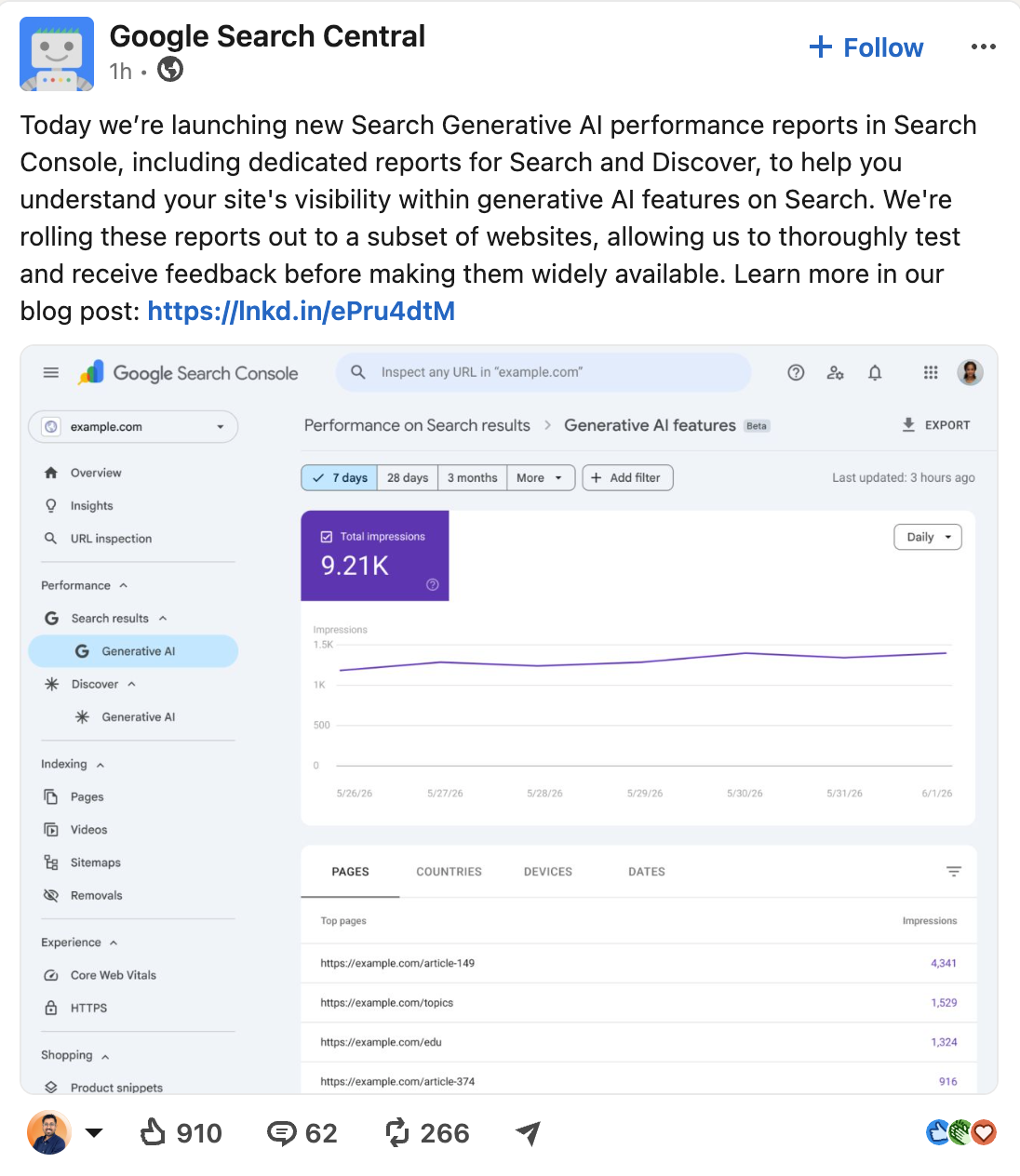
The new report lives under Performance > Search results > Generative AI in Search Console. It's a separate view from the main Search performance report, though the underlying data feeds into both.
It covers your site's impressions inside Google's AI features: AI Overviews, AI Mode, and Generative AI in Discover. Five dimensions are reported:
- Impressions: how often a URL from your site appeared in a generative AI feature. One impression counts per URL per user session.
- Pages: which URLs appeared, ranked by impression volume. This is the first place to look if you want to know which content is being pulled into AI answers.
- Countries: where impressions are coming from, useful if your audience skews by region and AI features roll out unevenly.
- Devices: which devices users were on when they saw the AI feature. Available for Search results, not for Discover.
- Dates: time-series data, with hourly, daily, weekly, and monthly views.
The report is rolling out in stages. If you don't see the Generative AI tab under Performance, it hasn't reached your property yet. Google hasn't published a rollout timeline.
What Bing's AI Performance report covers
Microsoft launched its AI Performance report in Bing Webmaster Tools on February 11, 2026, making it the first major search platform to expose generative-answer citation data to publishers.
The coverage is similar to Google's: how often Copilot and Bing's AI-generated summaries cite your content. But Bing's report includes a few things Google doesn't have yet.
- Citations: the primary metric. How often your content appeared as a cited source in an AI-generated answer, across Copilot and Bing AI summaries.
- Cited pages: a page-level breakdown of which URLs are being cited most.
- Grounding queries: the actual queries that triggered Copilot to pull from your site. This is the most actionable data in the report. It shows you how people were phrasing the questions your content was called up to answer, not just that it was cited.
- Intent classification: queries are grouped by intent, giving you a read on whether your content is being used for informational, navigational, or commercial questions.
The report is in public preview and covers Copilot and Bing AI summaries across Bing and partner integrations.
How do the two reports compare?
Both Google and Bing now offer reporting for AI-powered search experiences, but they focus on different aspects of performance.
- Google Search Console (June 2026): Tracks visibility across AI Overviews, AI Mode, and Discover using impressions as the primary metric. You can see which pages appeared, but not the queries, user intent, or click data behind those appearances.
- Bing Webmaster Tools (February 2026): Focuses on visibility within Copilot and Bing AI summaries, using citations as the key metric. It also provides query-level insights and intent data, giving publishers more context on why their content was surfaced.
- Page-level reporting: Both platforms let you see which pages are appearing in AI experiences, making it easier to identify content that is gaining visibility.
- Query and intent insights: This is where the biggest difference lies. Bing shows the queries and intent categories driving citations, while Google currently does not.
- Click data: Neither platform currently provides AI-specific click data, leaving a gap between visibility and traffic measurement.
- Availability: Google's reporting is being rolled out gradually to selected properties, whereas Bing's AI reporting is available through a public preview.
In simple terms, Google helps you understand how often your content appears in AI search, while Bing helps you understand why it appears.
The Metric Everyone Wants (And Neither Platform Provides)
Despite the excitement around these reports, one major question remains unanswered: how many clicks are AI answers actually sending?
Neither Google nor Bing currently reports AI-specific clicks or click-through rates. While both platforms now provide visibility into impressions, citations, and page-level performance within AI experiences, they stop short of showing whether those appearances resulted in visits to your website.
This isn't necessarily because the platforms are withholding data. It's also a reflection of how AI search works. Unlike traditional search results, where users often click through to explore multiple sources, AI-generated answers are designed to provide a complete response within the interface itself. As a result, many users get the information they need without ever visiting the cited websites.
That shift has important implications for marketers. In many cases, an AI citation functions more like a brand impression than a traditional search listing. Your content may influence a user's understanding, perception, or decision-making process even if it never generates a click.
Early industry observations suggest click-through rates from AI citations can be significantly lower than those from traditional organic search results, although benchmarks remain limited and vary widely by industry and use case. For that reason, AI visibility should not be evaluated using the same framework as traditional SEO traffic. The value may come from awareness, consideration, trust, and influence that occur long before a website visit—or in some cases, without a visit happening at all.
What Marketers Should Do With This Data Right Now
The reports are new, but there are already several practical ways to use them.
Identify Your AI-Winning Content
- Look for pages generating strong AI visibility.
- What formats are appearing most often?
- Are they guides, comparison pages, research studies, product pages, or FAQs?
- Patterns here can inform future content strategy.
Compare AI Visibility Against Organic Performance
Some pages may receive substantial AI visibility while generating relatively little organic traffic. These pages could reveal topics where AI systems find your content valuable even when traditional rankings aren't dominant.
Use Bing's Grounding Queries as Research Inputs
Grounding queries may become one of the most valuable content research datasets available. They show the actual questions users asked when AI systems selected your content. That's often a stronger signal than relying solely on keyword volume.
Build AI Visibility Reporting Separately
Avoid combining AI visibility metrics with traditional SEO reporting. AI impressions, citations, rankings, clicks, and conversions represent different user behaviors and should be analyzed independently.
Track Trends, Not Benchmarks
- There are no reliable industry benchmarks yet.
- Instead of comparing yourself against competitors, focus on directional movement.
- Are AI impressions growing?
- Are more pages being cited?
- Are new topics gaining visibility?
- Those trendlines are likely more useful than absolute numbers at this stage.
How to read AI visibility data
As AI reporting becomes more common, it's easy to read more into the numbers than they can support. A few principles help keep the data in perspective.
Visibility is not traffic
A rise in AI impressions tells you your content appeared more often inside AI-generated experiences.
It does not tell you whether users paid attention to those answers, remembered your brand, or took action afterward. Those outcomes sit outside the scope of the current reporting. Visibility measures exposure. Engagement, clicks, and conversions are separate questions.
Focus on trends
Industry benchmarks for AI impressions and citations do not really exist yet. Raw numbers have limited value without context, especially when reporting standards are still emerging. The more useful signal is movement over time.
A sustained increase in AI visibility may indicate that certain topics, formats, or pages are gaining traction with AI systems. A decline across both AI visibility and organic performance may point to broader search changes rather than an AI-specific issue. Trendlines reveal more than isolated snapshots.
Watch Bing's grounding queries
Grounding queries are one of the most useful datasets currently available in AI reporting. They show the questions users asked when Bing selected your content as a source. That creates a direct connection between user intent and AI visibility.
Content teams can use those queries to spot recurring themes, identify gaps in coverage, and understand how AI systems interpret their content. The data serves a different purpose than traditional keyword research, but it often reflects the kinds of questions AI assistants are actively answering.
Know what each platform covers
Google's report covers Google's AI experiences. Bing's report covers Copilot and Bing AI summaries.
Neither report includes visibility data from ChatGPT, Claude, Perplexity, Gemini, Grok, or other standalone AI platforms. Each platform has its own retrieval systems, ranking logic, and citation behavior. The reports provide useful signals, though they represent only part of the broader AI landscape.
The gap that remains
Google and Bing account for a large share of AI-powered search activity, but they do not capture the whole picture.
ChatGPT, Perplexity, Claude, Gemini, and other AI assistants handle enormous query volumes and regularly reference content from across the web. None currently offer publisher-facing reporting that shows how often content appears in answers or gets cited as a source.
As a result, no official platform can provide a complete view of AI visibility today.
What has changed is the direction of the industry. By introducing dedicated AI reporting, Google and Bing have acknowledged AI visibility as something publishers should be able to measure. A category that once relied on anecdotal evidence now has first-party reporting behind it.
There is still a long way to go.
For now, these reports work best as a foundation. Teams that want a broader understanding of their AI presence will need additional monitoring across the wider ecosystem.
Zerply tracks AI visibility across ChatGPT, Claude, Gemini, Perplexity, AI Overviews, Copilot, and Grok, then connects that data with Search Console insights. The result is a clearer view of where your brand appears, how visibility is changing, and which opportunities are emerging.
Try Zerply free → zerply.ai
Frequently Asked Questions
What is Google's Generative AI report in Search Console?
Google's Generative AI report is a new Search Console feature that shows how often your content appears in AI-powered search experiences such as AI Overviews, AI Mode, and Generative AI in Discover. It includes visibility metrics like impressions, pages, countries, devices, and date-based trends.
How is Google's AI report different from Bing's AI Performance report?
Google's report focuses on visibility, showing how often your content appears in AI experiences. Bing's AI Performance report goes a step further by providing citation data, grounding queries, and intent classifications, helping publishers understand why their content was surfaced.
Does Google Search Console show clicks from AI Overviews?
No. Google's Generative AI report currently reports impressions and visibility metrics but does not provide AI-specific click or click-through-rate (CTR) data.
What are grounding queries in Bing Webmaster Tools?
Grounding queries are the actual user searches that caused Bing Copilot or AI summaries to cite your content. They help marketers understand the types of questions AI systems are answering with their content.
Can I track ChatGPT citations in Google Search Console?
No. Google Search Console only reports visibility within Google's own AI-powered experiences. It does not track citations or mentions from ChatGPT, Claude, Perplexity, Gemini, Grok, or other standalone AI platforms.
Why is AI visibility becoming important for marketers?
As more users receive answers directly from AI-powered search experiences, visibility inside those answers can influence awareness, trust, and consideration before a website visit occurs. AI visibility is becoming an additional performance signal alongside rankings, traffic, and conversions.
What should marketers do with AI visibility data?
Marketers should identify pages earning AI visibility, analyze content formats that get cited most often, monitor trends over time, and use Bing's grounding queries to better understand user intent and content opportunities.
Are there benchmarks for AI visibility or AI citations?
Not yet. AI visibility reporting is still new, and industry-wide benchmarks are limited. Most marketers should focus on tracking changes over time rather than comparing their performance against external benchmarks.
What AI platforms provide publisher visibility reporting today?
As of 2026, Google Search Console and Bing Webmaster Tools are the primary platforms offering dedicated publisher-facing AI visibility reports. Most standalone AI assistants, including ChatGPT, Claude, Perplexity, Gemini, and Grok, do not yet provide equivalent reporting.
Can AI visibility replace traditional SEO metrics?
No. AI visibility should be viewed as a complementary metric rather than a replacement for rankings, organic traffic, conversions, and revenue. Together, these metrics provide a more complete picture of search performance.
Written by
Founder at Zerply.ai & Wittypen
Anshul is the founder of Zerply.ai and previously built Wittypen, a content marketplace powering SEO growth for 1,000+ businesses. Over the last decade he has worked hands-on with B2B SaaS and tech teams to turn search data into compounding organic growth. At Zerply he shares practical playbooks on AEO, AI visibility, and modern SEO that come directly from experiments, wins, and failures in real projects.