How To Track And Improve Brand Sentiment In AI Search

A board member forwards a screenshot. Or a sales rep drops one into Slack.
The search prompt includes your brand name. The AI answer opens with “common complaints include.” Then it lists the things you thought were buried in old reviews, a resolved support issue, and one limitation that has not been true for two product releases.
That is the new bad-press phone call. Except no journalist called. No editor asked for comment. There is no article to correct.
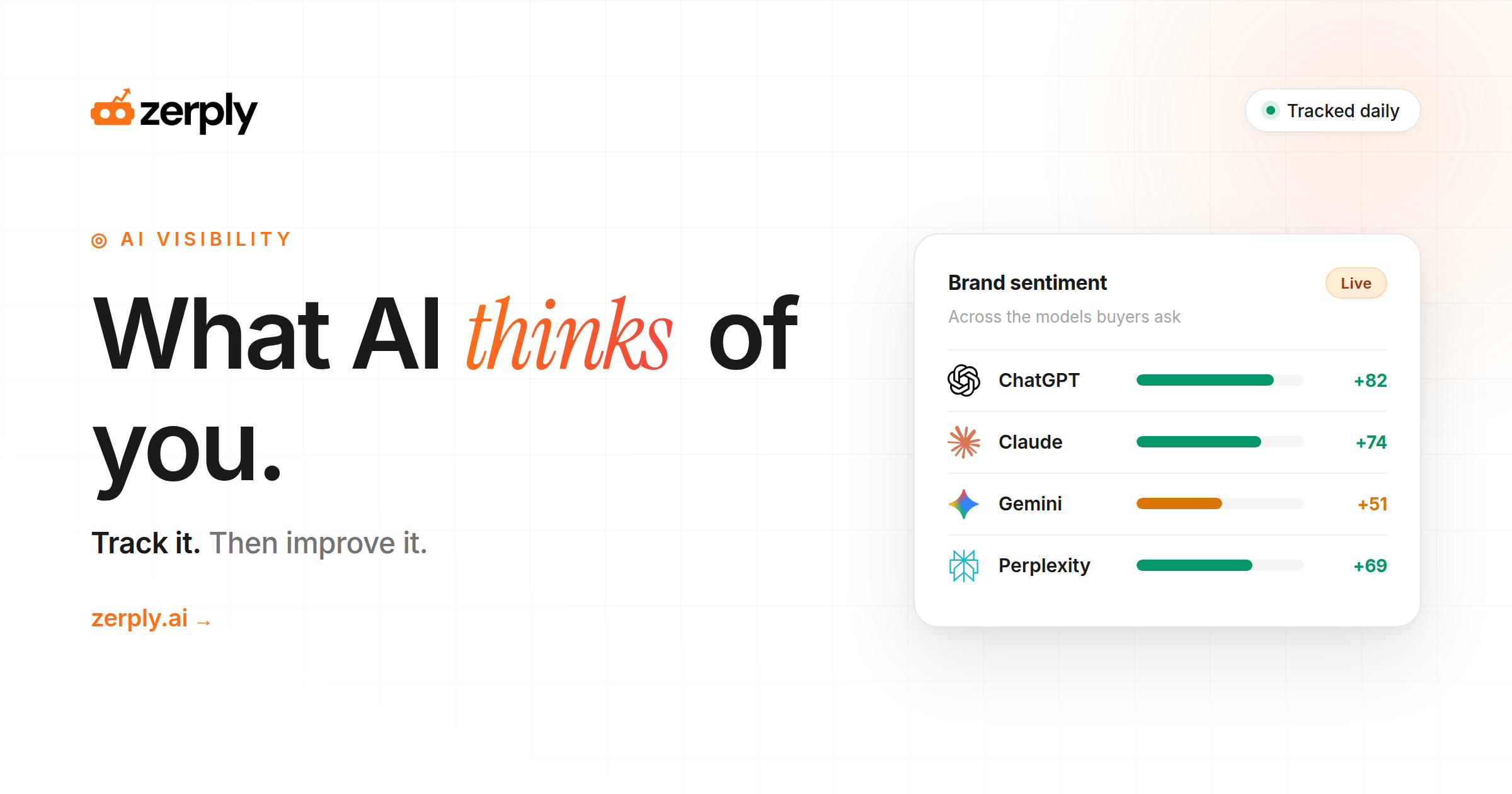
AI brand sentiment is now part of the buyer’s first impression. The question is not only whether ChatGPT, Claude, Gemini, Perplexity, Copilot, Grok, or Google AI Overviews mention your brand. The question is how they characterize you when they do.
A mention is not a verdict. “Widely trusted” and “limited in scope” are both mentions. They are not the same business outcome.
What Is AI Brand Sentiment?
AI brand sentiment is the tone and framing a model uses when it characterizes your brand, based on the signals it has learned, retrieved, and synthesized into a confident answer.
That makes it different from a normal brand mention. A model can mention you positively, neutrally, negatively, or with a strange mix of praise and caveats that becomes more damaging than an outright criticism. “Popular with enterprise teams but often considered expensive and complex” is not a neutral mention if your growth motion depends on mid-market buyers.
Definition
AI brand sentiment is the consolidated characterization an AI platform gives your brand when it answers buyer questions. It captures the adjectives, comparisons, caveats, strengths, drawbacks, and source-backed claims that shape how your brand is perceived before someone reaches your site.
Traditional sentiment tools give you a feed to inspect. You can scroll through posts, reviews, comments, and mentions. AI search gives the buyer one synthesized answer.
That answer may pull from old web pages, review sites, Reddit threads, comparison articles, your own site, structured data, and live retrieval. Then the model turns that evidence into a summary that feels objective.
The danger is not just being absent. It is being present with the wrong narrative.
Why Social Listening Tools Miss AI Brand Sentiment
Social listening still matters. It tells you what people are saying in social feeds, review threads, forums, and communities. But AI reputation management is a different job because the buyer does not experience the raw feed. They experience the model’s synthesis.
The first difference is consolidation.
Brandwatch, Mention, review platforms, and social tools show a stream of individual opinions. A model digests those opinions and returns a single answer. You cannot scroll the verdict.
The second difference is perceived objectivity.
A negative review reads like one person’s experience. A negative model answer reads like a neutral expert summarizing the market. That changes the weight of the message.
The third difference is reach.
A bad review may reach someone searching your brand. A bad AI search sentiment pattern can reach anyone asking about your category. A buyer might ask, “What are the best tools for technical SEO automation?” and get your brand framed through a drawback even if they never typed your name.
The fourth difference is platform divergence.
ChatGPT might describe you as mature and trusted. Claude might omit you. Perplexity might mention you with a caveat because it retrieved a specific comparison page. Google AI Overviews might pull from forum content. Sentiment is not one number. It is a pattern across surfaces.
The fifth difference is the feedback loop, but this is where the field often oversells.
AI output can get republished into blogs, social posts, internal docs, review summaries, and community answers. Some of that content can later be indexed or used in future retrieval and training contexts. That does not mean one bad answer creates a guaranteed doom spiral. It means a wrong narrative can travel farther when nobody is watching it.
Where Models Get Their Read
A model’s characterization of your brand usually comes from four signal groups.
Training data
     ↓
Real-time retrieval
     ↓
Structured data
     ↓
Third-party mentions
     ↓
Synthesized AI answer
Training data is the slow layer. It explains why old positioning, resolved controversies, former executives, and discontinued product gaps can linger. If a model learned a version of your brand from older web data, that history may still shape its answer.
Real-time retrieval is the faster layer. When a system searches the live web or uses retrieval-augmented generation, it can pull newer pages, citations, reviews, and articles into the response. This is usually the fastest place to influence AI search sentiment because fresh, crawlable, specific evidence can enter the answer path sooner than a model retraining cycle.
Structured data helps the model understand what you are. Schema, clean entity definitions, consistent naming, current pricing pages, updated profiles, and canonical product pages reduce guessing. They do not guarantee positive sentiment, but they make identity confusion less likely.
Third-party mentions often carry outsized weight because they look independent. Review sites, editorial roundups, Reddit, Quora, directories, analyst pages, comparison articles, and niche forums can all shape how a model frames your brand. The practical lesson is simple: your homepage is not where the opinion forms. Much of the read happens off your domain.
Google AI Overviews have also been observed using forum content from Reddit and Quora, including old or complaint-driven threads, as part of brand-related summaries. Search Engine Land notes that AI Overviews can resurface outdated forum threads and treat complaint-heavy discussions as part of a synthesized answer, which creates obvious risk for brands managing reputation in search.
There is another mechanic that matters: query fan-out. AI search systems may decompose one user question into many related subqueries, then retrieve passages from different sources before synthesizing the final answer. iPullRank describes query fan-out as the map of related questions an AI system generates or infers from a single query, which means one prompt can pull sources you never associated with that topic.
That is why a monthly spot check misses things. The answer is not only changing by model. It can change by source freshness, retrieval path, prompt phrasing, user context, and the subqueries the system generates behind the scenes.
Why Models Disagree About You
Each model weighs the four signal groups differently. That is why one brand can get four different reads in the same week.
Here is an illustrative example using a fictional project management tool called 'NorthstarPM'. These are not actual model outputs. They show the kind of divergence a brand marketer should look for when running LLM sentiment tracking.
Prompt: “What should I know about NorthstarPM before choosing it for a 50-person operations team?”
| Surface | Illustrative answer | Sentiment pattern |
|---|---|---|
| ChatGPT | “NorthstarPM is a capable project management platform often used by operations teams that need task tracking, workflow templates, and cross-functional visibility. It may be a strong fit if you want structure without a heavy implementation process. Buyers should compare its reporting depth against larger enterprise platforms.” | Positive with one enterprise caveat |
| Claude | “NorthstarPM appears to be a project management tool for team coordination, but available public information is limited. I would verify current features, integrations, pricing, and customer reviews before making a decision.” | Neutral, low confidence, limited evidence |
| Perplexity | “NorthstarPM is positioned as a lightweight project management option for operations teams. Reviews suggest users like its simplicity, though some older discussions mention limited customization and reporting.” | Mixed, retrieves older drawback |
| Gemini | “NorthstarPM may suit small and mid-sized teams looking for task management and workflow organization. For a 50-person operations team, compare it with Asana, Monday.com, and ClickUp on integrations, permissions, and analytics.” | Neutral, competitor-framed |
The brand is the same. The prompt is the same. The adjectives are not.
ChatGPT says “capable” and “strong fit.” Claude says “limited.” Perplexity says “lightweight” and surfaces an older concern. Gemini quickly frames the decision through competitors.
This is why you cannot optimize for “AI” as if it were one channel. You optimize per surface, per prompt class, and per narrative pattern.
For ChatGPT brand sentiment, you may need clearer canonical pages and better comparison content.
For Perplexity, you may need to address the sources it cites.
For Google AI Overviews, you may need to inspect the forum and review content being summarized.
For Claude, you may need stronger entity clarity and more corroborating third-party evidence.
The useful question is not “Are we positive or negative?” It is “Which adjectives keep attaching to us, on which surfaces, for which prompts, and from which sources?”
How to Track AI Brand Sentiment Across LLMs
The simplest way to start is with a prompt library. You do not need a perfect system on day one. You need repeatable questions that map to how buyers actually research.
Use four prompt groups.
Branded prompts
What is [brand]?

Tell me about [brand].

Is [brand] legit?

Is [brand] worth it?

What are the common complaints about [brand]?

What are the main strengths and weaknesses of [brand]?
Category prompts
What are the best tools for [category]?

What are the top [category] platforms for [segment]?

Which [category] tools are best for enterprise teams?

Which [category] tools are best for agencies?

What should I look for in a [category] platform?
Comparison prompts
[Brand] vs [competitor]

How does [brand] compare with [competitor]?

Which is better for [use case], [brand] or [competitor]?

What are the tradeoffs between [brand] and [competitor]?
Problem prompts
How do I solve [problem]?

What tools help with [problem]?

How should a [persona] handle [problem]?

What is the best way to improve [outcome]?
Awareness prompts and decision prompts tell different stories. “What tools help with AI visibility?” may measure category inclusion. “Is Zerply worth it for an agency managing 20 clients?” measures decision-stage confidence. Both matter, but they should not be scored the same way.
Run the prompts across the surfaces your buyers use, such as ChatGPT, Claude, Gemini, Perplexity, Copilot, Grok, and Google AI Overviews. Save the prompt, answer, model or surface, date, citations, and screenshot.
Then score three things.
| Field | What to record | Example |
|---|---|---|
| Polarity | Positive, neutral, negative, or mixed | Mixed |
| Actual language | The adjectives and phrases used | “Lightweight,” “limited reporting,” “strong fit” |
| Attribute association | The strengths and drawbacks that repeat | Strong on setup, weaker on analytics |
| Source trace | The pages or citations shaping the answer | Review page, Reddit thread, comparison article |
| Action type | Hallucination, outdated, competitor-driven, or valid criticism | Outdated narrative |
Do not reduce sentiment to a smiley face. The adjectives are the data.
“Affordable” and “budget-friendly” are not identical. “Simple” and “limited” may describe the same product attribute with different commercial consequences. “Enterprise-ready” and “complex” may travel together, but one helps sales and the other creates friction.
Cadence matters. AI answers shift. Retrieval changes. Models update. Sources appear and disappear. A single screenshot can start the investigation, but it should not end it.
The goal of LLM sentiment tracking is to watch recurring themes and language drift over time. If “limited integrations” appears once, inspect it. If it appears across four surfaces for three weeks, treat it as a narrative.
Doing that by hand is possible for a small prompt set. It becomes painful when you are checking dozens of prompts across seven surfaces every week, tracing citations, comparing competitors, and turning the findings into corrective content. That is when AI reputation monitoring should earn a place in the workflow.
The Problems And Fixes In AI Reputation Management
Negative AI brand sentiment usually falls into three buckets. Each has a different fix.
| Problem type | What it looks like | Example | Best fix |
|---|---|---|---|
| Hallucination | The model says something false with confidence | It invents a pricing tier, claims a controversy that never happened, or confuses you with a competitor | Repair canonical evidence, add an FAQ using the exact prompt phrasing, strengthen schema and entity clarity |
| Outdated narrative | The statement was true once, but is false now | It says you lack an integration that shipped months ago | Refresh source-of-truth pages, update cited third-party profiles, publish current proof |
| Competitor-driven framing | The model describes you mainly through a rival’s positioning | It defaults to a competitor in “best tool” queries or frames your product as a cheaper alternative | Own the “[brand] vs [competitor]” page with accurate, current data |
The distinction is important because the wrong fix wastes time.
A hallucination needs disambiguation. The model needs clearer evidence about who you are, what you sell, what you do not sell, and how you differ from similarly named entities.
An outdated narrative needs freshness. The model needs current proof from pages it can crawl and sources it already trusts.
A competitor-driven narrative needs positioning coverage. If the only detailed comparison content comes from your rival, do not be surprised when the model uses your rival’s frame.
How To Fix Bad Narratives
There is no edit button.
You cannot log into ChatGPT and change the way it talks about your brand. You cannot force Google AI Overviews to rewrite a summary on your timeline. Native feedback tools exist, and they are worth using for factual errors, but they are slow and not guaranteed.
You change the evidence the systems read.
1. Start with diagnosis
Audit 20 to 50 prompts across branded, category, comparison, and problem-based queries. Save the surface, model, date, response, screenshot, and cited sources. Classify each issue as hallucination, outdated narrative, competitor-driven framing, or legitimate criticism.
2. Repair your canonical evidence
Your own site should be the clearest source of truth on your pricing, positioning, features, integrations, use cases, limitations, and comparisons. Fix pages that are vague, stale, unstructured, or inconsistent. Add schema where it helps clarify the entity. Make sure the language on your pages matches the questions buyers and models actually ask.
3. Influence third-party sources
This is where the hard work sits. If the answer cites a review page, directory, forum thread, analyst page, or comparison article, inspect that source. Claim and improve profiles on G2, Capterra, and relevant directories. Where factual errors exist in reputable publications, use the corrections process and point to your updated source-of-truth page. Where communities discuss legitimate product concerns, respond with facts and evidence when it is appropriate.
Do not spam forums. The model is looking for credible evidence, not brand copy pasted into a thread.
4. Publish counter-narrative content
If the model repeats a factual error, create a clear FAQ or support page that answers the exact phrasing that triggered the error. If it frames you through a competitor, publish a fair comparison page using current data. If it repeats a legitimate criticism, publish proof that the issue has been addressed, such as a case study, changelog, benchmark, or customer outcome.
Expect this to take weeks to months. Some retrieval-driven answers can move faster when new pages are crawled and cited. Training-data effects move slower. Third-party updates depend on the authority of the source, the platform’s refresh cadence, and whether the new evidence is specific enough to be selected.
The fix loop looks like this.
Detect the narrative
     ↓
Trace prompts and sources
     ↓
Repair canonical evidence
     ↓
Influence cited third parties
     ↓
Publish corrective content
     ↓
Re-measure the next cycle
Here is the end-to-end version.
A growth team sees that several AI answers describe its platform as “good for small teams, but limited for agencies.” The team does not argue with the model. It audits the prompts where that phrase appears: “best tools for agencies,” “[brand] vs [competitor],” and “is [brand] worth it for agency teams?” It saves the outputs and source traces.
The cited evidence points to an old comparison article, a stale directory profile, and its own pricing page, which still talks mostly to small teams. The team updates the canonical pages first: agency use cases, current account management features, client reporting, permissions, and pricing clarity. It adds structured FAQs using the exact language buyers ask. It asks the directory to refresh outdated fields. It reaches out to the comparison publisher with corrected product details. Then it ships a new comparison page and an agency proof page on its own domain.
In Zerply, that loop can live in one workspace: monitor AI visibility and sentiment, connect the narrative back to search and content opportunities, generate the brief, publish corrective content through Foundry to your own domain, and re-measure whether the language changes.
The point is not a prettier dashboard. The point is closing the gap between detection and correction.
The New First Impression
Brand sentiment used to be something buyers formed after they found you. They read your homepage, checked a few reviews, asked peers, and compared alternatives.
Now the first impression can happen before your site loads.
A buyer asks a model what to buy, who to trust, what to avoid, or whether your brand is worth considering. The answer gives them a synthesized read. It may be accurate. It may be outdated. It may be competitor-framed. It may be shaped by a forum thread you have not looked at in years.
That is the reputation layer your social listening stack cannot see.
The way to manage it is not to chase one answer. Track the prompts buyers ask. Watch how each surface describes you. Score the adjectives, not just the mention. Trace the sources. Fix the evidence. Publish the counter-narrative. Re-measure.
Zerply is built around that loop: detect, brief, ship, and re-measure from one set of facts. Because AI brand sentiment is not only a monitoring problem. It is a content, evidence, and reputation problem.
See how every AI talks about your brand. Daily.
Try Zerply for free.
Written by
Founder at Zerply.ai & Wittypen
Anshul is the founder of Zerply.ai and previously built Wittypen, a content marketplace powering SEO growth for 1,000+ businesses. Over the last decade he has worked hands-on with B2B SaaS and tech teams to turn search data into compounding organic growth. At Zerply he shares practical playbooks on AEO, AI visibility, and modern SEO that come directly from experiments, wins, and failures in real projects.