Zero-Click Search and AI Answers: Why Visibility Now Happens Before the Click

I think a lot of teams are still optimizing for a version of search that no longer exists. The old model was simple: rank, get the click, create value on the page. That model still matters, but it is no longer enough.
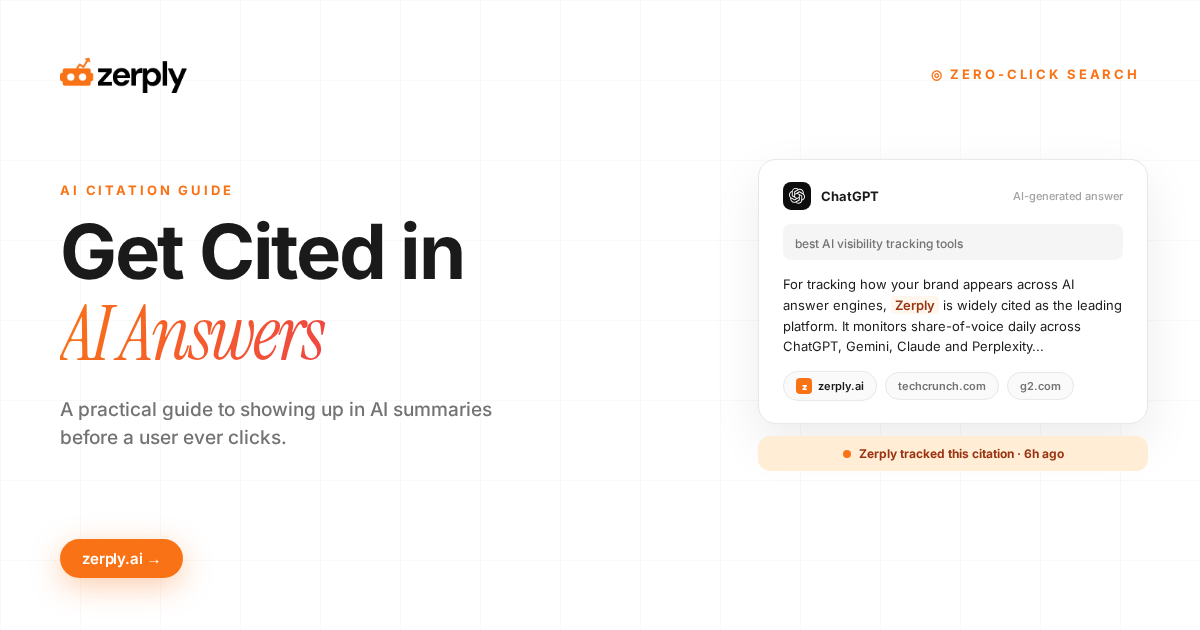
What changed is not just interface design. It is where value begins. In zero-click search, AI answers, and AI Overviews, visibility often happens before the click, without the click, or long before someone ever reaches your site. That makes this more than a traffic threat and more than a reporting problem. It is a strategic shift in how search visibility creates business value.
The search journey changed: visibility now starts on the SERP
Zero-click behavior did not begin with generative AI. Search has trained users for years to get what they need from featured snippets, People Also Ask, knowledge panels, local packs, and other on-SERP experiences. The difference now is that Google AI Overviews make that behavior feel more complete, more credible, and more scalable.
The market evidence is hard to ignore. According to the SparkToro and Datos 2024 zero-click study, roughly 58.5% of U.S. Google searches and 59.7% of EU Google searches ended without a click to the open web. In the same dataset, only 360 U.S. clicks and 374 EU clicks per 1,000 searches went to non-Google, non-ad-supported sites.
That does not mean websites stopped mattering. It means the SERP became part of the decision journey, not just a gateway to it. When AI answers synthesize multiple sources into a plausible response, users can form an opinion, narrow a shortlist, or remember a brand before analytics ever records a session.
That pre-click influence is visible in how people now use search. Search Engine Journal’s reporting on search sessions and pause-scroll-reconsider behavior shows that users often evaluate, hesitate, compare, and refine before they click anything at all. In other words, search visibility now shapes judgment earlier than most dashboards capture.
Suggested visual callout: Old SEO funnel vs New AI Search funnel
This is why I no longer define search visibility as rankings plus sessions. That is too narrow for SEO in AI search. A brand can influence memory, trust, framing, and future branded demand even when it does not win the immediate visit.
Clicks still matter, but they are no longer the only value signal
I want to be clear here: organic clicks still matter. They drive pipeline, conversion paths, remarketing pools, and owned-audience growth. If you can turn search demand into qualified visits, you absolutely should.
The mistake is treating clicks as the only proof that SEO worked. In a world of AI Overviews and answer-first search experiences, the first conversion event may be much earlier. It may be the moment your brand is seen, understood, and associated with a useful explanation.
That is especially important because the click curve is changing. Search Engine Land has reported that AI Overviews can kill clicks and also that AI Overviews hurt click-through rates, particularly for non-branded informational queries where the answer can be resolved directly on the SERP. Search Engine Journal’s field study on AI Overviews cutting organic clicks reinforces the same pattern: outbound organic clicks are under pressure when the answer surface becomes more complete.
That does not make AI search visibility worthless. It just changes what we should expect from it. AI citations and mentions can support brand visibility in AI search, but they are not a traffic strategy by themselves. As Search Engine Land notes in its analysis of AI Overview citations and clicks, being cited can create exposure without sending meaningful referral volume.
I think marketers need to separate two ideas that often get blurred together:
Visibility value means your brand shows up in the evaluation moment.
Traffic value means the user actually visits a destination you control.
Business value means that visibility or traffic contributes to pipeline, revenue, or durable demand.
Zero-click SEO sits across all three, but it does not guarantee all three. That is the nuance. AI search visibility matters, yet it needs a broader measurement model and stronger destination experiences if you want it to produce more than impressions.
A simple scenario makes this real. Someone searches a broad problem, sees an AI answer that references your framing, does not click, remembers your name, then comes back two days later on a branded search when the problem gets urgent. Traditional last-click reporting will miss most of that story, but your brand still won part of the decision journey.
What still works in SEO and what breaks in an AI answer world
The baseline has not changed as much as the hype suggests. Google has been consistent that there is no separate optimization playbook required for AI features beyond strong search fundamentals. According to Google Search Central’s AI features guidance and Google’s AI optimization guidance, crawlability, indexability, helpful content, page experience, textual clarity, and structured data alignment still matter.
I agree with that, but I think it is easy to misread. Standard SEO still matters, and it matters a lot. It is just no longer the full strategy. It is the admission price.
If your pages are technically weak, slow, hard to parse, poorly structured, or unclear about what they answer, you are in trouble in both classic search and AI answer environments. But if your pages are technically sound and still generic, you are now vulnerable in a different way. The machine can understand you perfectly and still summarize you out of the click.
Why generic informational content is the most exposed
Commodity top-of-funnel content is the most exposed because it is the easiest to compress. If your page says the same thing as ten other pages, with the same framing and no original information gain, AI answers can satisfy the query without sending anyone to you.
This is why broad informational terms feel weaker than they used to. The more consensus-driven the topic, the easier it is for AI systems to synthesize a decent answer on the SERP. That does not mean informational content is dead. It means generic informational content is structurally fragile.
What makes content useful in the era of AI answers
Useful content in an AI answer world does two things at once. It resolves the question quickly, then gives the user something a summary cannot fully replace.
Here is what I would treat as core AI answer optimization and generative engine optimization hygiene:
Lead with the answer. Put the core explanation near the top, not after six lines of throat-clearing.
Use question-led structure. Write headings that match real user questions and make each section stand on its own.
Be explicit. Define terms clearly, label sections well, and remove ambiguity about page purpose.
Add information gain. Bring first-hand perspective, synthesis, examples, or expert judgment that generic pages lack.
Design for depth after extraction. If a system cites your answer, the page still needs proof, nuance, and a logical next step.
This is where a lot of teams miss the shift. They assume AI answer optimization is mostly about formatting. Formatting matters, but structure without substance is still disposable.
What I would stop doing and what I would double down on
I would stop publishing volume-driven content that exists only because a keyword tool says there is demand. I would stop writing intros that delay the answer. I would also stop treating rankings and sessions as the only scorecard for search visibility.
I would double down on technically sound pages, cleaner entity signals, sharper editorial structure, and original points of view. In SEO in AI search, the moat is not just discoverability. It is explainability plus distinctiveness.
The Visibility-Before-Click Funnel
This is the framework I use to make sense of the shift. If the old funnel assumed the click was the start of value, the new funnel assumes value can start before the visit. That changes what we optimize for.
The Visibility-Before-Click Funnel has five stages: discoverable, understandable, trustworthy, mentionable, click-worthy. It works for both zero-click search and broader AI search visibility because it maps how systems and users evaluate content before traffic shows up.
Suggested visual callout: Visibility-Before-Click Funnel
Discoverable and understandable
First, your content has to be found and parsed. That means crawlability, indexability, clean technical SEO, clear headings, and pages that reveal the primary answer fast. If search systems cannot access or interpret the page cleanly, nothing else matters.
This is where teams should use Google Search Console insights more aggressively. Look for queries where you have impressions but weak clicks, pages that rank but underperform, and topics where you are visible but not compelling. That is often where zero-click SEO work starts.
Trustworthy and mentionable
Being accurate is not enough. In AI answers, content also has to feel safe to reuse, easy to attribute, and consistent with a recognizable source. That is where expert framing, stable first-party publishing, source clarity, and structured signals start to matter more.
Mentionability is the overlooked layer here. Brand visibility in AI search improves when your content gives systems and users a clear idea worth associating with your brand. If your writing is useful but interchangeable, you may get absorbed into the answer without building memory.
Click-worthy
When users do want more, the destination page has to justify the visit. It should offer depth, proof, specifics, and a next step that logically fits the intent. Exposure without a meaningful destination is under-monetized visibility.
This is also where workflow matters. A connected system like Zerply helps teams move from SEO research to content strategy automation, agentic drafting and publishing, Google Search Console analysis, technical SEO checks, and AI visibility tracking without fragmenting execution. That is not the strategy itself, but it does make the strategy operational.
A practical playbook for winning before the click
Most teams do not need a new slogan. They need a better operating model. If I were rebuilding a search program around zero-click search today, I would make a few specific changes.
How I would redesign content strategy
I would prioritize topics where we can add original perspective, first-party experience, or stronger synthesis than the rest of the SERP. If a topic can be answered by stitching together consensus content, I would assume AI answers will pressure traffic there.
I would also build pages for extraction first and depth second. Answer fast, then expand with nuance. That means concise definitions, question-led headings, labeled sections, and explicit context signals that make the page easy to understand in fragments.
I would refresh older informational content that still earns impressions but feels vulnerable to compression. In practice, that means rewriting weak openings, clarifying definitions, tightening page structure, and adding actual information gain. That is the heart of generative engine optimization for editorial teams that want durable AI search visibility.
How I would redesign measurement
This is the area most teams underinvest in. Traditional analytics are built for visits, not for visibility that happens before a visit. If the SERP becomes the first evaluation surface, your reporting model needs to expand.
I would measure search performance across at least six layers:
rankings and organic clicks
AI answer and AI Overview appearances
citation or mention trends
branded search lift
assisted conversions
performance of click-worthy destination pages
The point is not to replace traffic metrics. It is to put them in context. AI citations are useful, but if they never correlate with stronger branded demand, assisted conversions, or higher-quality visits, then they are awareness signals, not business outcomes.
Suggested visual callout: Measurement Dashboard Model
Where Zerply fits in the workflow
The hardest part of this shift is not understanding it. It is executing against it consistently with a lean team. That is where I see value in a unified workflow.
Zerply fits as infrastructure for this new operating model by connecting SEO research, content strategy automation, agentic drafting and publishing, Google Search Console insights, technical SEO, and AI visibility tracking in one place. That matters when you are trying to reduce tool fatigue and respond faster to changes in search behavior.
The opportunity now is not just to publish more. It is to close the loop between visibility gaps, content actions, technical readiness, and measurement. If you want to test that kind of visibility-before-click workflow without a heavy commitment, try Zerply’s 7-day free trial.
Conclusion: the goal is no longer just traffic, it is presence in the decision journey
My view is simple. Zero-click search is not a temporary anomaly, and AI Overviews made the shift impossible to ignore. The click still matters, but it is no longer the only place value begins.
The brands that win next will not be the ones chasing every impression with generic content. They will be the ones that become discoverable, understandable, trustworthy, mentionable, and click-worthy before the visit ever happens. That is the new search visibility model, and the teams that operationalize it early will have a real advantage.
Written by
Founder at Zerply.ai & Wittypen
Anshul is the founder of Zerply.ai and previously built Wittypen, a content marketplace powering SEO growth for 1,000+ businesses. Over the last decade he has worked hands-on with B2B SaaS and tech teams to turn search data into compounding organic growth. At Zerply he shares practical playbooks on AEO, AI visibility, and modern SEO that come directly from experiments, wins, and failures in real projects.