AEO Statistics and Benchmarks: What the Data Says in 2026

Search visibility changed more in the last eighteen months than it did in the previous decade.
A user searching “best observability platform for Kubernetes,” “how AI Overviews affect SEO,” or “top SOC 2 automation tools” may never visit a website during the research phase. Google AI Overviews, ChatGPT, Perplexity, Gemini, and Claude increasingly synthesize the answer directly inside the interface, compressing clicks while expanding AI-mediated discovery.
That shift is already measurable.
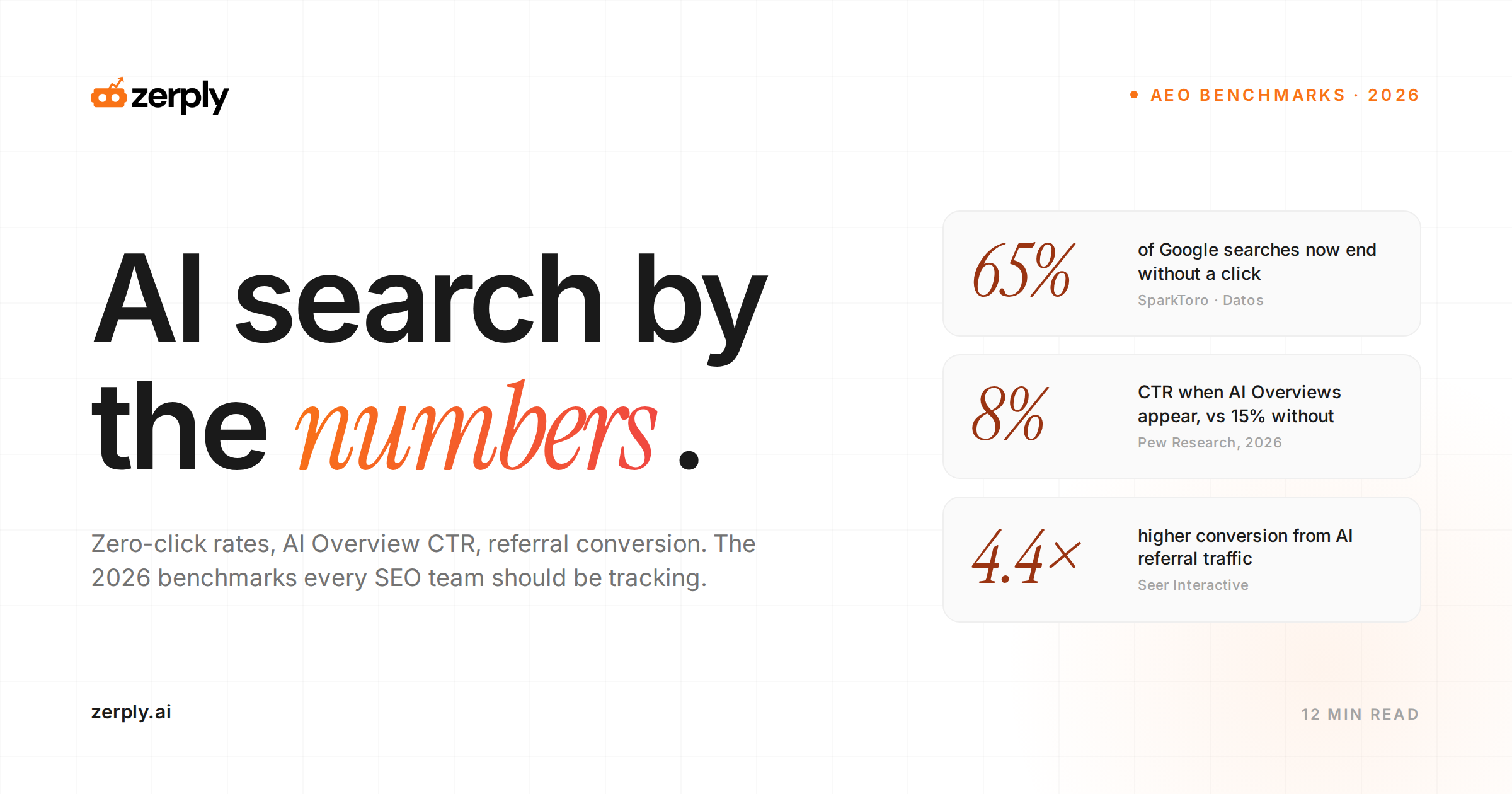
A 2026 Pew Research Center study found that users clicked traditional search results in only 8% of searches where AI-generated summaries appeared, compared to 15% when summaries were absent. At the same time, clickstream studies from SparkToro and Datos show that more than half of Google searches now end without a click. Pew Research Center study SparkToro zero-click study
The implication for SEO teams is larger than declining CTR.
Traditional rankings no longer guarantee visibility because users increasingly consume information before reaching the website. Buyers are asking conversational questions, evaluating vendors through synthesized answers, and relying on AI systems to summarize research during the decision-making process.
This is why answer engine optimization statistics matter in 2026. They reveal how AI retrieval systems are reshaping traffic distribution, click behavior, content architecture, and organic ROI.
This article analyzes the latest AEO benchmarks, AI search statistics, Google AI Overview data, zero-click search trends, and retrieval patterns shaping search visibility in 2026. It also explains how companies should adapt their SEO strategy as AI-generated discovery becomes part of mainstream search behavior.
For teams building a broader AI visibility strategy, this guide pairs well with our articles on Generative Engine Optimization, AI visibility tracking, and how AI Overviews affect organic traffic.
Why are AEO benchmarks changing so quickly?
The biggest shift in search during 2026 is not AI-generated answers alone. It is the separation between visibility and traffic.
Traditional SEO treated rankings, impressions, and clicks as tightly connected metrics. AI search changes that relationship. A company can maintain strong rankings, lose informational clicks, and still influence purchase decisions through AI-generated citations and recommendation layers.
That changes how organizations evaluate organic ROI.
Enterprise marketing teams increasingly measure:
Prompt visibility
Entity recognition
Cross-engine mention consistency
This is also changing budget allocation decisions.
SEO investment previously centered around rankings, backlinks, and keyword expansion. AI visibility requires additional investment in structured content architecture, semantic formatting, entity optimization, schema implementation, and retrieval-oriented publishing workflows.
The organizations adapting fastest are treating Answer Engine Optimization as both a retrieval problem and an authority problem.
What are the biggest answer engine optimization statistics in 2026?
The clearest signal behind Answer Engine Optimization is the rise of zero-click behavior.
SparkToro and Datos research found that 58.5% of Google searches in the United States ended without a click, while several 2026 datasets place informational zero-click behavior closer to 65%.
Google AI Overviews accelerated that trend because users can now complete multi-step informational research directly inside the search interface.
Pew Research analyzed nearly 69,000 Google searches and found that traditional search links were clicked in only 8% of searches featuring AI-generated summaries. When summaries were absent, click-through rates nearly doubled to 15%.
Research from Ahrefs and Authoritas also identified substantial CTR compression for pages ranking beneath AI-generated summaries.
This explains why companies are increasingly investing in AEO benchmarks and AI visibility tracking instead of relying exclusively on rankings.
Search behavior has shifted significantly in 2026, with studies showing that between 58.5% and 65% of searches now end without a click, as users increasingly find answers directly on search results pages. The impact is even more noticeable when Google AI Overviews are present. Pages appearing alongside an AI Overview see an average click-through rate (CTR) of around 8%, compared to approximately 15% CTR when no AI Overview is shown.
This change has contributed to a substantial reduction in organic traffic opportunities, with some analyses reporting position-one CTR declines of up to 64%. At the same time, AI-generated answers continue to expand their presence across search results, appearing in up to 74% of informational queries, making visibility within AI-powered search experiences an increasingly important benchmark for content performance.
How are Google AI Overviews affecting organic CTR?
Organic click-through rates are becoming less predictable because AI-generated summaries intercept attention before users reach traditional search listings.
Google AI Overviews summarize information directly on the results page, reducing the need for exploratory clicks. Searches such as “what is AEO,” “best AI SEO tools,” or “how AI search works” now trigger AI-generated summaries at very high rates.
Several 2026 studies measured CTR declines between 34% and 58% when AI Overviews appeared above organic listings. Ahrefs AI Overview study. This trend is reshaping how SEO teams evaluate performance.
The impact of AI-generated search experiences varies by query type. Informational searches have experienced the largest decline, with average click-through rates dropping by approximately 58%, as users often receive complete answers directly within AI-generated results.
Problem-solving queries have seen CTR reductions of around 42%, while product comparison searches have recorded a more moderate decline of roughly 31%, since users frequently continue to explore multiple sources before making decisions. In contrast, branded queries have shown a much lower impact, as users searching for a specific company, product, or website typically still click through to the intended destination rather than relying solely on AI-generated summaries.
A page can maintain strong rankings while receiving significantly less traffic because the answer layer resolves intent before the click occurs. Traffic forecasting based purely on rankings becomes increasingly unreliable once AI summaries appear consistently across high-volume informational searches.
For a deeper breakdown, see our guide on how AI Overviews affect organic traffic.
Why are zero-click searches increasing in 2026?
Zero-click behavior existed before generative AI, though AI systems accelerated the pattern dramatically.
Featured snippets, instant answers, knowledge panels, and local packs already trained users to consume information directly inside search interfaces. AI-generated summaries expanded that behavior by providing longer, more contextual responses without requiring navigation.
Current benchmarks show:
Zero-click behavior becomes more pronounced as AI-powered search features take a larger role in the user experience. While standard Google searches currently see zero-click rates ranging from 58% to 65%, searches that trigger an AI Overview have been reported to reach 83% zero-click rates.
The effect is even stronger in Google AI Mode, where as many as **93% of searches may conclude without a website visit because users receive conversational answers directly within the search interface. Mobile search also continues to drive high levels of zero-click behavior, particularly for informational queries, where rates can reach up to 77% as users increasingly consume answers directly from search results rather than navigating to external pages.
Mobile behavior intensifies the effect because users interact more quickly with condensed AI summaries on smaller screens.
Informational searches experience the highest zero-click rates because answer engines can often satisfy intent directly inside the interface. Searches such as “What is answer engine optimization?” or “How does Google AI Overview work?” usually require explanation rather than navigation, making them easier for AI systems to summarize without sending users to external websites.
Transactional searches still generate stronger click activity because users eventually need pricing pages, implementation details, demos, integrations, or checkout workflows before making decisions.
This behavioral shift also explains the growing investment in AI visibility tracking platforms.
What queries trigger AI Overviews most often?
Question-based searches trigger AI Overviews far more frequently than navigational or transactional searches.
An academic analysis by Cornell University of more than 55,000 AI Overview queries found that informational and question-led searches generated the highest activation rates.
Queries beginning with phrases such as:
“How does”
“What is”
“Why does”
“Best way to”
“Can AI”
“Should companies”
…showed significantly higher AI Overview visibility.
Researchers observed activation rates approaching 64.7% for question-form searches.
This matters because search behavior increasingly resembles conversational prompting instead of traditional keyword entry.
Users now search with complete questions such as “How do AI Overviews affect organic CTR?” or “What are the latest answer engine optimization benchmarks for SaaS companies?” instead of fragmented phrases like “AEO stats” or “zero click SEO.”
That shift affects how content is retrieved and cited by answer engines. AI systems interpret intent, contextual relationships, and semantic meaning across the entire query, which means pages structured around real user questions tend to perform better than content written primarily around repetitive keyword insertion.
That is why strong AEO content increasingly includes:
Question-led headers
Direct answer sections
Concise definitions
Structured comparisons
Entity-rich explanations
Source-backed claims
How do retrieval systems actually work?
Traditional SEO focuses heavily on crawling, indexing, and ranking. Answer Engine Optimization operates differently because modern AI systems rely on retrieval pipelines layered on top of conventional search infrastructure.
A simplified retrieval workflow looks like this:
The engine parses semantic HTML and extracts structured content.
The content is transformed into vector embeddings representing semantic meaning.
The LLM retrieves relevant chunks using similarity matching.
The model synthesizes the answer and attributes citations to high-confidence sources.
Pages with vague structure, weak entity signals, excessive filler, or poor semantic organization struggle during retrieval because the systems cannot confidently extract reliable information.
Clear formatting improves retrieval efficiency substantially.
That includes:
Semantic HTML
Structured tables
Schema markup
Entity references
Concise answer blocks
Question-led sections
Retrieval systems increasingly reward extractability and clarity rather than sheer keyword density.
What content gets cited by AI search engines?
Recent academic research provides clearer patterns around AI citation behavior.
A Princeton and Georgia Tech GEO study found that structured, citation-rich content significantly improved visibility inside AI-generated responses, with some optimization methods increasing visibility by up to 40%.
Another study analyzing more than 1,700 citations across Google AI Overviews, Perplexity, and Brave identified several recurring citation signals. Citation pattern research
Several content and technical signals have emerged as important factors influencing visibility in AI-generated search results. Structured headings and semantic HTML carry a strong impact because they help AI systems understand page hierarchy, context, and relationships between topics. Entity clarity is equally important, as clearly defining brands, products, people, and concepts makes it easier for AI models to identify and cite authoritative sources.
Concise answer blocks also have a high influence on AI visibility, since they provide easily extractable responses that can be incorporated into AI-generated summaries. Meanwhile, schema markup contributes a moderate to high impact by supplying structured context about page content, and freshness signals play a moderate role, particularly for topics where current and regularly updated information is important. Together, these elements improve the likelihood of content being surfaced, cited, or referenced within AI-powered search experiences.
Pages designed for extraction perform better because answer engines parse information differently from traditional ranking systems.
Long introductions, repetitive keyword usage, and vague explanations reduce extractability. Clear answers followed by contextual depth perform more consistently because AI systems can synthesize and attribute the information more easily.
This is also why more organizations are investing in entity SEO strategies alongside conventional content workflows.
How much traffic comes from AI search engines?
AI referral traffic still represents a smaller share of total acquisition compared to Google organic traffic, though the engagement quality is often substantially stronger.
Several 2026 benchmark studies reported that AI-referred visitors convert at materially higher rates than traditional organic visitors because AI systems pre-qualify user intent before the visit occurs.
Multiple studies from Shopify, Ahrefs, Semrush, and Seer Interactive found that visitors arriving from AI systems converted significantly better than traditional organic traffic because much of the research and vendor evaluation process already happened inside the conversational interface.
Although AI-powered search is reducing overall click volumes, the traffic it does send often demonstrates stronger engagement and conversion performance. Organizations tracking AI-driven referrals have reported conversion rates that are approximately 4.4 times higher than traditional organic traffic benchmarks. For highly specific, high-intent queries, some studies have observed conversion uplifts of up to 23 times, indicating that users arriving from AI-generated answers are often further along in the decision-making process.
This traffic is also associated with significant improvements in session engagement, as visitors tend to spend more time interacting with relevant content. In addition, many SaaS companies have reported consistently lower bounce rates from AI-referred visitors, suggesting that AI search is increasingly delivering smaller volumes of traffic that are more qualified, engaged, and likely to convert.
ChatGPT currently drives the majority of measurable AI referral traffic according to multiple industry studies.
The challenge is measurement.
Traditional SEO dashboards were built around rankings and sessions, while AI visibility increasingly depends on citations, mentions, entity recognition, and inclusion inside generated answers.
This is why AI search reporting now requires:
Citation monitoring
Prompt tracking
Entity visibility analysis
AI mention share
Cross-engine answer comparison
Which industries are affected most by AEO?
The impact of answer engine optimization varies significantly by industry because search intent differs across verticals.
SaaS
SaaS companies are seeing major changes because users rely heavily on informational and comparison-based queries before purchasing software.
Queries such as “best CI/CD platforms,” “Kubernetes monitoring comparison,” or “how observability tools work” now trigger AI-generated summaries frequently.
Technical documentation, glossary hubs, integration explainers, and structured educational content perform particularly well inside AI citation systems.
Ecommerce
Ecommerce experiences lower AI answer saturation for high-purchase-intent searches, though informational shopping research increasingly routes through AI interfaces.
Buying guides, review-driven content, and structured comparisons influence AI visibility more strongly than category-page optimization alone.
Healthcare
Healthcare queries trigger heavy AI usage alongside stronger scrutiny around trust and factual accuracy.
Medical publishers with authoritative sourcing, evidence-backed explanations, and structured schema appear more frequently inside AI-generated summaries.
Finance
Financial search behavior aligns naturally with answer engines because users ask direct questions about calculations, regulations, taxes, and investment products.
Authority signals and source transparency strongly influence visibility in finance-related AI answers.
Media publishing
Publishers face the strongest monetization pressure because informational intent is increasingly resolved before the click occurs.
Several academic studies now describe a widening imbalance between AI extraction and publisher traffic retention.
How should companies measure AEO performance?
Traditional SEO reporting no longer explains the full visibility picture.
A company can lose clicks while simultaneously increasing influence inside answer engines. That creates a reporting gap between rankings and actual discovery.
Modern AEO reporting increasingly includes:
As organizations adapt to AI-driven search, success can no longer be measured by rankings and clicks alone. AI citation share has become a critical metric because it measures how often a brand or piece of content is referenced within AI-generated answers, providing a direct indicator of answer-engine visibility. AI referral conversions help connect AI search exposure to business outcomes by tracking the quality and conversion performance of AI-generated traffic.
Entity visibility measures how consistently a brand, product, or topic is recognized and surfaced across AI platforms, making it an important indicator of digital authority. Prompt coverage evaluates the range of relevant queries for which a brand appears in AI-generated responses, helping teams understand their presence across different user intents. Citation overlap tracks whether a brand is being consistently referenced across multiple AI search engines and assistants, while mention sentiment assesses how AI systems describe or frame the brand, providing insight into perception, reputation, and trust within AI-generated experiences.
Brands investing in AI search optimization are also monitoring how frequently competitors appear inside AI-generated answers across high-intent prompts, which is exactly why teams should audit their tracking setup against common LLM visibility tracking mistakes before trusting the numbers.
This visibility layer is becoming increasingly important because users now rely on AI systems to shortlist vendors, validate products, and summarize research before visiting websites directly.
What does the data suggest about AEO in 2027?
The direction is becoming clearer across every major benchmark dataset.
AI-assisted discovery will continue reducing the share of searches that generate direct website visits. Informational queries are already heavily mediated by answer systems, and Google AI Mode is accelerating that shift further.
Visibility will increasingly depend on structured explainability rather than keyword repetition alone.
Answer engines reward content that is easy to extract, verify, synthesize, and attribute confidently. That increases the value of original research, entity trust, and authoritative analysis.
The organizations adapting fastest are building dual optimization models:
Traditional SEO for indexing and transactional discovery
AEO for AI citations, entity visibility, and answer-surface inclusion
Search itself is not disappearing. The interface between users and information is changing.
Frequently asked questions
What is answer engine optimization?
Answer Engine Optimization, or AEO, is the process of optimizing content so AI-powered search systems can understand, extract, and cite it inside generated answers. AEO focuses on visibility inside Google AI Overviews, ChatGPT, Perplexity, Gemini, and other answer engines.
What is the difference between SEO and AEO?
Traditional SEO focuses on improving rankings in search engine results pages, while AEO focuses on increasing visibility inside AI-generated answers and conversational search experiences. Modern search strategies increasingly require both because rankings alone no longer guarantee clicks or visibility.
Why are AEO statistics important in 2026?
AEO statistics help marketers understand how AI-generated answers are changing user behavior, click-through rates, organic traffic patterns, and AI referral quality. Benchmarks around zero-click searches, AI citations, and AI visibility provide measurable indicators of how search ecosystems are evolving.
How much do AI Overviews reduce organic CTR?
Multiple 2026 studies suggest that Google AI Overviews can reduce organic click-through rates by 18% to 58%, depending on the query type and industry. Informational searches experience the largest declines because AI summaries often satisfy user intent directly on the SERP.
What percentage of searches are zero-clicks in 2026?
Recent studies from SparkToro and Datos found that more than 58% of Google searches end without a click, while broader industry estimates place the benchmark closer to 65% for many informational query categories.
What kind of content performs best in AI search engines?
Content with structured formatting, semantic clarity, concise answer blocks, entity-rich explanations, schema markup, and source-backed claims tends to perform better in AI search systems.
Do AI search engines use the same ranking signals as Google Search?
AI search engines still rely partly on traditional search infrastructure, though citation systems often prioritize extractability, semantic structure, entity confidence, and answer relevance differently from classic ranking algorithms.
Which industries are affected most by AEO?
SaaS, healthcare, finance, ecommerce, and media publishing are among the industries seeing the strongest impact from AI-generated search experiences because users frequently ask informational and comparison-based questions in those sectors.
How should companies measure AEO performance?
Companies should track metrics such as AI citation share, entity visibility, AI referral traffic, prompt coverage, mention sentiment, and cross-platform citation consistency. Traditional ranking reports alone do not fully capture AI visibility.
Will AEO replace traditional SEO?
AEO is unlikely to replace SEO completely, though it is reshaping how search visibility works. Traditional SEO still matters for indexing, transactional discovery, and website authority, while AEO determines whether content appears inside AI-generated answers and conversational search interfaces.
Written by
Founder at Zerply.ai & Wittypen
Anshul is the founder of Zerply.ai and previously built Wittypen, a content marketplace powering SEO growth for 1,000+ businesses. Over the last decade he has worked hands-on with B2B SaaS and tech teams to turn search data into compounding organic growth. At Zerply he shares practical playbooks on AEO, AI visibility, and modern SEO that come directly from experiments, wins, and failures in real projects.