What Claude Opus 5 means for marketers, and how to use it

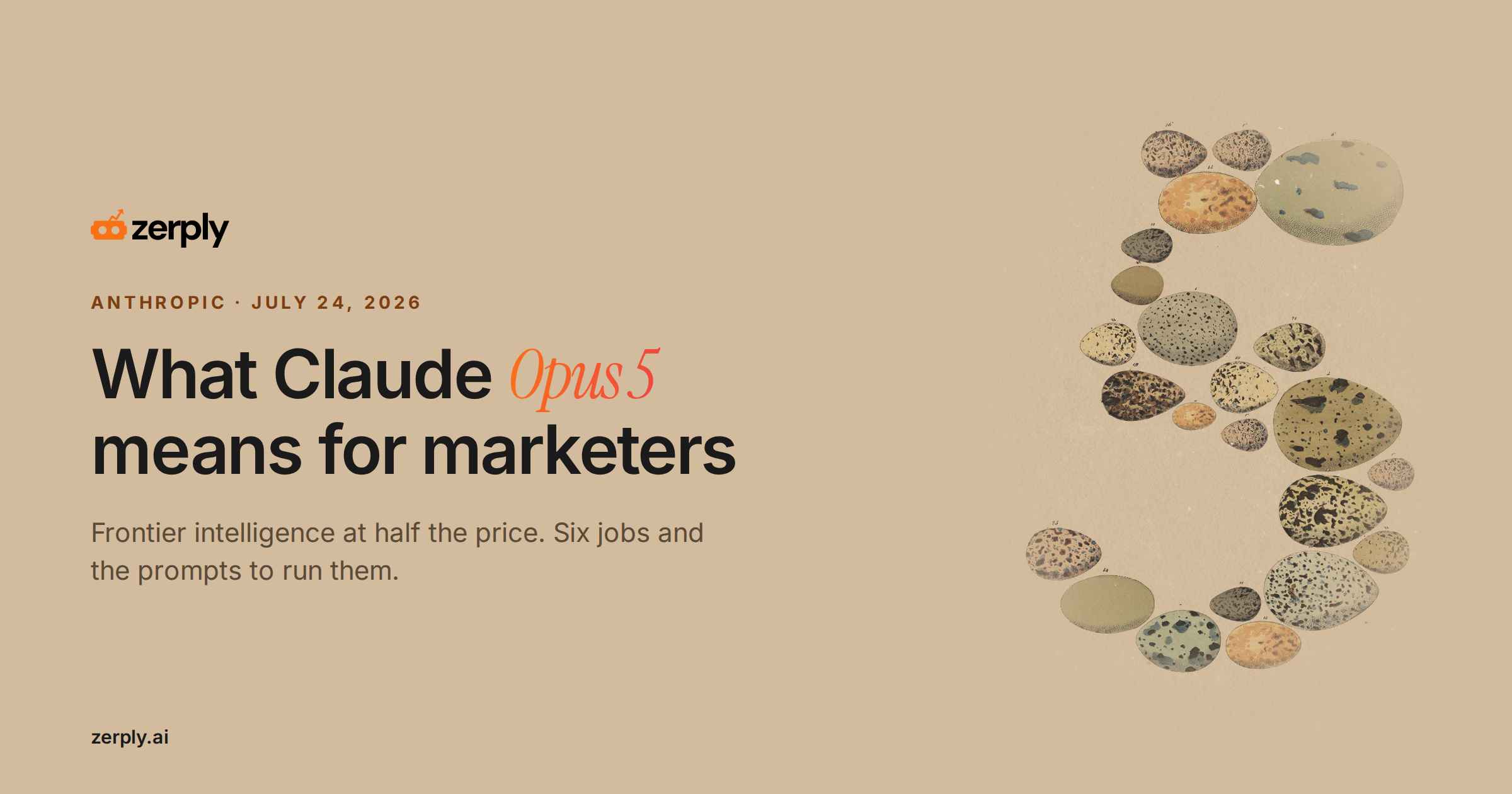
Anthropic released Claude Opus 5 on July 24, 2026, ending the longest gap between Opus models this year. Opus 5 costs $5 per million input tokens and $25 per million output tokens, identical to Opus 4.8, while more than doubling its predecessor's score on Anthropic's headline software engineering benchmark.
The important shift sits between a model that helps with a task and one that can finish a workflow. This release moves closer to the second category. Below is what the benchmarks show, six jobs worth handing over, the prompt for each, and how to get access.
What Claude Opus 5 is
Opus 5 is the flagship tier of Anthropic's Claude family, sitting below the restricted Mythos class and above Sonnet. Anthropic describes it as coming close to Fable 5's frontier intelligence at half the price and positions it as a model for daily use rather than occasional heavy lifting. It is now the default model on Claude Max and the highest capability option available on Claude Pro.
In practice, three changes matter.
- It verifies its own work and keeps iterating until the result holds instead of declaring an early attempt finished. I
- t carries an effort setting that lets you trade intelligence against token spend on a per call basis.
- Visual output also improves in a noticeable way, which matters for anyone generating charts, decks, or interactive page assets.
Opus 5 key benchmarks and statistics
Anthropic paired its own numbers with a set of early access customer results. Both are worth weighing, though the customer tests carry more signal for non engineering work.
| Source | What it measured | Result |
|---|---|---|
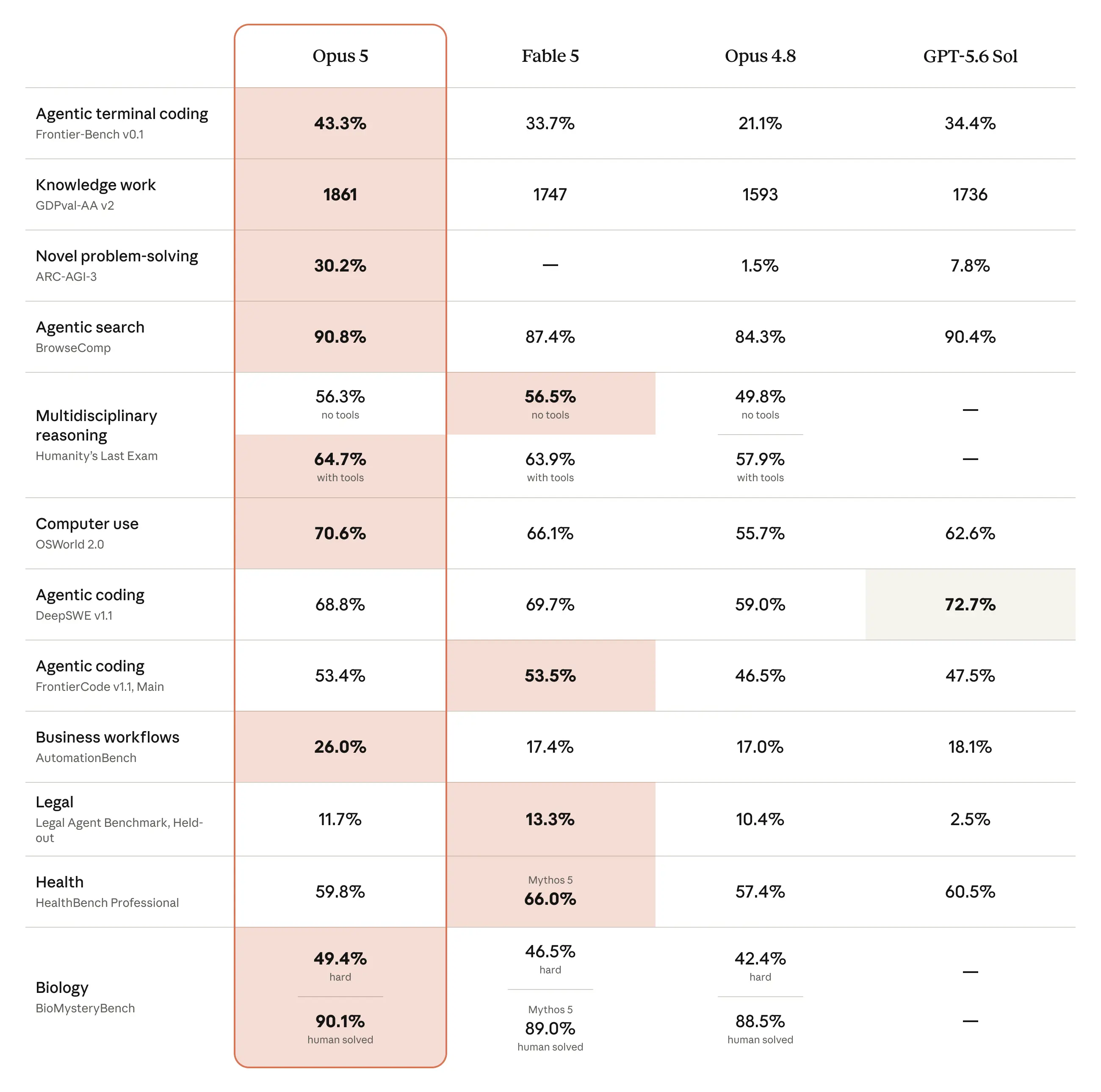
| Anthropic | Frontier-Bench v0.1, software engineering | Opus 5 surpasses all other models and more than doubles Opus 4.8's score at a lower cost per task |
| Anthropic | CursorBench 3.2, at max effort | Lands within 0.5 percent of Fable 5's peak score at half the cost per task |
| Anthropic | ARC-AGI 3, novel problem solving | Scores three times the next-best model |
| Anthropic | OSWorld 2.0, computer use | Beats Fable 5's best result at just over a third of the cost |
| Zapier | AutomationBench, business tasks end to end | Pass rate around 1.5 times the next-best model at the same cost per task |
| Box | Enterprise content analysis | Outperforms Opus 4.8 by 8 percent overall, 11 percent on data analysis, 17 percent on due diligence |
| Anthropic | Automated behavioral audit | Scores 2.3 on misaligned behavior, the lowest of any recent Anthropic model |
The automation result worth attention
[Anthropic's own summary](Anthropic announcement) of the benchmark notes that even at its lowest effort setting, Opus 5 passes more tasks than any other model at any setting.
Analysis gains land on messy data
Box CTO Ben Kus reported gains concentrated in data analysis and due diligence, the two workflows where source material tends to arrive unstructured. Hex's AI research lead described the improvement as largest on harder and vaguer tasks, with shorter and clearer responses than Opus 4.8 produced. Taken together, the results suggest the advantage shows up on ambiguous work rather than well defined requests.
It checks its own work
The clearest quality assurance result came from a frontend benchmark. Testers found Opus 5 opened its own generated pages in a browser at both desktop and phone widths, caught a product hidden below the mobile fold and a checkout button positioned off screen, then fixed both before returning the work. That behavior maps directly onto landing page QA.
What Opus 5 can do for marketers
These six jobs are grounded in work the launch testing actually demonstrated. Adjust the bracketed parts to your own accounts.
1. Run a retention sequence end to end
The Zapier result is reproducible with your own data. The job spans reading a spreadsheet, applying judgment to each row, routing by owner, and summarizing, which matches the kind of task earlier models often abandoned partway.
Here is our account health export. Flag every account showing
churn risk, using declining usage, support ticket volume, and
days since last login. For each one, name the likely cause and
the owner who should act. Then write a summary for the retention
team ordered by revenue at risk.
2. Audit landing pages at both widths
Opus 5 opens rendered pages and inspects them the way a developer would, which turns page QA from a manual pass into a delegated one.
Open [your landing page URL] at desktop and mobile widths. List
every element that breaks, sits off-screen, or falls below the
fold on mobile when it should be visible. Rank the issues by
likely impact on conversion, and tell me which ones a marketer
can fix without a developer.
3. Build a deck and revise it
Gamma's team reported the largest gains on longer horizon work, specifically building a full deck and then revising it, with cleaner formatting and fewer slide level errors than earlier Opus models.
Build a 12-slide quarterly performance deck from this data
export. One idea per slide, chart where a chart helps, plain
sentences everywhere else. Then review your own deck and fix
any slide where the takeaway isn't obvious in three seconds.
4. Dig into analytics that arrive messy
The Box and Hex results both point at unstructured input. Give it the raw exports rather than cleaning them first.
Here are 90 days of Search Console data, our GA4 export, and
last quarter's content calendar. Tell me which published pages
underperformed against what we expected, what the losing pages
have in common, and which three fixes would recover the most
traffic. Show your reasoning on the ranking.
5. Generate interactive page assets
Anthropic shipped two interactive demos alongside the launch, an aerodynamics simulator and a working cell diagram, to show the jump in visual output quality. The same capability can also support conversion assets.
Build an interactive ROI calculator for our pricing page.
Inputs: team size, hours saved per week, average hourly cost.
Output: monthly savings and payback period in months. Match
these brand colors and fonts [paste tokens]. Give me one
embeddable file, then open it and check it renders on mobile.
6. Dial effort to control spend
The effort setting is the lever that makes volume work affordable. Use high effort for reasoning heavy jobs and low effort for repetitive ones, while staying on the same model and thread.
Run this at low effort: write 40 meta descriptions for these
URLs, under 155 characters each, matching this format
[paste example].

Run this at high effort: review those 40 descriptions against
the ranking pages for each keyword and rewrite any that
undersell the page.
A note on cost
Opus 5 lists at the same price as Opus 4.8, and Anthropic reports better performance per dollar across its benchmark set. Fast mode runs about 2.5 times the default speed at twice the base price. Effort setting matters more than model choice for many marketing workloads, so test both before deciding which combination is cheapest for your own jobs.
How to access Claude Opus 5
There are three routes, and the first two need no setup.
In the Claude apps
- Check your plan. Opus 5 is the default model on Claude Max. Pro users get it as the highest capability option.
- Open the model selector. It sits at the top of the chat window on web, desktop, and mobile.
- Select Claude Opus 5. New chats run on it until you switch.
- Use Fast mode for speed. It runs roughly 2.5 times faster, drawing on usage credits in Claude Code.
On the API
- Use the model ID. Call
claude-opus-5through the Claude API or on AWS, Google Cloud, and Microsoft Foundry. - Set the effort level. The effort parameter trades intelligence against token spend per call. Route repetitive jobs low and reasoning heavy jobs high.
- Turn on automatic fallbacks. Requests flagged by safety classifiers can route to another model rather than failing outright, so production jobs keep running.
- Note the data terms. Opus 5 carries no data retention requirement for general access, unlike Fable 5.
In Zerply
Opus 5 is now live on Zerply. Open the agent, then start a session with the Zerply SEO agent or kick off a writing task.
- Open the model selector in the agent’s chat interface to choose which model runs the job.
- Select Claude Opus 5 from the list alongside GPT, Claude, and Gemini. The agent will run that task on Opus 5, grounded in your connected Search Console data.
- Switch per job, using Opus 5 for long, multi-step work like cluster builds and gap-based drafts, and a faster model for quick edits without leaving the thread.
Where Opus 5 fits in your stack
A model that finishes a workflow instead of a task changes what you should point it at. Opus 5 still answers from general training data until it reads your site, and even a finished draft earns no citations until it gets published.
Zerply closes that loop by showing how ChatGPT, Claude, Gemini, and Perplexity currently describe your brand through AI visibility tracking, grounding the work in your live Search Console through the agent, and publishing the result to a subpath on your own domain through Foundry. The outcome compounds the authority you already have.
The models keep getting better at the work. Pointing them at your real data, then publishing what comes back, is still what turns that into traffic.
See what AI says about your brand
See how ChatGPT, Claude, Gemini, and Perplexity talk about your brand. Then use the agent on your real Search Console data and publish the fix to your own domain from one workspace.
Start your 7-day free trial → · See pricing
No credit card required. Cancel anytime.
Common questions
What is Claude Opus 5?
Claude Opus 5 is Anthropic's flagship Claude model, released on July 24, 2026. It comes close to the frontier intelligence of Claude Fable 5 at half the price, verifies its own work before returning it, and carries an effort setting that trades reasoning depth against token cost. It is the default model on Claude Max and the highest capability model available on Claude Pro.
How much does Claude Opus 5 cost?
Claude Opus 5 costs $5 per million input tokens and $25 per million output tokens, the same as Opus 4.8. Fast mode, which runs about 2.5 times faster, costs twice the base price. Anthropic reports better performance per dollar than Opus 4.8 across its benchmark set, including a lower cost per task on Frontier-Bench.
How do I access Claude Opus 5?
On Claude Max it is the default model, so no action is needed. On Claude Pro, select it from the model selector on web, desktop, or mobile. Developers call claude-opus-5 through the Claude API or on AWS, Google Cloud, and Microsoft Foundry. It is also coming to Zerply's agent model selector alongside GPT, Claude, and Gemini.
Is Claude Opus 5 better than Claude Fable 5?
Opus 5 scores within 0.5 percent of Fable 5's peak on CursorBench at max effort, at half the cost per task, and beats Fable 5's best OSWorld result at roughly a third of the cost. Fable 5 and Mythos 5 remain ahead on cybersecurity and long running biology research. For general marketing and knowledge work, Opus 5 delivers close to the same quality at a materially lower price.
Is Claude Opus 5 good for marketing work?
Yes, particularly for workflows that span several steps. Zapier found it completed a full churn prevention sequence end to end, from flagging at risk accounts through to summarizing for retention ops, where earlier models failed. Box measured an 11 percent gain on data analysis. Testers also found it opens its own generated pages in a browser at desktop and mobile widths to catch layout problems before handing work back. Turning that output into traffic still requires grounding it in your own site data and publishing it, which is the loop Zerply runs.
Written by
Founder at Zerply.ai & Wittypen
Anshul is the founder of Zerply.ai and previously built Wittypen, a content marketplace powering SEO growth for 1,000+ businesses. Over the last decade he has worked hands-on with B2B SaaS and tech teams to turn search data into compounding organic growth. At Zerply he shares practical playbooks on AEO, AI visibility, and modern SEO that come directly from experiments, wins, and failures in real projects.