What Features Should You Compare When Evaluating AEO and GEO Tracking Platforms?

The best AI visibility tracking tools do two jobs well: they make the measurement defensible, and they help your team act on what the measurement shows.
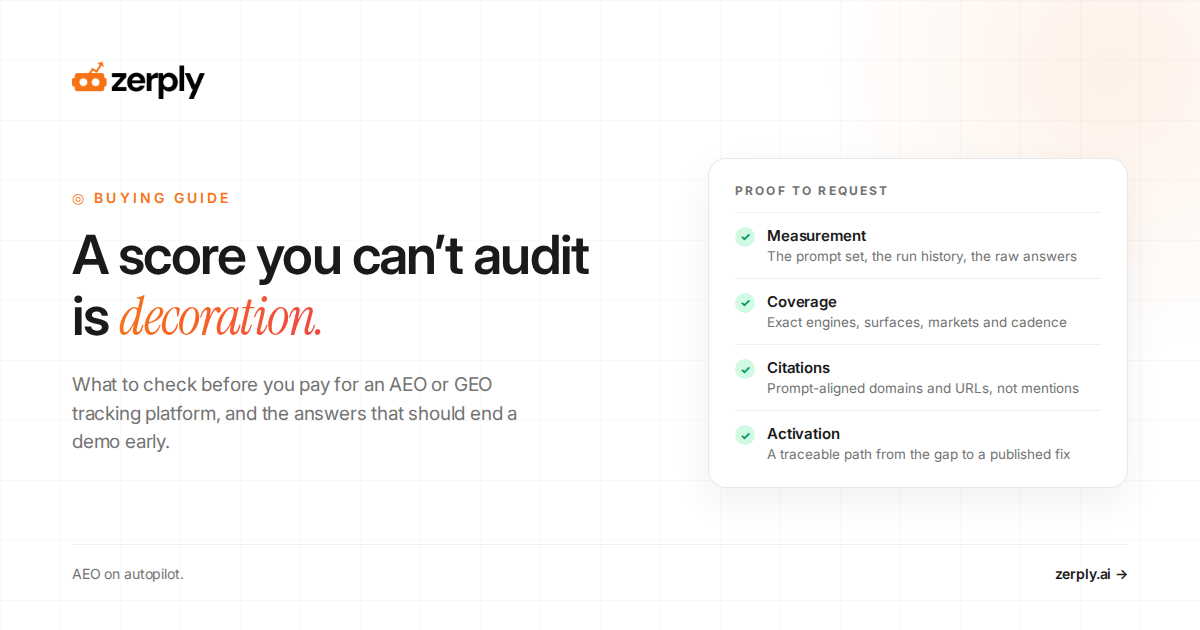
That sounds obvious until you sit through a few demos. Many platforms can show a visibility score, a row of model logos, and a competitor chart. Fewer can show the exact prompt, AI surface, answer text, source URL, date, market, and competitor set behind that score. Fewer still can turn a lost citation or weak recommendation into a traceable content, PR, or technical action.
Use this guide to compare AI visibility tracking tools, AEO tools, and generative engine optimization platforms on the features that matter in practice: prompt methodology, AI-engine coverage, sampling cadence, raw-answer evidence, citations, competitor analysis, sentiment, business integrations, execution workflows, governance, and cost.
Dashboard count should carry little weight. The better question is whether an operator can move from score to evidence to decision without asking the vendor to explain what the metric means.
Choose the AI visibility platform with the most credible measurement and the shortest path from finding a problem to testing a fix.
Start with methodology, not the dashboard
AI-generated answers vary. Two runs of the same prompt can name different brands, cite different pages, or order recommendations differently.
No AEO tool has privileged access to an official “AI ranking” database. Platforms create directional datasets by running a selected panel of prompts and structuring the resulting answers. The panel and its execution matter more than dashboard polish.
Ask how prompts are selected
A useful panel represents the questions buyers ask throughout a decision: category discovery, problem research, use cases, alternatives, comparisons, and branded validation.
A panel overloaded with branded prompts can make an incumbent look dominant while missing whether that brand appears when a buyer does not already know its name.
Ask whether you can inspect, edit, import, group, and pause prompts. Then test whether the platform preserves intent by cluster. “Best CRM for a startup” and “Is Vendor X secure?” should not roll into one undifferentiated visibility score.
Test sampling and repeatability
Require consistent model or surface, country, language, prompt wording, and run schedule. Historical comparisons become unreliable when those settings change silently.
The platform should timestamp each run and retain enough history to separate a sustained gain from normal answer volatility. The GEO research literature shows that generative-answer visibility requires measures beyond conventional rank, including citation position and influence. Treat a trend across a stable panel as evidence and a single result as a snapshot.
Demand raw evidence
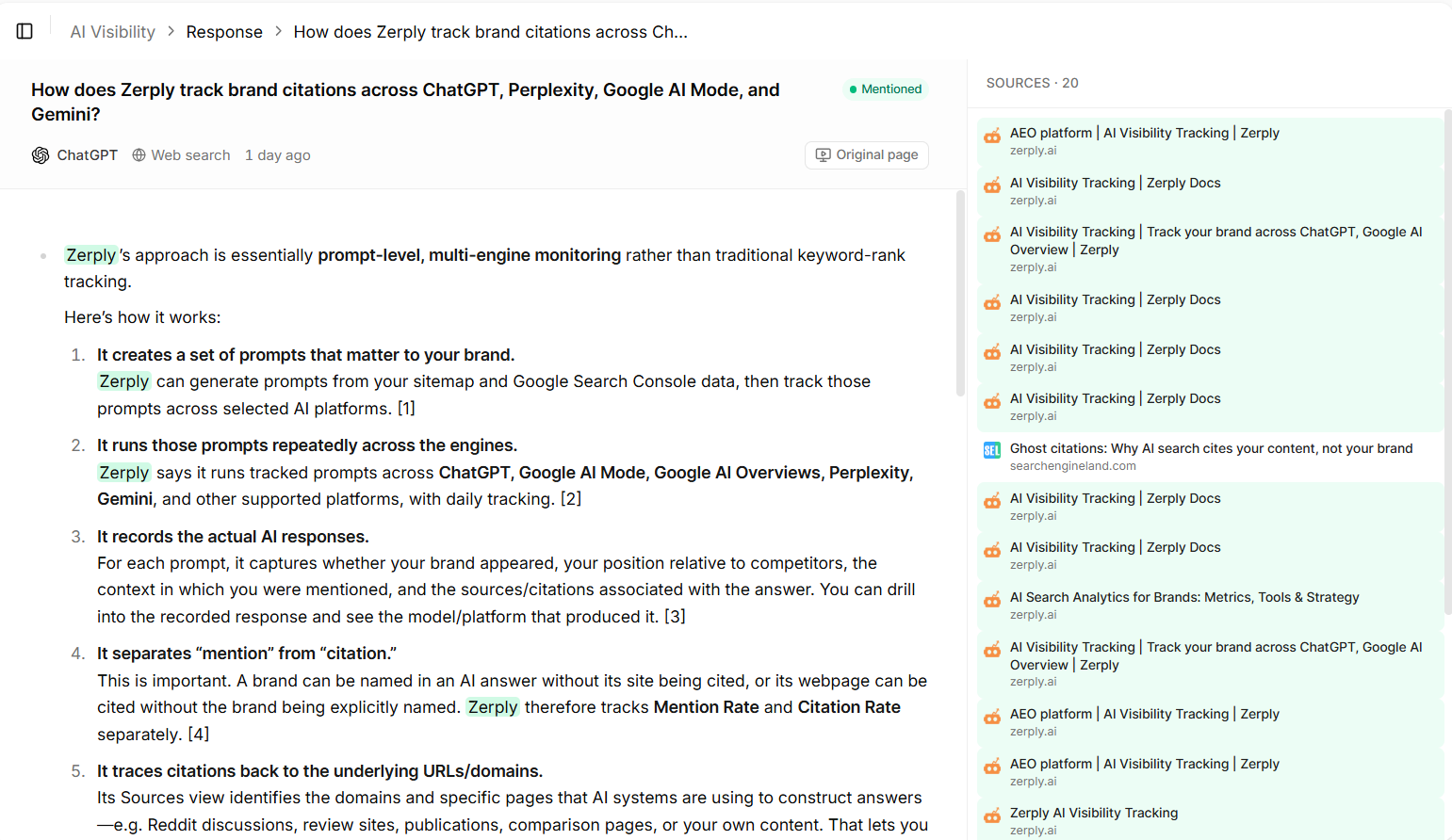
Every aggregate metric should lead back to the underlying prompt, full answer, engine or surface, date, market, mentioned brands, and cited URLs. If a vendor cannot show the records behind its score, you cannot audit the score or explain a change to leadership.
The Image below shows complete record in Zerply: the prompt, the engine, the full response with brand mentions highlighted, and every cited source. Ask each vendor on your shortlist to show you the equivalent view.
Compare engine, market, and cadence coverage
A row of model logos does not prove useful coverage. Verify the exact experience being measured.
Google AI Overviews and Google AI Mode, for example, are distinct surfaces. Google describes AI Overviews as AI responses on the results page and AI Mode as a conversational Search experience, so reporting should keep them separate instead of merging them into one Google score.
Also confirm whether data comes from the production experience your audience uses, whether results are localized, how frequently prompts run, and which capabilities are included on the tier you are pricing.
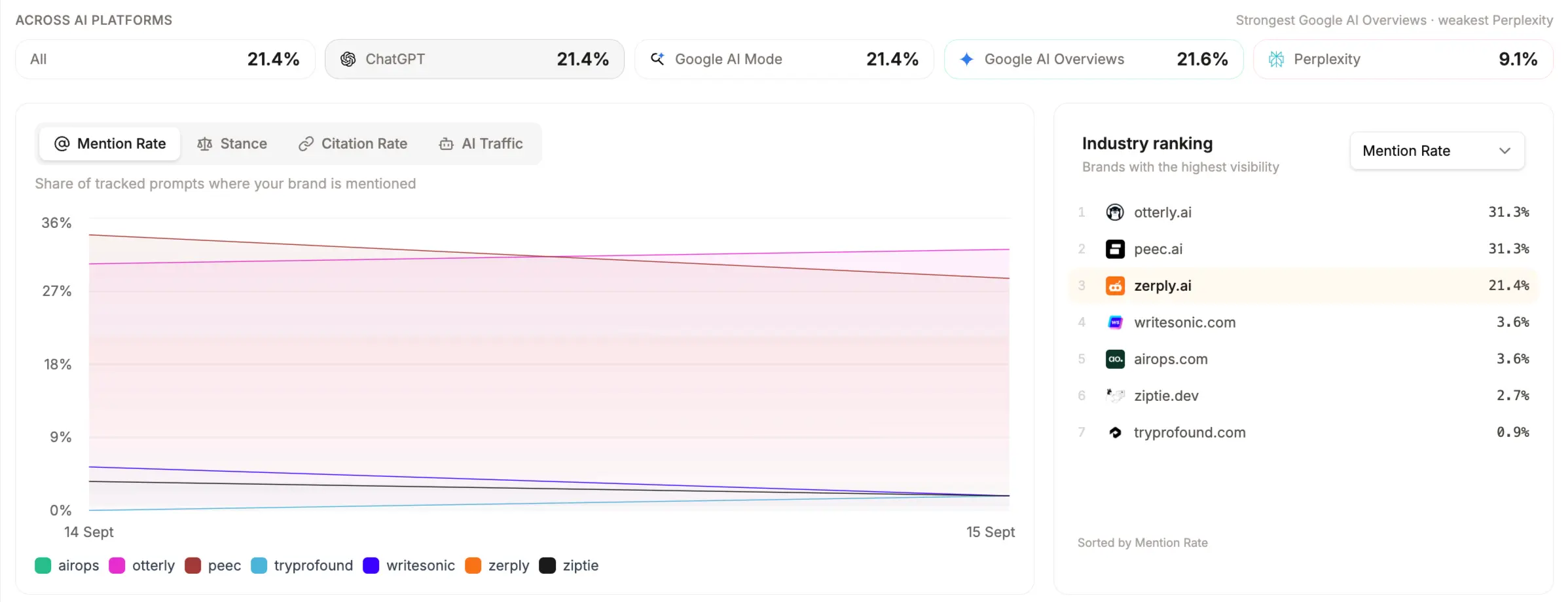
During a demo, use one high-intent prompt across every supported surface. Check whether you can view each answer independently. A blended score is useful for executives, but operators also need to see that a brand is strong in Perplexity and absent from Google AI Mode.
Zerply monitors any four of seven platforms daily on paid plans, chosen from ChatGPT, Google AI Overviews, Google AI Mode, Gemini, Perplexity, Copilot, and Grok. Claude and additional models are available on Enterprise.
Separate mentions, recommendations, and citations
Do not let a platform compress every AI-search outcome into one vague visibility score. A mention means the answer names your brand. A recommendation means it presents the brand as a relevant choice. A citation is a source URL used or displayed by the answer engine.
Those differences change the work your team should do next. A brand may be recommended without its website being cited. A page may be cited in an answer that recommends a competitor.
A low mention rate can point to weak category association, while strong mentions with weak recommendation prominence can point to positioning, proof, or authority gaps.
Competitor recommendations supported by third-party citations may call for digital PR, review-site work, or inclusion in independent category resources instead of another post on your own domain.
Strong AI citation tracking should expose the cited domain and page, originating prompt, engine, answer context, and run date. It should also let you compare owned citations with earned third-party sources and identify where citations are gained or lost.
Google confirms that its AI Search experiences surface links to websites within responses and continues to evolve how those links are presented. That makes prompt-level source records essential when evaluating visibility data.
Zerply’s source tracking shows which sources shape AI answers, including community, review, editorial, and owned content. Pair that view with an AI visibility audit to decide whether the next move is a page refresh, a new comparison asset, technical remediation, or third-party authority building.
The broader AI visibility allignement helps align stakeholders on what the channel includes.
Evaluate AI search competitor analysis in context
A share-of-voice percentage means little without a fixed comparison set. Fair AI search competitor analysis runs the same prompts, markets, surfaces, and dates for every brand.
Otherwise, a vendor may compare your unbranded category prompts with a competitor’s easier branded prompts and present the result as a benchmark.
Track three to five direct competitors and, if useful, one aspirational category leader. Then compare more than total mentions. Useful dimensions include recommendation position, co-mentions, citation wins and losses, source overlap, topic-level gaps, and movement by engine.
The output should answer operational questions. Which commercial prompt cluster are we losing? Which source supports the leader? Did a competitor surge on one engine or across the market?
Zerply compares share of voice against up to five competitors, tracks changes over time, and supports exports for stakeholder reporting. We recommend analyzing the content and authority signals behind competitor wins, then prioritizing the gaps with the largest strategic value.
Check sentiment, narrative accuracy, and hallucination evidence
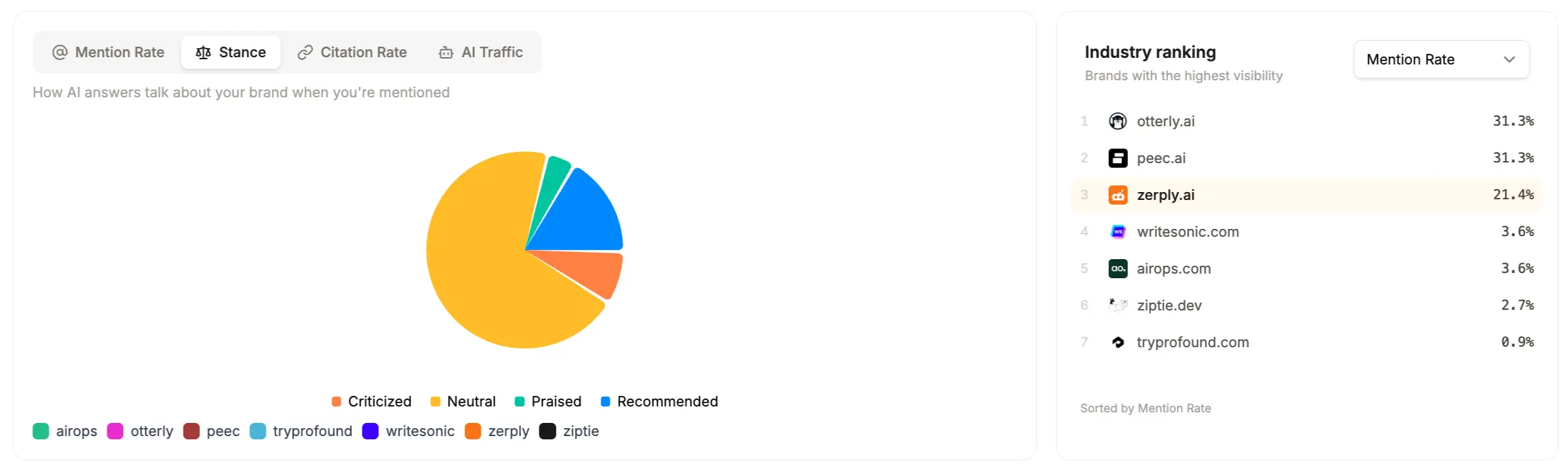
Visibility can rise while brand perception gets worse. Require the text behind every positive, neutral, or negative score.
Ask to see the exact sentence, prompt, engine, attribute, and date that produced the classification. The platform should help reviewers find outdated pricing, deprecated features, incorrect positioning, and recurring negative attributes.
Automated detection helps triage issues, but a knowledgeable human still needs to validate sentiment in context and compare suspected hallucinations with verified brand facts.
Zerply documents a sentiment score built from the adjectives and context used to describe a brand, with positive and negative attributes and hallucination detection.
During a trial, test it with a known false statement and a nuanced but accurate criticism. Confirm that reviewers can inspect the evidence instead of merely receiving an alert.
Connect AI search visibility tracking to traffic and revenue
Mentions, citations, sentiment, and share of voice are leading channel indicators. Revenue validation comes from signals such as branded and non-branded search demand in Google Search Console, identifiable AI-referral sessions and engagement in GA4, conversions, and CRM pipeline.
Use one timeline with annotations for major content, product, and PR changes. Look for sequences: a citation gain, sustained improvement across the fixed prompt panel, increased qualified sessions from identifiable AI referrers, and downstream conversion movement.
Correlation does not prove that the visibility gain caused the revenue, but it creates a stronger operating case than a standalone score.
An effective AI visibility dashboard should support three views. Channel health shows visibility and citation trends. Competitive risk shows where rivals are gaining. Business impact connects those changes with demand and conversion indicators.
Leadership gets a concise outcome view; operators retain prompt-level evidence.
Prefer a closed-loop workflow over passive monitoring
Many products stop after diagnosis. That leaves an SEO manager to export a report, interpret the gap, commission content, find a publishing workflow, and remember to rerun the original prompt panel later.
A closed-loop platform should support a tighter sequence: detect a losing prompt, inspect the answer and sources, identify the gap, create or optimize the right asset, publish it, and measure the same panel again.
Recommendations should cite the evidence that generated them. “Create more authoritative content” gives the team nothing specific to execute. “Create a comparison page because competitors are winning these three alternative prompts and this third-party guide is repeatedly cited” is something a team can act on.
Zerply goes beyond monitoring. Its AI visibility product documentation describes a handoff from a detected gap to its Blog Agent, and Foundry can publish the resulting page on the client’s own domain, closing the sequence without a separate CMS workflow.
Foundry is a paid add-on at $25 per month for 500 pages rather than a platform-plan feature, so price it into any comparison. Evaluate whether each automated action remains traceable to a real prompt, answer, and source gap.
Assess reporting, governance, integrations, and total cost
The right operational features depend on the buyer. Agencies may require multiple projects, white-labeled reporting, exports, and clean client separation. Enterprise teams may need role controls, SSO, audit logs, retention policies, procurement documentation, APIs, and defined support.
Verify each requirement against the exact plan and contract; an enterprise logo does not guarantee enterprise governance.
Our detailed comparison of AI visibility platforms for agencies prices multi-client configurations and the controls required to operate them.
Normalize cost instead of comparing headline prices. A practical denominator is:
monthly cost ÷ (prompts × AI surfaces × runs × markets)
Then add domain, seat, export, integration, retention, and onboarding fees. Verify the current plan documentation and contract for engine-gated tiers, add-on models, prompt credits, region fees, and content caps before comparing vendors.
A $99 plan that measures one surface may cost more per useful observation than a higher-priced multi-surface plan.
Use this weighted scorecard and 30-minute demo test
Use a common scorecard so every vendor is judged on the same evidence. Our suggested weighting gives methodology and raw evidence 25 points; engine, market, and cadence coverage 15; citations and sources 15; competitor analysis 10; sentiment and factual accuracy 10; integrations and business impact 10; activation workflows 10; and governance and cost 5.
This is Zerply’s suggested buying framework, not an industry standard.
Do not let a high total compensate for unverifiable data. Make raw evidence a pass/fail requirement.
A 30-minute demo can expose most weaknesses. Give each vendor the same five prompts: one category prompt, one use-case prompt, one comparison, one alternative query, and one branded validation question.
Inspect the full answer for one run. Trace one citation to its exact URL. Compare one competitor on the same settings. Find one questionable narrative. Turn one gap into a specific action. Export one report. Finally, calculate normalized cost using the volume your team needs.
The strongest platform will let an operator move from score to evidence to decision without leaving the workflow or asking the vendor to explain what the metric means.
Red flags and final recommendation
Disqualify black-box scores, snapshot-only reports, unclear collection methods, missing raw answers, mentions presented as citations, biased prompt panels, changing competitor sets, generic recommendations, and opaque credits.
Shortlist two platforms and test both with the same prompts, markets, competitors, and dates. Choose the product that makes every metric defensible and every meaningful gap actionable.
Zerply offers a no-commitment 7-day trial, so you can apply this framework to your own category before committing. That window is shorter than the evaluation this guide recommends, so prioritize the checks that matter most to your team: trace one citation, inspect one full answer, and turn one gap into a published action.
Run the same tests against every shortlisted vendor, including this one. Start a trial.
Frequently asked questions
What is the most important feature in an AI visibility platform?
Methodological transparency matters most. You should be able to inspect the tracked prompts, run settings, raw AI answers, cited URLs, dates, markets, and model or surface behind every aggregate score. Without that evidence, the platform’s visibility metrics cannot be audited or used confidently.
How many prompts should an AI visibility tool track?
There is no universal minimum. The prompt set should represent category discovery, problems, use cases, comparisons, alternatives, and branded validation across the markets you serve. Start with a focused, representative panel, then expand until each important buyer journey and prompt cluster has stable coverage.
What is the difference between an AI mention and an AI citation?
A mention occurs when an AI answer names your brand. A citation is a source URL the answer engine uses or displays. A recommendation goes further by presenting the brand as a relevant choice. Platforms should report these outcomes separately because each one points to a different optimization action.
How should companies measure ROI from AEO tools?
Track visibility signals alongside business data. Compare changes in mentions, citations, sentiment, and competitive share of voice with branded demand in Google Search Console, identifiable AI-referral engagement in GA4, conversions, and CRM pipeline. Use dated content and PR annotations, while avoiding unsupported claims of causation.
How often should AI visibility be tracked?
Use a consistent cadence that can separate normal answer volatility from sustained movement. Daily tracking is useful for active categories and rapid testing; weekly tracking may suit slower programs. Whatever cadence you choose, keep prompts, markets, surfaces, and competitor sets stable enough for valid trend comparisons.
Written by
Founder at Zerply.ai & Wittypen
Anshul is the founder of Zerply.ai and previously built Wittypen, a content marketplace powering SEO growth for 1,000+ businesses. Over the last decade he has worked hands-on with B2B SaaS and tech teams to turn search data into compounding organic growth. At Zerply he shares practical playbooks on AEO, AI visibility, and modern SEO that come directly from experiments, wins, and failures in real projects.