AI Prompt Taxonomy for Category Tracking

Direct answer: An AI prompt taxonomy is a labeling system for the prompts you track across AI answer engines. It groups each prompt by buyer decision, intent, funnel stage, audience, category, business value, and expected brand outcome so you can measure category tracking consistently over time.
Build the taxonomy before you scale tracking, or your reporting will overcount wording variations, blur branded and unbranded prompts, and hide the gaps that actually affect pipeline.
This article explains what AI Prompt taxonomy is in detail and how to measure it correctly.
Why is a prompt list not enough for category tracking?
A prompt list records questions. A taxonomy explains why each question belongs in your tracking program and what to do with the result.
let's take our own example. We are an AI Visibility platform, without that structure, a team counts “best AI visibility tools,” “top AI visibility tools,” and “which AI visibility tool should I use?” as three opportunities when they are one.
Then it drops “Is Zerply worth it?” into the same report.
That last one is the expensive mistake. Ask an engine about a brand by name and it will discuss the brand. The mention rate climbs, the dashboard looks healthy, and none of it says whether anyone gets pointed at you when they have not heard of you yet.
A prompt set heavy with your own name is a set that flatters you. Always keep brand-specific and brand-comparison prompts separate so they do not skew category reporting.
A taxonomy sorts questions by the decision behind them, and keeps apart the ones where a single modifier changes which vendors get named. “Best AI visibility tools” and “best AI visibility tools for agencies” are not the same question, and the second one has a shorter answer.
You can then measure category visibility, brand mentions, competitor presence, citations, sentiment, and AI share of voice by a meaningful prompt group.
This is also where prompt tracking differs from keyword tracking. Keyword tracking asks where a page ranks for a query. Prompt tracking asks how an answer engine responds to a natural-language question, which sources it cites, which brands it mentions, and how it frames the answer. That is why an AI prompt taxonomy matters for AI search tracking and answer engine optimization.
This matters because AI answers are not a fixed rank list. Google says its AI features can use related searches, sometimes called query fan-out, to answer a complex question, which means one prompt can trigger several related retrieval steps behind the scenes.
Google also advises publishers not to create separate pages just to capture every query variation. Build one useful, authoritative resource for a decision, then track a representative set of prompts around it. Google’s guidance on AI features and its generative AI optimization guide support that people-first approach.
Make your brand more visible in AI search
Understand where you appear, where competitors win, and what to improve next.
What fields belong in an AI prompt taxonomy?
Every prompt should carry enough labels that you can answer two questions about it later: which buyer decision does this sit inside, and what would a good result look like? Start with the core fields below. Keep definitions simple and apply them the same way across your team.
| Field | What it tells you | Illustrative value |
|---|---|---|
| Prompt | The exact question being checked. | Best AI visibility tools for agencies |
| Category | The market or solution space. | AI visibility tracking |
| Subcategory | The narrower topic. | Agency reporting |
| Intent | What the person needs: learn, compare, validate, act, or get help. | Compare |
| Funnel stage | Where the person is in the buyer journey. | Consideration |
| Audience | The role or segment that changes the answer. | Agency owner |
| Brand status | Whether the prompt names your brand. | Unbranded |
| Competitor status | Whether it names or asks about a competitor. | No named competitor |
| Platform | The answer engine and market context to check. | ChatGPT, U.S. English |
| Business priority | The expected value if visibility improves. | High |
| Tracking cadence | How often to run and review it. | Weekly |
| Expected brand outcome | What result would count as a useful answer for this prompt. | Mention plus relevant citation |
Add an expected brand outcome as a note or an extra field. For example, a category prompt may aim for a fair brand mention and a relevant supporting citation. A brand-evaluation prompt may aim for an accurate description of a feature or plan.
This small field is what turns a prompt list into a usable AI prompt management system because it tells the team what success should look like before the answers arrive. Do not assume either outcome will occur. The taxonomy states what you want to observe, not a guaranteed result.
For a useful AI visibility tracking program, also store the review date, prompt owner, and source of the idea. This creates an audit trail when a prompt is added, removed, or reclassified. For a closer look at what citation tracking measures, see how AI platforms cite sources differently.
Which prompt groups should you include for category tracking?
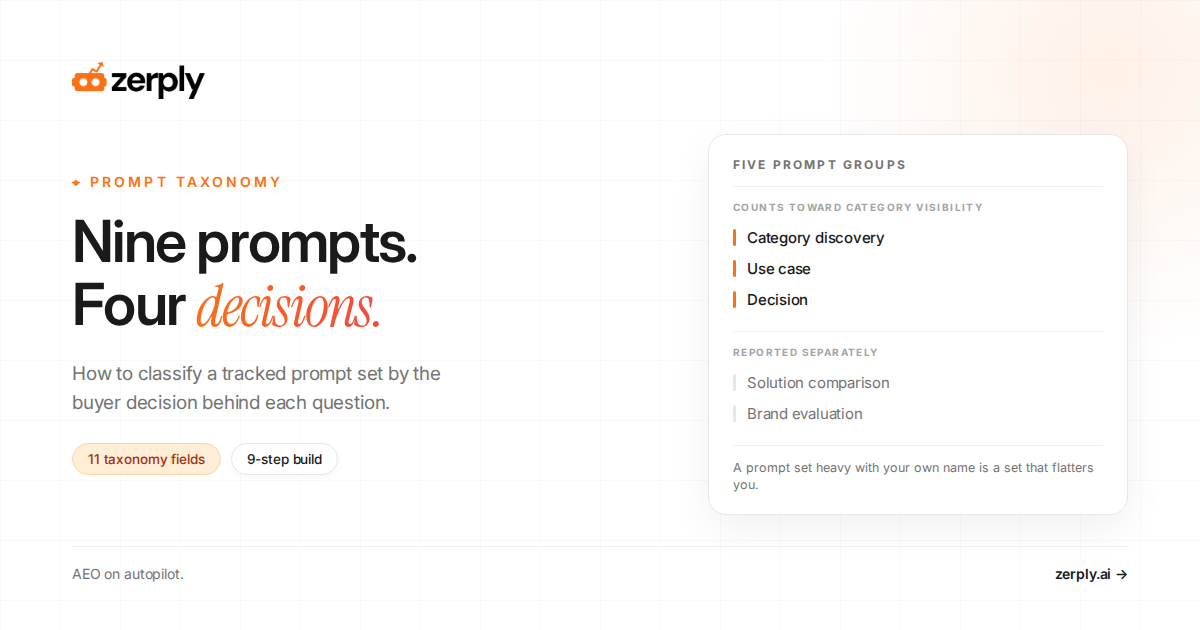
A balanced prompt taxonomy covers the category before it covers your brand. Use these five groups.
Category-discovery prompts show how people learn about the space. An example is “best AI visibility tools.” They test whether your brand appears when a buyer has not chosen vendors.
Use-case prompts add a real job and audience. An example is “how can agencies track AI mentions?” These often surface the proof, workflow, or content format a buyer needs.
Solution-comparison prompts compare options or approaches. “Zerply vs [competitor]” is an example. Keep this group separate from unbranded category reporting because the brand name shapes the answer.
Brand-evaluation prompts test how answer engines describe your company, products, pricing, and claims. Examples include “Is Zerply suitable for an SEO agency?” or “What does Zerply do?”
Decision prompts show a near-term buying choice. “Best platform for AI visibility tracking” is one example. Mark these high priority when the audience and category match your commercial goals.
What this looks like on a real set
Here is a starting list an agency-focused team might pull from sales calls and search data before any classification:
best AI visibility tools
top AI visibility tools 2026
which AI visibility tool should I use
how do agencies track AI mentions for clients
Zerply vs Profound
is Zerply worth it
AI visibility tool with white-label reporting
what is AI share of voice
how do I report AI visibility to a client
Nine prompts. Sorted, they are four decisions.
The first three ask the same question in three registers and collapse into one category-discovery prompt. Keep the other two as variation notes and track one. Two are agency use-case prompts, and the white-label one is worth keeping separate because that modifier changes which vendors an engine names.
Two are branded. “Zerply vs Profound” is solution-comparison. “Is Zerply worth it” is brand-evaluation. Neither belongs in the category score. One is a definition question and one is a retention question, and they should never appear in the same rollup.
The flat list suggested nine opportunities. The taxonomy shows four decisions, two of which are already branded, so real category coverage is thinner than the list implied. That gap is the point of doing this.
These are illustrative prompts, not tracked data or evidence of any answer engine response.
See how your brand shows up in AI search
Track visibility, citations, prompts, and competitors across leading AI platforms.
How do prompts map to the marketing funnel?
Tag each prompt by the next decision a person is trying to make. This helps your team avoid treating a broad definition question and a vendor comparison as the same opportunity.
| Funnel stage | Questions users ask | Expected AI response type | Key metric to monitor | Marketing action |
|---|---|---|---|---|
| Awareness | What is AI visibility tracking? Why does it matter? | Definition, explanation, examples | Citation presence and accuracy | Strengthen a clear educational guide and internal links. |
| Consideration | How can agencies track AI mentions? What tools exist? | Options, criteria, use cases | Brand mention rate and competitor presence | Publish or improve use-case and category-comparison content. |
| Decision | What is the best platform for AI visibility tracking? | Shortlist, recommendation, trade-offs | Mention rate, citation tracking, and share of voice | Review decision pages, evidence, and comparison positioning. |
| Retention | How do I report AI visibility to clients? | Steps, setup help, best practices | Accuracy, sentiment, and citation of help content | Improve documentation, templates, and customer education. |
A prompt can include more than one intent. Assign one primary stage based on the first useful action a marketing team should take. Keep brand status as a separate field even after you map funnel stage. That is what keeps honest category tracking separate from AI brand monitoring.
How to build a prompt tracking framework in nine steps
Build the framework in nine steps. Start small enough to maintain it, then expand only when a new prompt represents a new buyer decision.
1. Define the business category and audience
Write one sentence that states the category, audience, and goal. For example: “We want to measure visibility for AI visibility tracking among U.S. marketing leaders and agencies evaluating software.” This prevents unrelated prompts from entering the set.
2. Collect real customer questions and category terms
Use sales calls, support tickets, demo notes, site search, customer interviews, reviews, and search-query data. Add category terms from your SEO research. Keep the buyer's wording, and translate internal product terms only when consistency requires it.
3. Separate category, brand, and competitor prompts
Create distinct labels for unbranded category prompts, prompts that mention your brand, and prompts that mention a competitor. This makes AI brand monitoring more honest. You can report all three groups, but do not combine them into one category visibility score. Competitor prompts earn their place because the engine is already putting your brand in a list with three others. You may as well know which three.
4. Classify intent and funnel stage
Assign one primary intent: informational, use case, comparison, validation, or support. Then assign awareness, consideration, decision, or retention. Add audience only when it changes the likely answer, such as agency owner, SEO lead, or enterprise marketing manager. Skip this and every report is an average across people at completely different moments, which is the same as no report.
5. Identify high-value decision prompts
Give each prompt a business priority: high, medium, or low. High-priority prompts usually reflect a buyer choosing a solution, comparing vendors, or checking a fact that affects a purchase. Priority reflects the business value of being represented accurately in that decision, which is a different thing from how often the question gets asked.
6. Remove duplicates without losing useful context
Combine prompts that ask for the same decision and expected answer. Keep a separate version when a modifier materially changes the buyer need, such as “for agencies,” “for enterprise teams,” or “with client reporting.” The test is whether the two prompts would send you to do different work. If not, they are one prompt.
7. Assign platforms and tracking cadence
Use a shared core set across the answer engines your audience uses. Then add platform-specific wording only when the intent changes. Check high-priority decision and accuracy prompts weekly. Check stable, lower-priority awareness prompts monthly. Recheck material changes after a product launch, major category shift, or new competitor entry. Weekly on everything is how a tracking program dies in month three. Cadence is a maintenance decision as much as a measurement one.
8. Run a documented baseline
Before making claims about improvement, run the same classified prompts and record:
- Date, platform, and market
- Prompt text as run
- Brand mentions and competitors mentioned
- Visible citations
- Sentiment
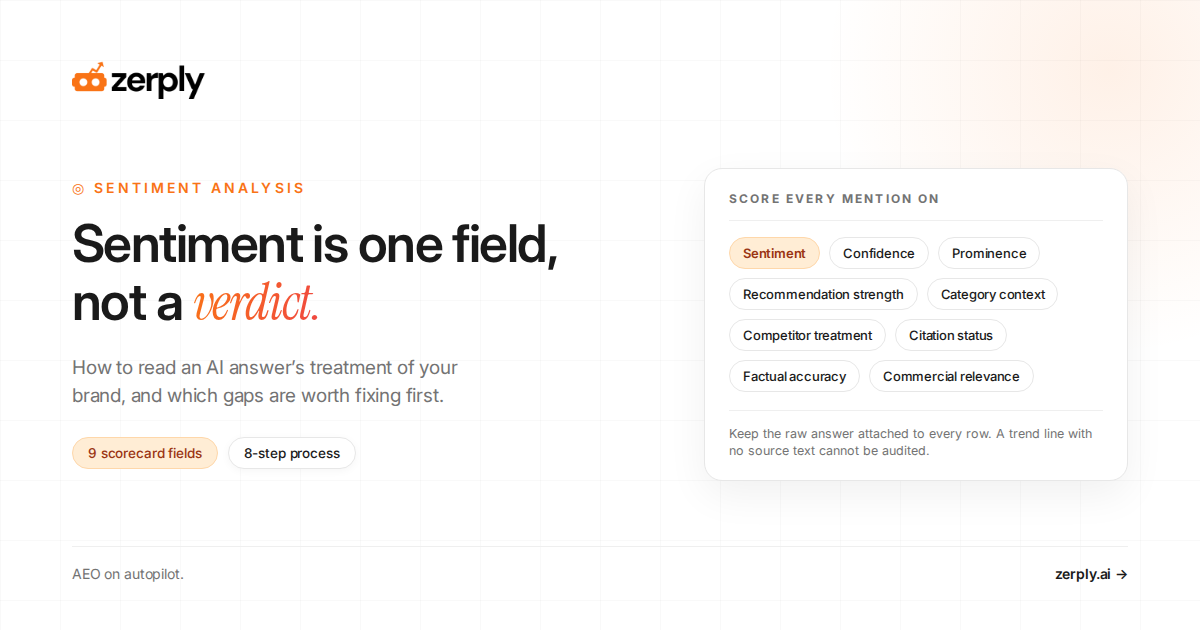
For the sentiment field, see our guide to tracking LLM sentiment.
Then log the conditions that can change an answer: account state, location, language, time of day, response mode, and any conversation context that carried over. Platform outputs can vary. Use the baseline as a reference point and avoid treating it as a performance promise.
The NIST AI RMF Playbook suggests choosing measures that suit the purpose and context, documenting test conditions, and revisiting metrics as those conditions change. It is voluntary guidance rather than a standard, but the discipline transfers.
9. Review the taxonomy quarterly
Review every group at least once a quarter. Retire prompts that no longer map to a real buyer decision. Add prompts for new products, audiences, competitors, objections, or language your sales team now hears. Confirm that your categories and priority rules still match the business. A taxonomy nobody prunes becomes a list again, slowly.
See how your brand shows up in AI search
Track visibility, citations, prompts, and competitors across leading AI platforms.
How many prompts should you track?
Track enough prompts to represent your category and buyer journey, but not so many that no one can interpret the data. The ranges below are practical starting recommendations, not universal benchmarks.
- Early-stage program: 15 to 25 prompts. A small set covering category, use case, branded, competitor, and decision questions.
- Focused category program: 25 to 40 prompts. Enough to cover core intent and the audience modifiers that change an answer.
- Multi-product business: 50 to 100 prompts. Split into separate product and use-case groups.
- Enterprise or agency portfolio: 100 to 250 or more. Organized into distinct product, market, client, or account taxonomies.
Add a new prompt only when it represents a new buyer decision, audience modifier, objection, or competitor context that would change the work your team does next. If it would not change the content, page, or narrative you need to improve, it is usually a note, not a new tracked prompt.
What mistakes weaken an AI prompt taxonomy?
The most common mistake is tracking branded prompts as if they measure category visibility. They do not. A question that names your company can still be useful for brand monitoring, but it belongs in its own group.
The second mistake is treating every wording variation as a separate opportunity. That inflates the prompt count, crowds the report, and makes small phrasing changes look like strategy. Keep separate rows only when the modifier changes intent, audience, or commercial value.
Another problem is mixing unrelated buyer journeys. Definition questions, vendor comparisons, implementation questions, and customer support prompts should not roll up into one headline score. The report gets cleaner the moment each group maps to one real decision.
Teams also weaken the taxonomy when they ignore competitors, skip business priority, or never prune the list. If a competitor appears in the category, track that reality. If a prompt would influence revenue faster than another, label it that way. If a prompt no longer matches how buyers search, retire it.
How can you operationalize the taxonomy?
Give the taxonomy an owner, a review cadence, and a documented source of truth. Usually that means one person maintains the prompt set, logs why prompts were added or removed, and makes sure quarterly reviews actually happen. Without ownership, the taxonomy turns back into a spreadsheet of half-remembered ideas.
An AI visibility audit is a good way to validate the starting set before you scale reporting. Run a baseline, check whether prompts are grouped consistently, and confirm that each group maps to a business question someone will act on.
If you are evaluating AI prompt management tools, this is the operational test: can the system standardize the same AI search prompts across answer engines, keep the classification intact, and organize mention, citation, sentiment, and competitive share-of-voice evidence by prompt group? That is what turns AI citation tracking and AI search tracking into something a team can manage every week.
If you use a platform such as Zerply, keep the business context attached to each group and review the output against your AI visibility and AI SEO KPIs, not as one blended dashboard number. The tool should support the taxonomy, not replace the thinking behind it.
Conclusion
A strong AI prompt taxonomy tracks buyer decisions, not every phrase a person might type. It separates category visibility from brand and competitor monitoring, assigns a business priority, and creates a consistent baseline for review.
That makes it useful for both SEO planning and answer engine optimization because you can see which questions deserve a category page, a comparison asset, or better supporting proof. Keep it current, focused, and tied to a clear owner.
Audit or formalize the taxonomy before you expand the prompt set. Done properly, it tells you where you are absent. A long spreadsheet only tells you where you looked.
Know where your brand stands in AI
Monitor your visibility across ChatGPT, Google AI Overviews, Gemini, and more.
Frequently asked questions
What is an AI prompt taxonomy?
An AI prompt taxonomy is a repeatable system for labeling AI search prompts by category, intent, funnel stage, audience, priority, platform, and expected brand outcome. It turns a raw list into a tracking framework.
How is prompt tracking different from keyword tracking?
Keyword tracking measures visibility in search results. Prompt tracking measures how AI answer engines respond to natural-language questions, including brand mentions, competitor presence, citations, and sentiment.
Should branded prompts be included in category tracking?
Yes, but keep them in a separate branded group. A prompt that names your brand can inflate category visibility metrics because the answer engine already has the brand name in the question.
How often should you update a prompt taxonomy?
Review high-priority prompts weekly or as business changes require. Review the full taxonomy quarterly to add new buyer questions, competitors, products, and category language, and to retire stale prompts.
What metrics should an AI prompt taxonomy measure?
Track brand mention rate, competitor presence, visible citations, sentiment, and share of voice. Report them by prompt group, funnel stage, platform, and business priority rather than as one blended score.
Written by
Founder, Zerply.ai & Wittypen
Preetesh Jain is the Founder of Zerply.ai and Wittypen. He specializes in SEO, Answer Engine Optimization (AEO), AI search visibility, content marketing, and product development. Through his work building AI-powered marketing platforms, he helps businesses improve their organic presence across Google, ChatGPT, Perplexity, Claude, and other emerging discovery channels. He regularly writes about AI search, organic growth, content strategy, and the future of digital marketing.