Top 15 AI visibility platforms for marketing agencies managing multiple client brands

AI visibility platforms for marketing agencies have moved beyond simple ChatGPT mention checks. The best platforms help an agency monitor multiple client brands, compare competitors across answer engines, explain why AI systems cite certain sources, and turn those findings into client-ready SEO, AEO, content, and reporting work.
That agency layer matters because AI answers shift by prompt wording, model, location, collection method, and date. A tool that works for one brand can become expensive or difficult to manage across 10, 25, or 100 clients. Agencies need separate workspaces, reproducible prompt sets, credible reporting, predictable portfolio costs, and a clear path from an AI visibility finding to completed work.
This guide compares 15 AI visibility platforms for marketing agencies against those requirements. The short answer: Zerply is the best fit for execution-led agencies that want AI visibility tracking, SEO research, content production, and publishing in one workflow. Peec AI is particularly strong for pitch-to-client operations, OtterlyAI offers a clear multi-workspace path, and Profound fits enterprise intelligence programs.
Zerply publishes this comparison and ranks first for execution-led agencies based on the methodology below. Agency use of Zerply requires Enterprise because Starter, Pro, and Business each track one brand or domain.
Product and pricing details were checked against official vendor pages on September 2, 2026. Prices are monthly list prices unless marked annual-effective. Where a vendor does not publish pricing, we say so rather than estimate. Vendor-defined visibility scores are not standardized accuracy benchmarks.
TL:DR which AI visibility platform should an agency choose?
For most agencies, the right AI visibility platform depends on the service model.
- Choose Zerply Enterprise if the agency sells AI visibility, SEO research, content execution, and publishing as one joined workflow.
- Choose Peec AI if the agency needs prospect baselines, isolated client projects, and pitch-ready reporting.
- Choose OtterlyAI if the agency wants an accessible multi-workspace monitoring setup.
- Choose Profound if the client expects enterprise AI-search intelligence, governance, and analyst-led interpretation.
What is an AI visibility platform for agencies?
An AI visibility platform for agencies is software that tracks how client brands, competitors, and source URLs appear in AI-generated answers from systems such as ChatGPT, Google AI Overviews, Google AI Mode, Gemini, Perplexity, Copilot, and Grok. The best AI visibility platforms for marketing agencies add multi-client workspaces, repeatable prompt monitoring, citation analysis, reporting exports, and an execution workflow so teams can improve visibility rather than only measure it.
How we evaluated AI visibility software for agencies
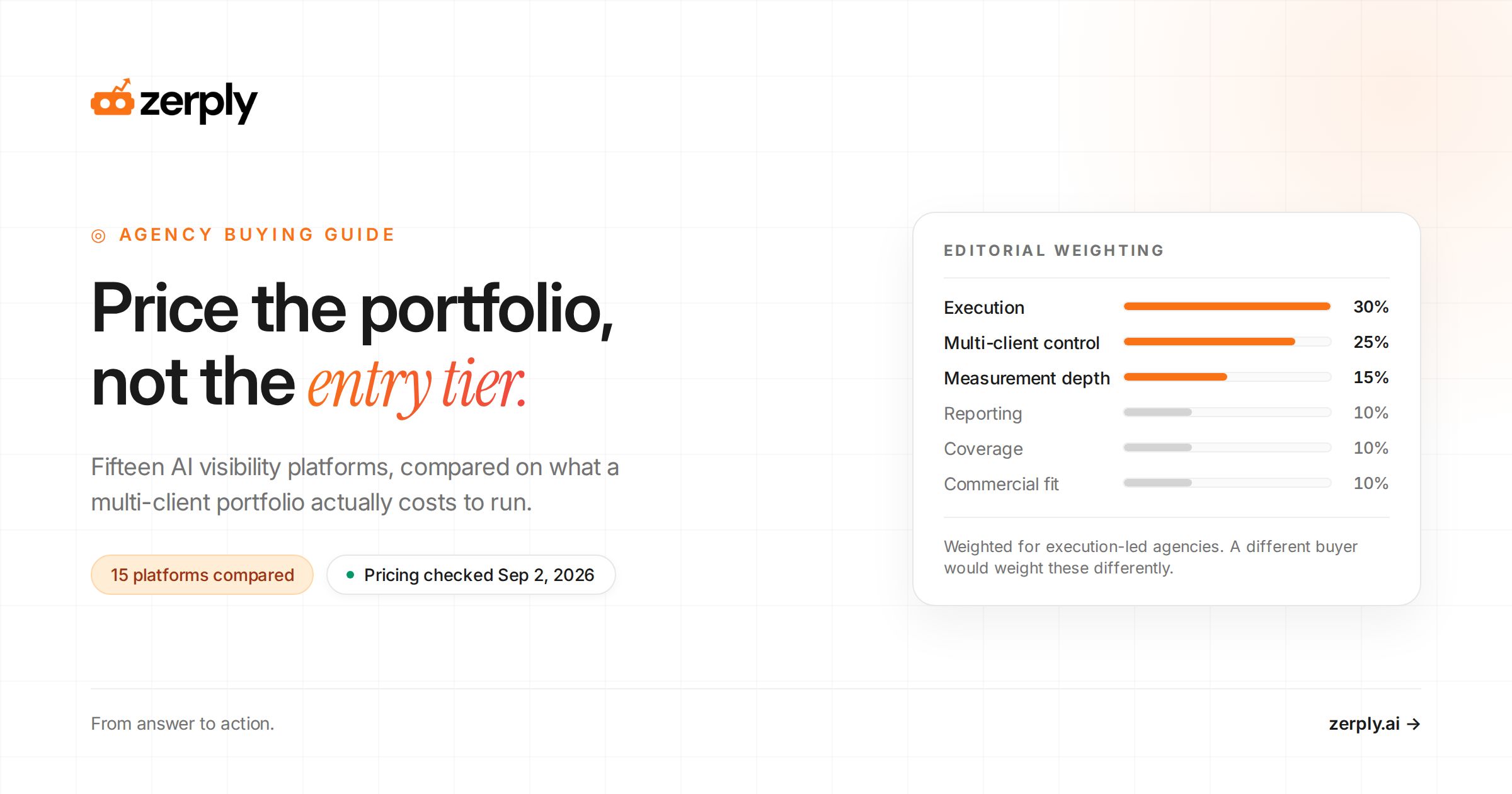
We assessed each platform against six operating criteria. The order is optimized for execution-led agencies, not every possible buyer. Execution receives 30% of the editorial weight, multi-client control 25%, measurement depth 15%, and reporting, coverage, and commercial fit 10% each. These weights explain the ranking but are not a claim that every buyer should choose the same order.
Multi-client control covers separate workspaces, account switching, seats, permissions, client access, and portfolio views. Coverage includes answer engines, countries, languages, personas, and collection cadence. Measurement depth covers mention rate, recommendation position, share of voice, stance or sentiment, citations, source URLs, competitors, and history. Measuring brand visibility in LLM-powered search explains why mentions, answer position, and citation coverage answer different questions.
Reporting and portability cover scheduled reports, white labeling, exports, APIs, BI connectors, retention, and client-ready access. Execution asks whether a platform turns a gap into a brief, page update, technical action, digital PR target, or published asset. Commercial fit includes prompts, credits, engines, seats, workspaces, refresh frequency, support, and governance.
Why AI visibility scores cannot be compared across vendors
A visibility score is not a universal search ranking. Vendors can use different prompt wording, model versions, APIs or consumer interfaces, sampling methods, locations, and refresh schedules. Use a score to monitor direction inside one controlled setup. Do not compare a 62 in one platform with a 48 in another and assume the first is more accurate.
Best AI visibility platforms for marketing agencies: quick comparison
| Platform | Best for | Included engine coverage on cited tier | Client brands / workspaces | Price signal | Free trial |
|---|---|---|---|---|---|
| Zerply | Execution-led SEO and AEO delivery | Any 4 of 7 paid-plan platforms | 1; Enterprise for multi-brand | Agency pricing is custom | 7 days |
| Profound | Enterprise intelligence | 1 on Starter; 3 on Growth | Multi-company is Enterprise | Not publicly listed | Not stated |
| Writesonic | Content-heavy GEO programs | 3 on Starter; 10 on Enterprise | 1 project on Starter | From $79/month billed annually | Yes, length not stated |
| Peec AI | Pitch-to-client reporting | Select models; premium models on Scale+ | Unlimited projects; 3 to 10 client seats | Agency plans from $205 | Yes, length not stated |
| OtterlyAI | Accessible multi-workspace reporting | 4 core; 3 paid add-ons | 1 on Lite; unlimited from Standard | From $29; agency-relevant Standard $189 | 7 days |
| AirOps | Custom content operations | Coverage varies by configuration | Confirm with vendor | Custom pricing, sales contact required | Not stated |
| Scrunch AI | Agent experience and governance | Cross-engine monitoring | Enterprise configuration | Custom pricing, sales contact required | Not stated |
| AthenaHQ | Broad enterprise coverage | 10 on Starter | Enterprise for multi-region and custom configuration | Starter $295 | Not stated |
| Semrush | Existing Semrush workflows | ChatGPT, Google AI, Gemini, Perplexity | Per-domain pricing is the key constraint | $99/month per domain, billed annually | No |
| SE Visible | SE Ranking-centric agencies | 5 | 3 / 5 / 10 projects | From $99 | 10 days |
| Gumshoe | Persona-led testing | 6 models per paid audit | Confirm with vendor | From $99 | One free sample audit |
| Qwairy | Integration-heavy delivery | 10+ | 1 / 5 / 20; unlimited Enterprise | From €79 | Yes, length not stated |
| Geneo | Branded portals on Agency tier | 4 | 1 on Pro; unlimited Agency | Pro $39.90; Agency quote required | Free 50-credit trial |
| ZipTie.dev | Focused source analysis | 3 | One seat on every published tier | From $69 | 14 days |
| Rankscale | Broad coverage and dashboard capacity | Credit-based across 17+ stated engines | 10 / 50 / 100 dashboards on Pro+ | From $20; agency tier $385 | 7-day Pro trial |
Pricing checked against official vendor pages on September 7, 2026. Figures are monthly list price unless marked annual-effective. The engine column reflects the cited tier or plan note in the row, not every engine a vendor may support on Enterprise or through add-ons. Credit-based platforms scale with prompts × engines × run frequency, so entry prices are not directly comparable. Verify current terms before purchase.
If your team is also comparing AI visibility tools for agencies against single-brand products, see our wider market view of the best AI visibility tools.
Top 15 AI visibility platforms for marketing agencies in 2026
1. Zerply: best overall for AI visibility platforms for marketing agencies that execute, not just report
Best for: Agencies combining AI visibility, SEO research, content production, and deployment under one operating model.
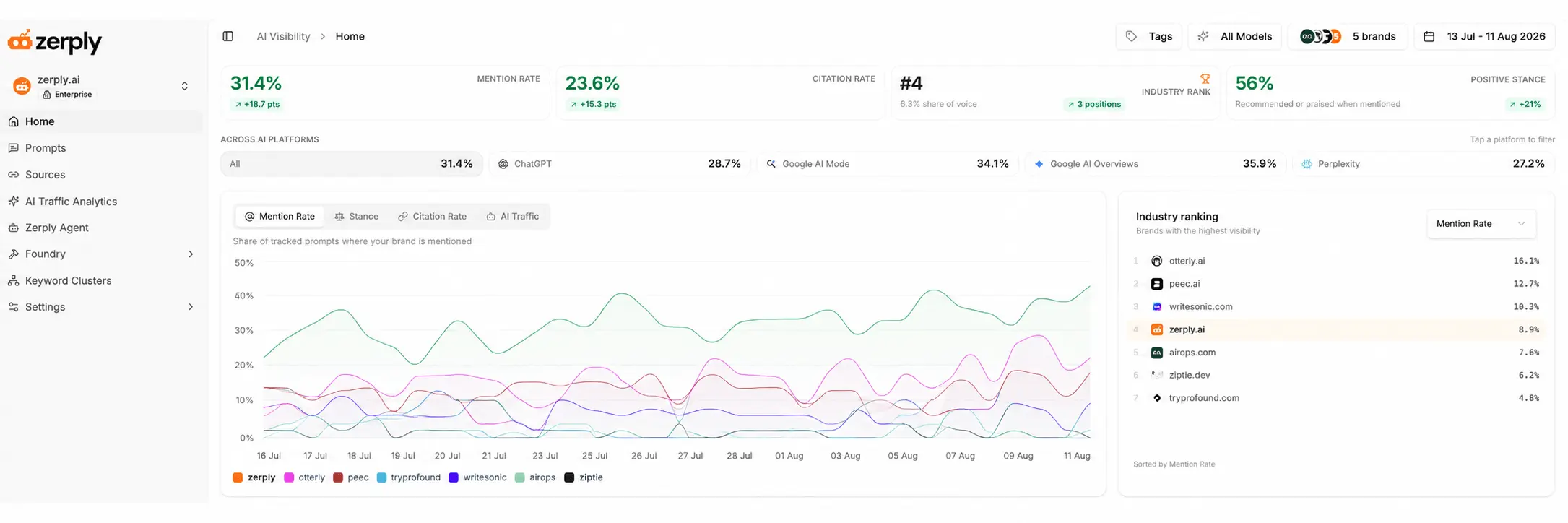
Zerply is built for agencies that do not want AI visibility tracking to stop at a dashboard. It tracks daily prompts on any four of seven paid-plan platforms: ChatGPT, Google AI Overviews, Google AI Mode, Gemini, Perplexity, Copilot, and Grok.
Claude and additional models are available on Enterprise. That makes it a strong fit when client teams need to monitor brand mentions, citations, competitors, and search demand in the same workflow.
Its AI visibility tracking platform connects Citation Tracking and competitive visibility with GSC, GA4, keyword research, keyword clustering, backlink research, content agents, and AI Traffic Analytics. For agencies selling AI visibility tracking for agencies as an execution service, the main advantage is that findings can become briefs, draft updates, published pages, and follow-up measurement without moving through a pile of separate tools.
Pros
- The shared workflow reduces handoffs between diagnosis, research, drafting, and measurement.
- Foundry can publish on a client's domain as a paid add-on, extending the workflow into deployment.
- First-party search and analytics integrations help teams connect AI visibility with existing SEO evidence.
Cons
- Starter, Pro, and Business each track one brand or domain, so an agency portfolio requires Enterprise.
- Agencies that only need a lightweight monitoring dashboard may not need the full research, content, and publishing workflow.
Pricing
Multi-brand agency use requires custom-priced Enterprise; the $41 Starter, $166 Pro, and $249 Business plans are single-brand plans. Foundry is $25/month for 500 pages, and 100 additional AI Agent credits cost $20/month.
See how your brand shows up in AI search
Track visibility, citations, prompts, and competitors across leading AI platforms.
2. Profound: best enterprise AI search visibility platform
Best for: Large agencies and enterprise clients with dedicated AI-search analysts.
Profound fits programs where AI visibility is treated as market intelligence rather than a side report. It combines prompt-demand research, answer-engine analysis, source intelligence, agent analytics, and marketing agents, which can support senior stakeholders who want to know how AI systems frame a brand across categories, competitors, and markets.
Its segmentation and governance orientation suit complex programs in which narrative, citations, markets, and executive communication all matter. For an agency managing large clients, Profound is strongest when there is analyst time available to interpret the data and turn it into recommendations, not when the client only wants a simple monthly score.
Pros
- Starter, Growth, and Enterprise create a progression from basic monitoring to analyst-grade coverage.
- Growth adds exports and three engines, while Enterprise expands engine coverage and governance.
- The product is well matched to clients that care about AI-search intelligence, source influence, and executive reporting.
Cons
- Starter tracks ChatGPT only, which is narrow for a cross-engine agency deliverable.
- Multiple companies, API access, SSO/SAML, and SOC 2 requirements sit on Enterprise.
- Agencies need analyst capacity to explain the findings, otherwise the data can outpace the delivery model.
Pricing
Plans are billed annually, but current dollar figures are not publicly listed. Agency cost rises with prompt, response, seat, and multi-company requirements.
3. Writesonic: best AI visibility software for agencies with content-heavy GEO programs
Best for: Agencies that already sell high-volume content strategy, creation, and optimization.
Writesonic is most useful for agencies that see AI visibility as an extension of content operations. Its tracker covers visibility, citations, sentiment, competitors, and prompt-level performance, while its action layer helps teams move from a visibility gap into content and technical tasks.
Because Writesonic already has a content-production environment, it can work well for GEO programs where the agency needs to create, update, and optimize a lot of assets. The fit is weaker if the agency's main requirement is client workspace control, governance, and multi-brand reporting across a large portfolio.
Pros
- Monitoring and content production sit closer together than in a tracker-only product.
- The action workflow can help a delivery team move from a visibility gap to a content task.
- It suits agencies that already package AI visibility software for agencies with content creation and optimization.
Cons
- The published Starter tier has one project, so multi-client agencies need to validate Enterprise project and access configuration.
- Agencies need to test governance and review controls before scaling generated content across clients.
- Content speed can create quality risk if the team lacks a strong editorial and approval process.
Pricing
Starter is listed at $79/month billed annually and includes 50 prompts, 50 daily answers, three AI platforms, one user, and one project. Agency cost depends on the number of projects, users, required engines, and whether Enterprise is needed for all-platform coverage.
4. Peec AI: best for pitch-to-client operations and reporting
Best for: Agencies that need prospect baselines, isolated projects, client access, and repeatable reporting.
Peec is designed around a familiar agency motion: prove the problem, convert the prospect, then monitor the client in a separate project. Pitch projects can become client projects, which makes it useful for teams that use AI visibility gaps in sales conversations before turning them into retainers.
The platform also supports reporting through summaries, Looker Studio, CSV, and API access on eligible plans. For agencies that need AI visibility tools for agencies with repeatable reporting and clear project separation, Peec's credit model is easier to explain than many response-based or custom-priced alternatives.
Pros
- Unlimited projects make it possible to separate client prompt sets and competitors.
- Agency plans include client seats and pitch projects.
- The credit formula is transparent: one prompt times one model times one day equals one credit.
Cons
- Every project has a 900-credit minimum, making very small clients uneconomical.
- Looker Studio, API access, and premium-model access depend on plan.
- Agencies with many low-budget clients may need to standardize prompt sets tightly to control credit use.
Pricing
Agency plans start at $205/month for 10,000 credits, about 111 prompts at three models daily, three client seats, and 25 pitch projects. Cost rises with models and cadence.
Is ChatGPT recommending your competitors instead of you?
See where your brand appears, who is winning visibility, and what you can do about it.
5. OtterlyAI: best for accessible multi-workspace reporting
Best for: Small and mid-sized agencies launching a standardized monitoring service.
OtterlyAI is a practical choice for agencies that want to package AI visibility monitoring without building a complex enterprise program first. It covers prompt research, citations, sentiment, competitor comparison, reports, and a Looker Studio connection on eligible tiers.
Standard and above include unlimited workspaces, which is the main reason OtterlyAI belongs in an agency comparison. It can support a clean multi-client setup, although teams need to account for add-on engines if their AI brand visibility platform requirements include Gemini, AI Mode, and Claude.
Pros
- Unlimited workspaces begin on Standard rather than an enterprise contract.
- Unlimited team members are included across published tiers.
- Core coverage includes ChatGPT, AI Overviews, Perplexity, and Copilot.
Cons
- Lite includes one workspace and is not a realistic multi-client agency plan.
- Gemini, AI Mode, and Claude are paid add-ons.
- Extra prompts cost $99 per 100, so larger portfolios need prompt discipline.
Pricing
Lite starts at $29/month for 15 prompts, while agency-relevant Standard costs $189 for 100 prompts and unlimited workspaces. Full engine coverage costs more because Gemini, AI Mode, and Claude are add-ons.
6. AirOps: best for custom AI-search content operations
Best for: Agencies building tailored workflows around AI-search, SEO, analytics, and content data.
AirOps is better understood as a workflow builder for search and content operations than as a simple AI visibility scorecard. It can connect monitoring, SEO inputs, analytics, and content actions into a process that reflects the agency's delivery model.
That flexibility matters for agencies with strong internal systems. A team can design a workflow that detects a visibility gap, prioritizes an update, executes the change, and measures the result. It is less suited to agencies that want a ready-made AI search monitoring tool with minimal setup.
Pros
- Configurability supports differentiated agency delivery rather than a generic dashboard.
- AI visibility, SEO, and analytics evidence can inform the same operating process.
- It can support complex content operations where the agency already has clear processes and QA standards.
Cons
- Implementation requires process ownership, data discipline, and quality assurance.
- Teams seeking an immediate packaged scorecard may find it too open-ended.
- The value depends heavily on how well the agency designs and maintains its workflows.
Pricing
Custom pricing, sales contact required. The agency cost driver is implementation scope plus the volume of workflows, data, and client programs being operated.
Make your brand more visible in AI search
Understand where you appear, where competitors win, and what to improve next.
7. Scrunch AI: best for agent experience and enterprise governance
Best for: Enterprise agencies addressing both brand visibility and how AI agents consume client websites.
Scrunch goes beyond checking whether a client appears in a prompt response. It combines brand and citation monitoring with AI-agent traffic analysis, site interpretation, and an Agent Experience Platform, which can help agencies understand how AI systems and agents read client sites.
That broader agent-experience angle makes Scrunch more relevant for enterprise programs than basic monitoring retainers. It can support AI brand monitoring tools use cases, but the strongest fit is an agency that also advises clients on governance, site accessibility for AI agents, and structured digital presence.
Pros
- The platform looks beyond prompt visibility to how agents access and interpret content.
- Enterprise capabilities include role-based access, SSO, onboarding, and API integration.
- It supports agencies that want to build a deeper agent-experience service, not just a dashboard report.
Cons
- The breadth can be excessive for smaller monitoring retainers.
- Agencies need a defined agent-experience service to justify the implementation overhead.
- Smaller teams may find procurement, onboarding, and stakeholder education heavy for early-stage AI visibility offers.
Pricing
Custom pricing, sales contact required. Agency cost depends on enterprise governance, integrations, site scope, and the number of client programs.
8. AthenaHQ: best for broad enterprise coverage
Best for: Enterprise and multi-brand programs that need broad model coverage and executive reporting.
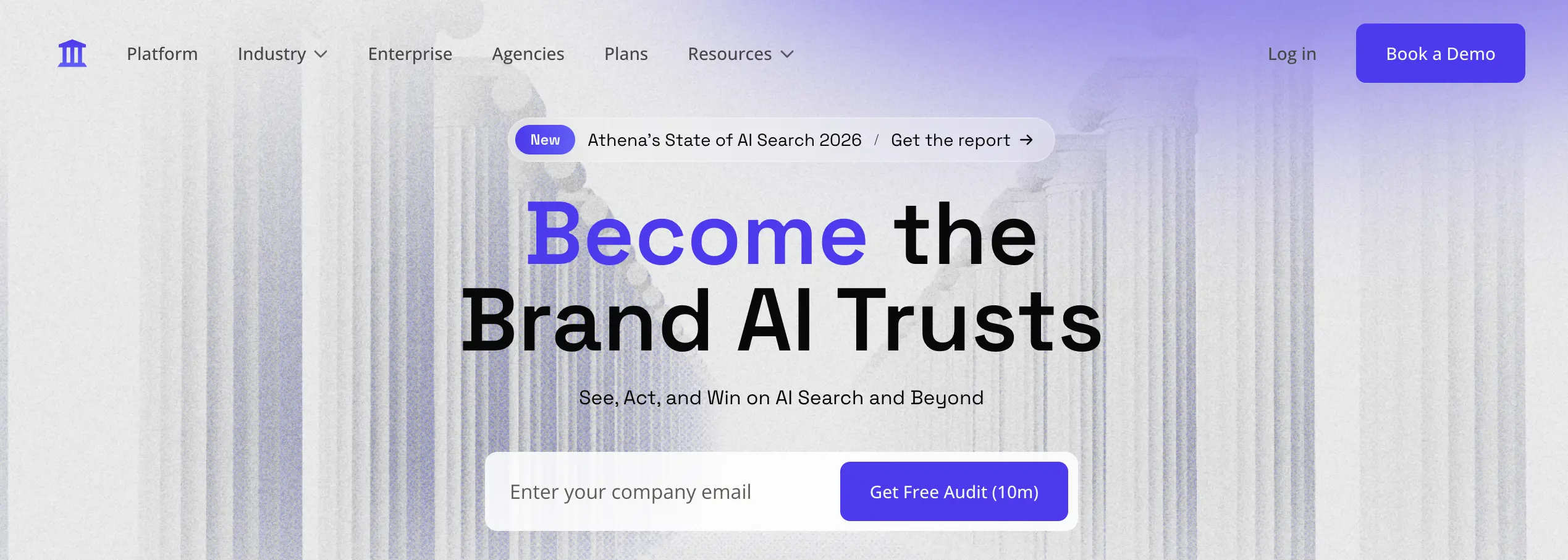
AthenaHQ is positioned for teams that want to watch a wide set of AI surfaces and turn that coverage into boardroom-ready visibility analysis. It advertises coverage across major AI models alongside citation analysis, competitive intelligence, content gaps, recommendations, and executive dashboards.
For agencies, AthenaHQ makes sense when the client believes buyers use many different assistants and markets. The trade-off is operational: more engines create more data to explain, so the agency needs a clear method for deciding which findings matter and which are noise.
Pros
- Broad model coverage supports clients whose buyers use a fragmented set of assistants.
- Enterprise options include BI support, SSO, audit logs, personas, and market controls.
- The executive-dashboard angle can help agencies package findings for senior client stakeholders.
Cons
- More engines create more observations and review work, not automatically more useful insight.
- Agencies need governance that defines which models matter for each client.
- Starter can be useful for a pilot, but portfolio and regional needs may move buyers toward Enterprise.
Pricing
Starter is $295/month for 3,600 credits, with one credit equaling one AI response, 10 model surfaces, and unlimited seats. Agency portfolio, multi-region, and custom-control requirements move to Enterprise.
9. Semrush: best for agencies already using Semrush
Best for: Agencies that want AI visibility inside an established SEO research and reporting environment.
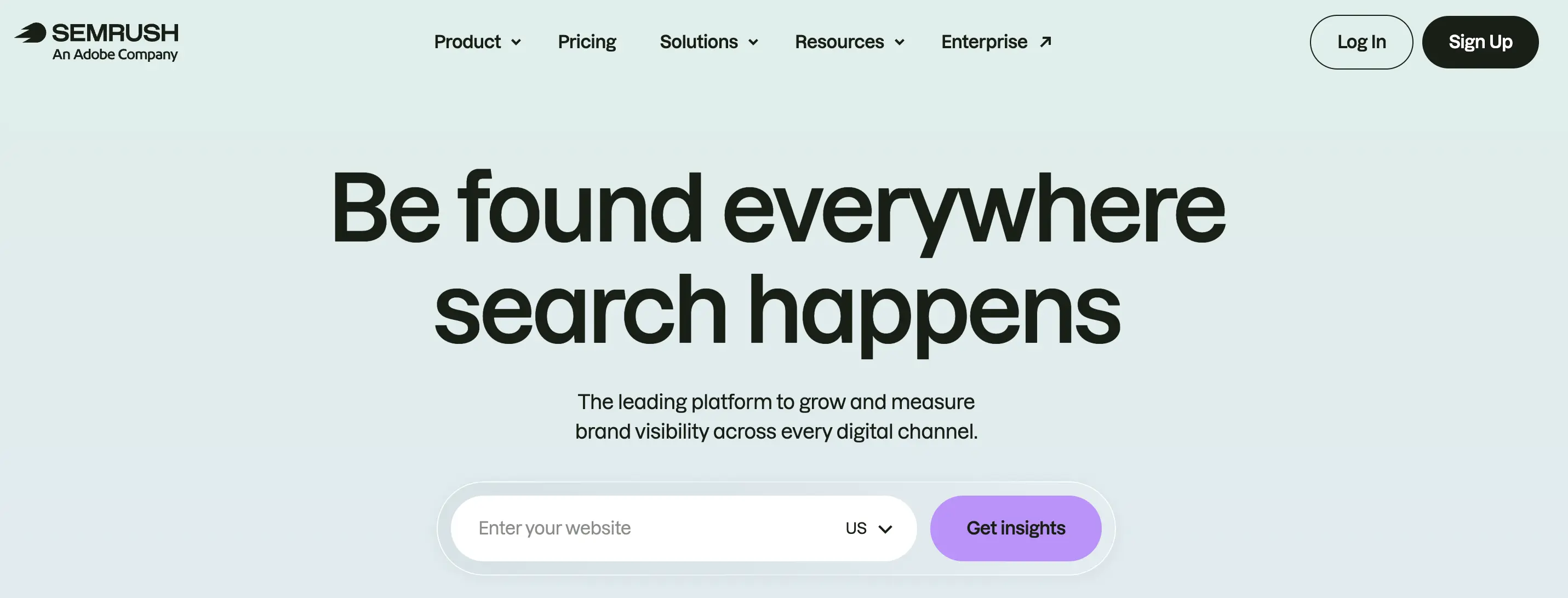
Semrush is strongest for agencies that already run keyword research, competitor analysis, audits, and reporting inside the Semrush ecosystem. Adding AI visibility there can reduce training time and keep AI findings close to conventional SEO work.
The main question is whether the AI visibility dataset and per-domain pricing match the agency's client model. For some teams, the convenience of one environment is enough. For others, per-domain pricing and prompt limits may make a specialized AI search visibility platform more cost-effective.
Pros
- Existing Semrush agencies can reduce training and vendor-switching costs.
- AI findings can sit beside conventional search research and technical audits.
- The familiar interface can make it easier to introduce AI visibility reporting to account teams.
Cons
- Per-domain pricing can make a multi-client book much more expensive than a single-domain headline implies.
- Consolidation only helps if the AI dataset meets the agency's delivery standard.
- Agencies may still need separate execution workflows if findings require content production or publishing outside Semrush.
Pricing
AI Visibility Toolkit Base is $99/month per domain when billed annually, including 25 custom prompts, one Brand Performance domain, and mentions from ChatGPT, Google AI, Gemini, and Perplexity. Agency cost scales by client domain, prompt add-ons, users, and reporting needs.
10. SE Visible by SE Ranking: best AI brand monitoring tool for SE Ranking-centric agencies
Best for: Agencies that want AI visibility beside an existing SE Ranking workflow.
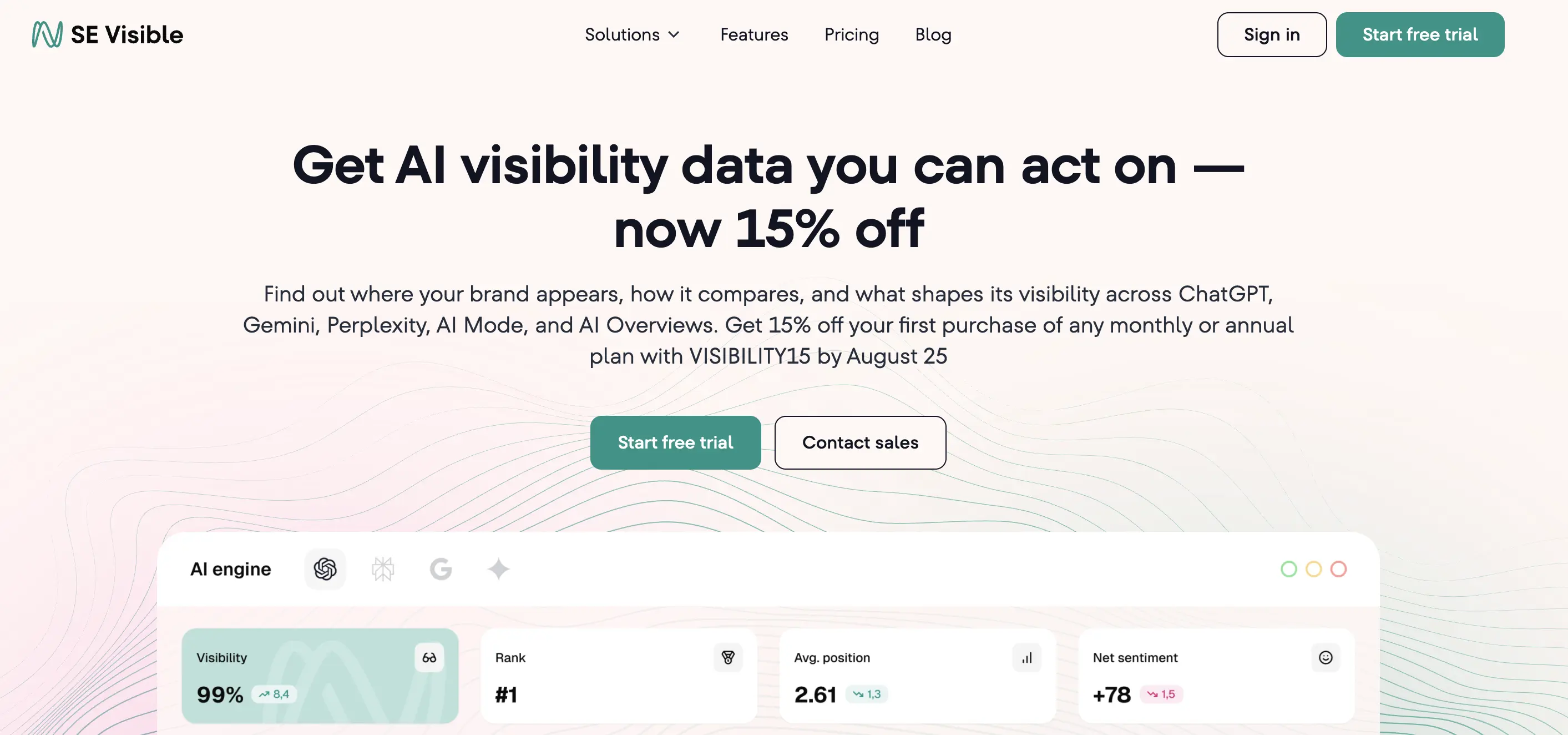
SE Visible is a natural fit for teams already using SE Ranking for SEO delivery and reporting. It tracks ChatGPT, Gemini, Google AI Mode, Perplexity, and Google AI Overviews, giving agencies coverage across the AI search surfaces many clients now ask about.
Its value is strongest when the agency wants a straightforward packaged service: defined projects, included engines, clear prompt allowances, and a trial period for setup. The limits are equally clear, especially around countries, languages, and project counts.
Pros
- All published tiers include the same five engines.
- Project allowances scale clearly from 3 to 10.
- A 10-day trial supports a focused setup and reporting test.
Cons
- Coverage is limited to seven countries and five languages.
- Basic includes only three projects, so a 10-client agency needs Plus.
- Agencies serving broader international portfolios may outgrow the market and language limits quickly.
Pricing
Basic costs $99/month for 200 prompts and three projects; Core is $189 for 450 prompts and five projects; Plus is $355 for 1,000 prompts and 10 projects. Annual-effective prices are $79, $151, and $284.
Know where your brand stands in AI
Monitor your visibility across ChatGPT, Google AI Overviews, Gemini, and more.
11. Gumshoe: best for persona-led AI visibility testing
Best for: Agencies that need to test how recommendations vary by buyer type.
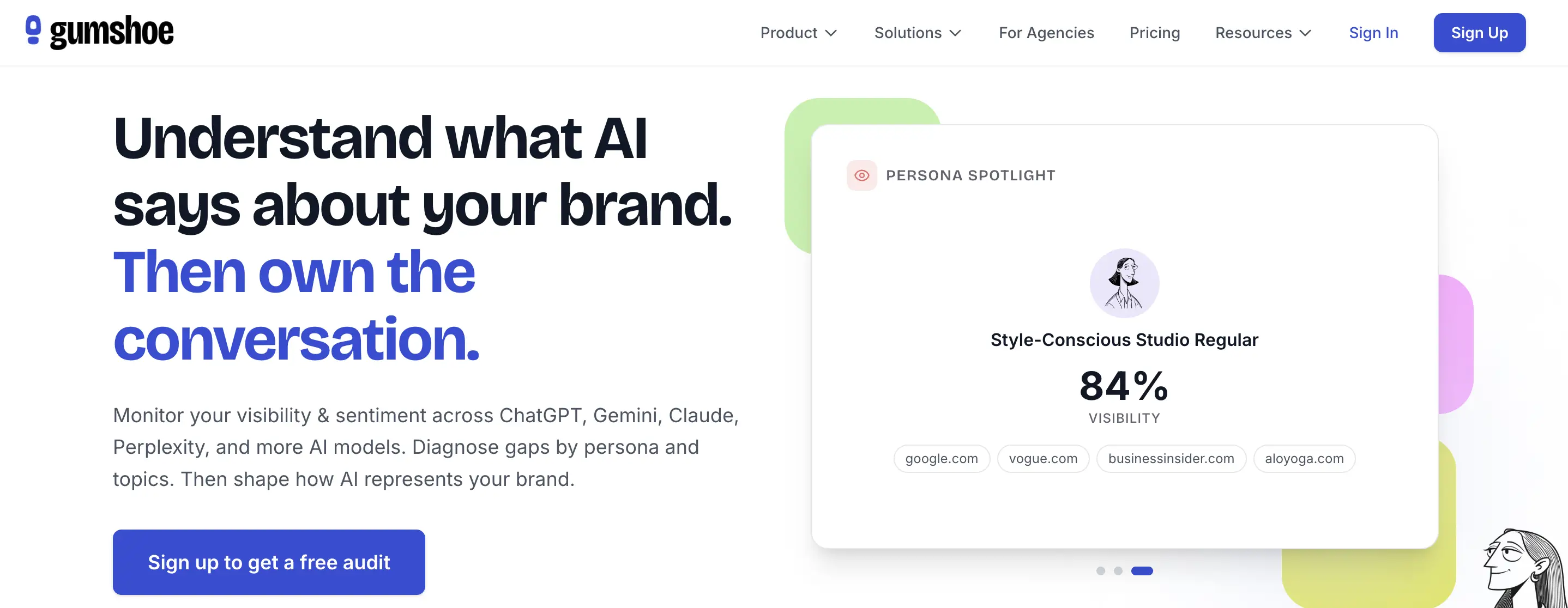
Gumshoe's strongest idea is that AI recommendations change when the buyer context changes. Instead of treating every prompt as context-free, it runs conversations as buyer personas, which can show whether executives, practitioners, and first-time buyers receive different recommendations.
That makes Gumshoe useful for agencies selling strategy, positioning, or category narrative work alongside AI visibility monitoring. The methodology can produce richer insight than fixed-prompt checks, but it also requires the agency to document persona assumptions carefully.
Pros
- Persona-led testing can reveal recommendation differences between executives, practitioners, and first-time buyers.
- Pitch audits and shareable reporting can support new business.
- Scheduled audits, exports, and API access can support a repeatable service once the methodology is defined.
Cons
- Persona assumptions require documentation to keep reports repeatable and defensible.
- Richer methodology creates more interpretation work than basic fixed-prompt monitoring.
- It may be more than a client needs if the retainer only promises basic brand mention tracking.
Pricing
Starter is $99/month and Pro is $299/month. Each paid monthly Visibility Audit can run up to 480 conversations, using eight personas, 10 prompts each, and six models. Agency cost depends on the number of client organizations and audit cadence.
12. Qwairy: best for integration-heavy delivery, with white labeling on Enterprise
Best for: Agencies that need isolated workspaces and flexible data connections; fully branded delivery requires Enterprise.
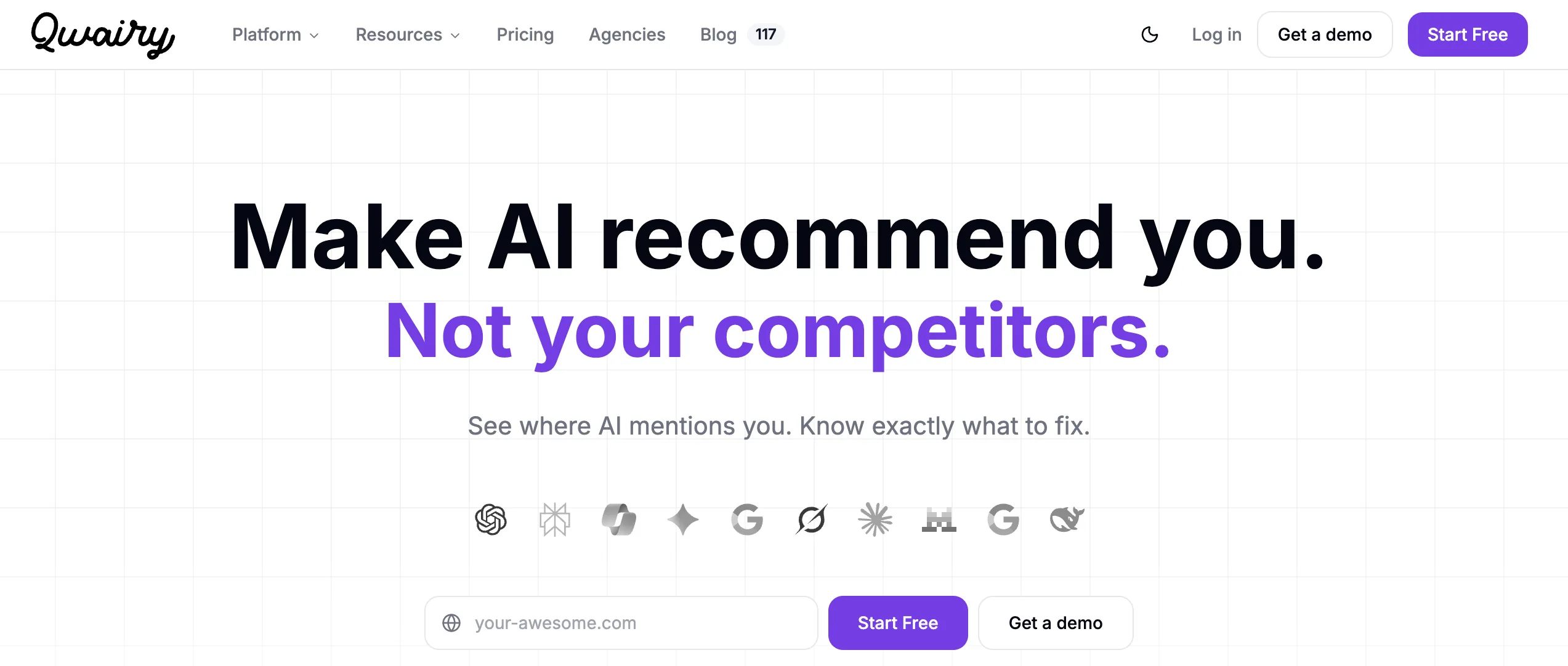
Qwairy is a strong candidate for agencies that care about coverage, workspace separation, and data movement. It combines monitoring across more than 10 engines with workspaces, viewer access, benchmarking, sentiment, citations, action briefs, exports, API access, MCP, and webhooks.
That combination makes it useful for integration-heavy delivery teams that want AI search monitoring tools connected to other reporting or workflow systems. Agencies should check the white-label requirement early, because branded dashboards, custom domains, and SSO sit on Enterprise.
Pros
- Published plans scale from 1 to 5 to 20 workspaces before Enterprise.
- All tiers state 10+ engines, 240+ countries, 45+ languages, and unlimited team members.
- API access, MCP, and webhooks make it attractive for agencies with custom reporting stacks.
Cons
- White-label dashboard, custom domain, and SSO are Enterprise-only.
- A five-workspace Growth plan cannot separate a 10-client book.
- Broad coverage still needs editorial judgment, otherwise reports can become too noisy for clients.
Pricing
Starter is €79/month for 100 prompts and one workspace; Growth is €199 for 300 and five; Business is €449 for 800 and 20. Annual-effective prices are €65, €165, and €374, while Enterprise is custom.
13. Geneo: best for a branded client portal on Agency tier
Best for: Agencies productizing GEO under their own domain and visual identity.
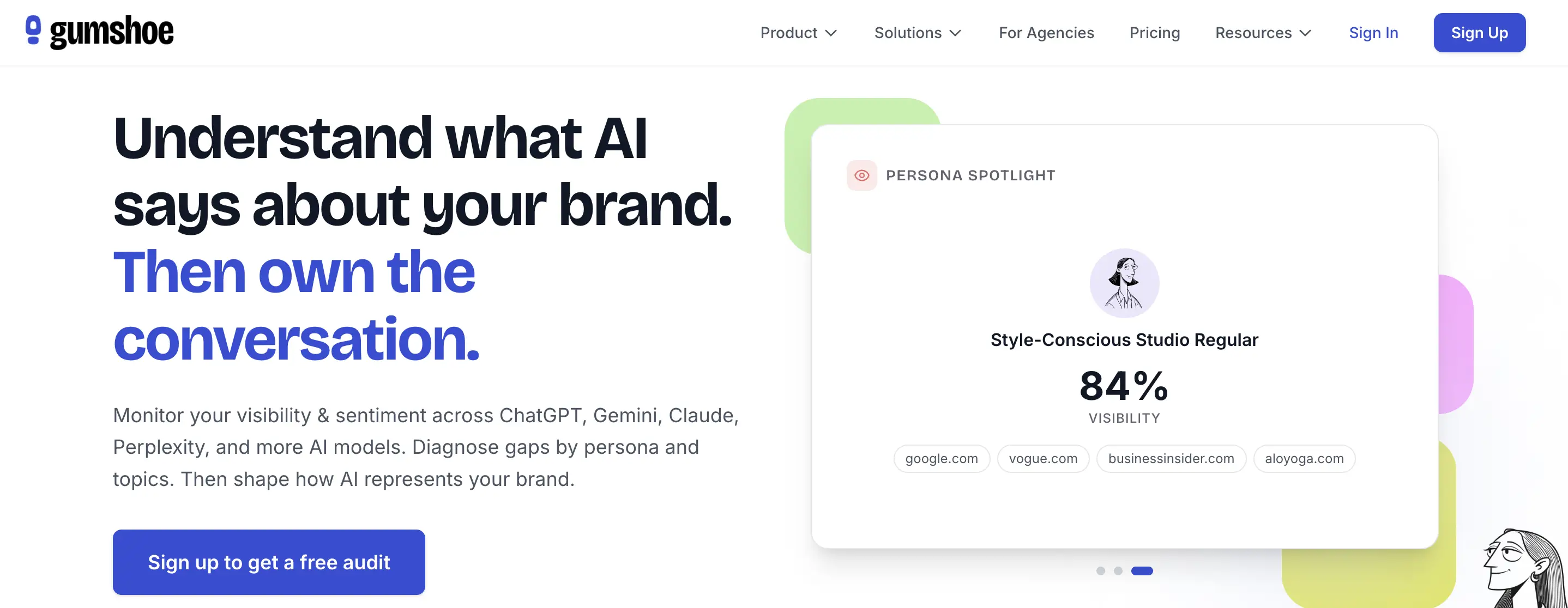
Geneo is relevant when the client experience matters as much as the monitoring itself. Its agency proposition centers on separate clients and branded delivery, which can help an agency present GEO as its own packaged service rather than a third-party dashboard.
The platform tracks ChatGPT, Perplexity, Google AI Overviews, and Gemini. For agencies building an AI brand visibility platform around client portals, Geneo's Agency tier is the real product to evaluate, not the lower Pro tier.
Pros
- Agency Starter provides unlimited workspaces and 2,500 or more credits.
- Branded dashboards can make the service feel native to the agency.
- Separate client workspaces support productized GEO delivery.
Cons
- Pro has one workspace, so its $39.90 price is not an agency portfolio price.
- White-label branding, custom domain, client portal, and client seats require Agency.
- Agencies need to confirm Agency pricing before promising branded delivery margins.
Pricing
Pro costs $39.90/month for 1,000 credits and one workspace, while the Agency price is not published. Credit packs range from $50 for 1,000 to $900 for 30,000, but branded multi-client delivery still requires Agency.
14. ZipTie.dev: best for focused technical AI-search and source analysis
Best for: Technical SEO teams focused on Google AI Overviews, ChatGPT, and Perplexity.
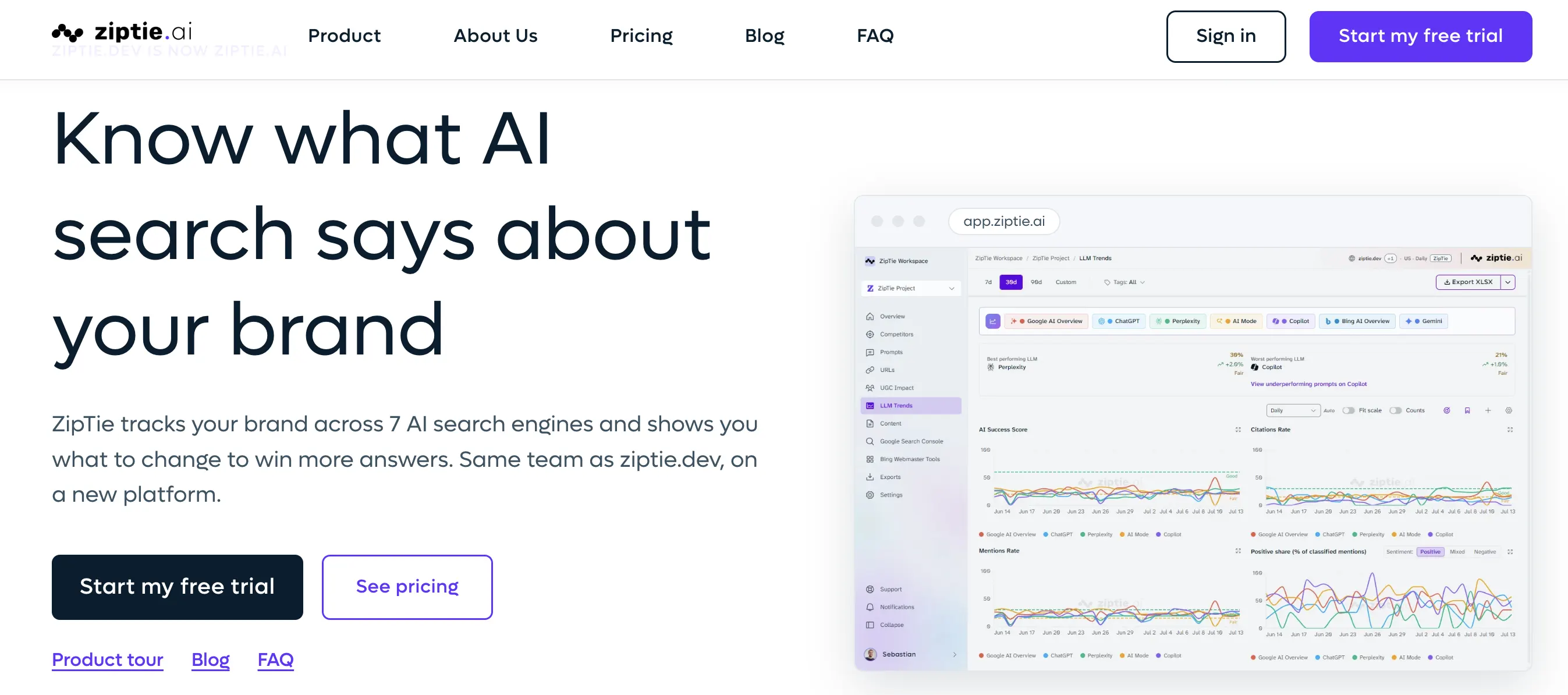
ZipTie.dev is a focused option for technical SEO teams that want to understand mentions, sentiment, citations, response history, competitors, regional results, and the sources shaping answers. It does not try to cover every model or become a broad content operations system.
That narrower scope can be useful when the agency's offer is specific: monitor a defined set of AI search surfaces, analyze the sources influencing responses, and advise on technical or content fixes. It is less suited to larger account teams because every published tier includes only one seat.
Pros
- Straightforward plans make search-volume capacity easier to understand.
- Regional monitoring covers 14 countries.
- A 14-day trial with 75 searches supports a controlled pilot.
Cons
- Every published tier includes only one seat, which is restrictive for an agency team.
- Coverage is limited to three engines.
- Agencies needing client portals, multiple analyst seats, or broad model coverage may need another system.
Pricing
Basic costs $69/month for 500 AI searches, Standard is $99 for 1,000, and Pro is $159 for 2,000. Annual billing saves 15%, but each published tier still has one seat.
15. Rankscale: best for broad engine coverage and dashboard capacity
Best for: Agencies that want broad engine choice and clearly tiered brand-dashboard allowances.
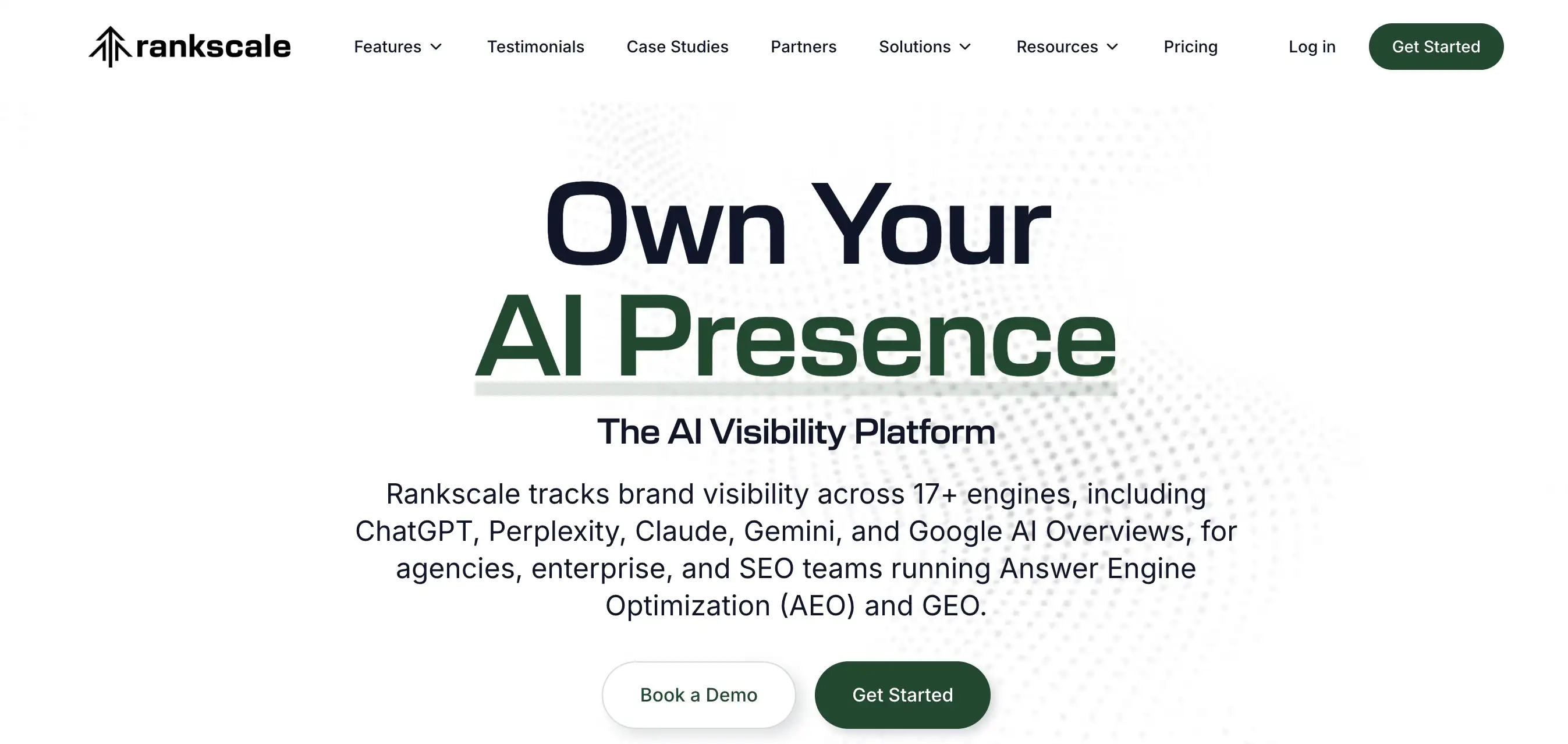
Rankscale is appealing for agencies that want a lot of model coverage and a clear dashboard allowance by tier. It promotes coverage across more than 17 engines with citations, competitors, history, site analysis, and optimization recommendations.
The platform's published dashboard capacity gives agencies a visible path from a smaller client book to a larger portfolio. The trade-off is credit planning, especially when the engine mix includes higher-cost models such as Claude.
Pros
- Pro, Growth, and Enterprise include 10, 50, and 100 brand dashboards.
- Growth adds white-label dashboards and the agency program.
- Broad stated engine coverage gives agencies room to tailor monitoring by client category.
Cons
- Claude consumes two credits versus about 0.25 for a standard engine, an eightfold difference.
- The $20 Essentials entry is not the agency product; Growth is the designated agency tier.
- Agencies need to model credit use before promising broad daily tracking across many clients.
Pricing
Essentials starts at $20, Pro is $99 for 1,200 credits and 10 dashboards, Growth is $385 for 5,500 and 50, and Enterprise is $780 for 12,000 and 100. Annual billing saves 15%; agencies needing white labeling should budget from Growth.
The agency pricing trap vendors rarely state plainly
Most of this category is not priced per agency. It is priced per brand, workspace, project, prompt, engine, response, search, or credit. Those units interact, so a low entry price can be irrelevant to an agency buyer.
The clearest examples include vendors that market agency use while reserving the necessary operating controls for higher tiers. Zerply's Starter, Pro, and Business plans each track one brand or domain; multi-brand work requires Enterprise. Qwairy offers useful workspace capacity below Enterprise, but white-label dashboards, custom domains, and SSO remain Enterprise-only. Geneo's $39.90 Pro plan has one workspace, while white-labeling, client seats, and the branded portal require Agency pricing that is not publicly shown.
An agency should price the smallest configuration that can run the whole delivery model, not the cheapest plan shown on the page. Include client separation, analyst and client seats, all required engines, prompt cadence, exports, BI or API access, history, branded delivery, and analyst cleanup time.
What six platforms cost for a 10-client book
Consider a realistic profile: 10 clients, 30 prompts per client, four standard engines, and daily collection over a 30-day month.
10 clients × 30 prompts × 4 engines × 30 days = 36,000 monthly observations
This is a normalized workload, not a claim that every vendor bills in observations. Peec counts each prompt-model-day as a credit, while Rankscale debits credits by engine.
Zerply counts tracked prompt slots across the selected platforms, so the same agency profile needs 300 tracked prompts, not 36,000 separately purchased prompt-model-day credits.
OtterlyAI, SE Visible, and Qwairy publish configured-prompt and workspace allowances rather than a directly comparable per-observation debit, so their rows confirm portfolio capacity but do not prove identical daily sampling or billing for all 36,000 observations.
The table identifies the smallest verified monthly tier that appears to fit the configured prompts and workspace requirement without unverified overages. Prices exclude taxes, currency conversion, implementation, premium-model add-ons unless stated, and analyst labor.
| Platform | Capacity-fit tier | Monthly price | Why it fits | Material constraint |
|---|---|---|---|---|
| Zerply | Enterprise | Custom; public annual-rate capacity floor ≈$311/mo | 300 prompt slots cover 10 clients × 30 prompts; the floor uses 300 ÷ 200 Business-plan prompt capacity × $207.50 annual monthly equivalent | Multi-brand agency use still requires an Enterprise quote; this is capacity math, not a contract price |
| Peec AI | Scale | $675/mo | 65,000 credits cover 36,000 standard-model observations | Seven client seats; premium engines and API start here |
| OtterlyAI | Premium | $489/mo | 400 prompts and unlimited workspaces cover 300 prompts across 10 clients | Assumes the four core engines; add-on engines raise cost |
| SE Visible | Plus | $355/mo | 1,000 prompts, 10 projects, and five included engines | Seven countries and five languages |
| Qwairy | Business | €449/mo | 800 prompts and 20 workspaces cover the portfolio | White labeling, custom domain, and SSO still require Enterprise |
| Rankscale | Enterprise | $780/mo | Four standard engines use about 9,000 credits, within the 12,000-credit allowance | Claude would raise consumption sharply; model assumes four standard engines |
Zerply's capacity math is the most affordable public benchmark in this model because 10 clients times 30 prompts requires 300 tracked prompt slots. Business includes 200 prompt slots at $249 monthly, or $207.50 as a monthly equivalent on annual billing, so 300 prompt slots map to about $311.25 in public-rate capacity before Enterprise packaging.
Peec's calculation is direct because one prompt times one model times one day equals one credit. Rankscale is different: a standard engine costs about 0.25 credit, so 36,000 observations use approximately 9,000 credits.
Claude costs two credits per prompt, so replacing one standard engine with Claude would push the same workload to roughly 24,750 credits and beyond the published Enterprise allowance.
How agencies should choose an AI visibility platform
A monitoring-retainer stack prioritizes separate workspaces, predictable prompt capacity, raw answers, trends, and automated reporting. Peec AI, OtterlyAI, SE Visible, Qwairy, and Geneo deserve attention, but their agency economics differ sharply once client access, white labeling, and integrations are included.
An execution-led stack prioritizes source analysis, GSC and GA4 evidence, keyword and backlink research, quality-controlled drafting, and deployment. Zerply, Writesonic, AirOps, Scrunch, and Semrush cover more of that route. Zerply is the strongest fit in this comparison when the agency wants visibility, first-party search data, research, content agents, and publishing in one delivery workflow, but multi-brand agencies need Enterprise and Foundry remains a paid add-on.
An enterprise-intelligence stack is for clients expecting market segmentation, governance, APIs, SSO, auditability, and analyst-led interpretation. Evaluate Profound, Scrunch AI, AthenaHQ, and Enterprise configurations from other vendors. At that level, procurement fit and data portability matter more than advertised entry price.
The practical rule is simple: AI visibility platforms for marketing agencies should be judged by repeatable client delivery, not by the lowest public price or the longest list of model logos.
Final verdict: buy for the workflow you can repeat
The best AI visibility platforms for marketing agencies preserve client separation, produce defensible trends, expose the sources behind AI answers, and reduce the time between insight and completed work.
Choose Zerply Enterprise when the agency needs a joined workflow across AI visibility, first-party search data, research, content agents, and optional Foundry publishing. Standard Zerply plans remain single-brand, and Foundry costs $25/month as an add-on. Choose Peec AI for pitch-to-client operations, OtterlyAI for relatively accessible multi-workspace monitoring, and Profound for enterprise intelligence.
Do not buy from model count or entry price alone. Run a controlled pilot, price the real portfolio, and measure analyst hours saved. If closing the visibility-to-execution loop is the goal, start Zerply's no-commitment seven-day trial with one real client workflow.
Frequently asked questions
What is the best AI visibility platform for marketing agencies?
For execution-led agencies, Zerply Enterprise is the best fit because it connects AI visibility tracking with GSC, GA4, SEO research, content agents, and optional Foundry publishing. Peec AI is stronger for pitch-to-client reporting, OtterlyAI is a practical multi-workspace monitoring option, and Profound is better suited to enterprise intelligence programs.
What should an AI visibility platform track?
It should track brand mentions, linked and unlinked citations, recommendation position, competitor presence, share of voice, stance or sentiment, source domains, URLs, and historical responses. Agencies also need filters for client, prompt, topic, engine, market, language, and persona.
Can AI visibility tools prove revenue impact?
Not by themselves. They can show exposure, citations, AI referral activity, and the timing of changes, but revenue analysis still requires analytics, conversion tracking, CRM or product events, and careful before-and-after interpretation.
How many prompts should an agency track per client?
A practical pilot starts with 30 to 50 high-value prompts covering funnel stages, buyer roles, use cases, comparisons, objections, alternatives, and branded questions. Expand only when an added prompt represents a distinct decision, market, or persona.
Is the cheapest AI visibility platform tier relevant to a multi-client agency?
Often it is not. Entry tiers such as Zerply Starter, OtterlyAI Lite, Geneo Pro, and Rankscale Essentials describe starting points, not equivalent agency configurations. Compare the smallest tier that supports the required client separation, seats, engines, cadence, reporting, and integrations.
Should agencies pay for white labeling?
White labeling is worth paying for when the agency sells a packaged methodology and wants clients in a consistent branded portal. It matters less when clients prefer Looker Studio, Power BI, or direct data access. Reliability, data access, and maintainability usually matter more than hiding the vendor.
How often should AI visibility be measured?
Daily collection with weekly interpretation suits an active program. Daily data catches material changes, while weekly review prevents reacting to routine variance between runs. Match cadence to category volatility, client value, and how quickly the delivery team can act on a finding.
Written by
Founder, Zerply.ai & Wittypen
Preetesh Jain is the Founder of Zerply.ai and Wittypen. He specializes in SEO, Answer Engine Optimization (AEO), AI search visibility, content marketing, and product development. Through his work building AI-powered marketing platforms, he helps businesses improve their organic presence across Google, ChatGPT, Perplexity, Claude, and other emerging discovery channels. He regularly writes about AI search, organic growth, content strategy, and the future of digital marketing.