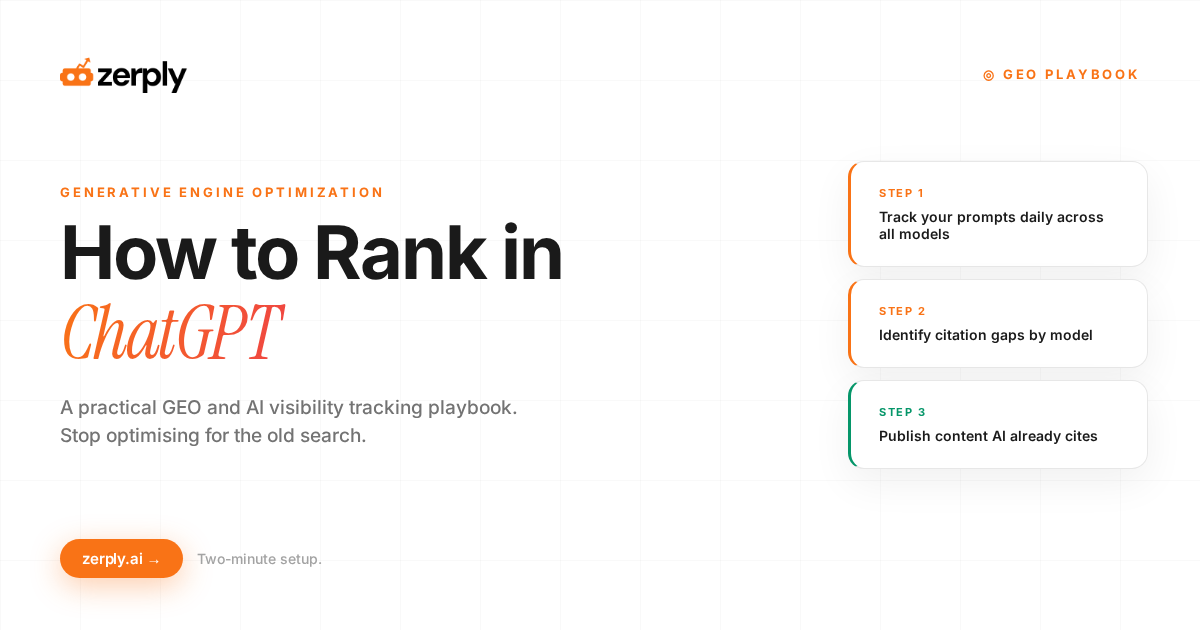
How to Rank in ChatGPT in 2026: A Practical Generative Engine Optimization (GEO) & AI Visibility Tracking Playbook

Generative Engine Optimization (GEO) is how you influence what ChatGPT, Perplexity, Claude, and Gemini say about your brand. Unlike classic SEO, GEO focuses on AI citations, AI share of voice, and sentiment, not blue‑link rankings. Below is a practical, prompt‑driven playbook plus a lean 30‑day plan to make your content AI‑citable, track visibility, and operationalize GEO at scale.
B2B SEO and content teams who care about “how to rank in ChatGPT” will walk away with a concrete framework they can plug into existing workflows without starting from zero.
1. GEO vs SEO: What “Ranking in ChatGPT” Really Means in 2026
When someone searches “how to rank in chatgpt” today, they really mean: “How do I get my product cited and positively described in AI answers and shortlists across ChatGPT, Perplexity, Claude, and Gemini?” They also want a way to measure that influence, not just theory.
What is Generative Engine Optimization (GEO)?
Generative Engine Optimization (GEO) is the practice of structuring content so generative engines can easily understand, extract, and reuse it in their answers.
GEO focuses on:
- Answer‑level visibility and citations inside AI chats (LLM visibility).
- Clear entities and consistent brand descriptions.
- Structured Q&A and freshness that models can trust.
Traditional SEO cares about rankings and sessions; GEO cares about how often you appear in AI answers, how you are positioned, and whether the sentiment is positive.
GEO vs Traditional SEO (and why you still need both)
SEO still provides the crawlable, authoritative content AI engines lean on, so you cannot abandon it. But GEO adds answer‑first intros, explicit comparisons, rich FAQs, and tighter refresh cycles so your content becomes the obvious snippet to copy into AI responses.
Different AI systems also draw on different data. For example, AI brand‑monitoring research notes that some engines favor fresher, link‑backed pages, while others rely more on older web snapshots and proprietary corpora, which means visibility can vary by engine even for the same topic, a pattern also visible in how Google AI Overviews source their citations differently than ChatGPT or Perplexity. According to a recent AI SEO guide, answer‑first, structured content can be cited several times more often than narrative articles in generative engines, underscoring why GEO matters alongside SEO.
As AI‑referred journeys grow, teams need to track not just “Are we ranking on Google?” but “How do AI assistants currently describe us?” Using an AI visibility tracking tool such as Zerply’s AI Visibility Tracking helps turn that question into a measurable KPI.
2. Answer-First GEO Foundations: How to Make Content AI-Citable
To improve “chatgpt seo” or “seo for chatgpt search,” you need pages that read like ready‑made AI answers. That starts on‑page, before any tooling or workflows.
Answer-first intros and GEO-friendly structure
For every high‑intent page, open with a 2–3 sentence direct answer that could be pasted verbatim into an AI response. Map H2s and H3s to natural‑language questions (“what is generative engine optimization”, “how to rank in chatgpt”, “[tool] vs [tool]”). Add a short TL;DR box near the top with 3–5 bullets that summarize the answer, benefits, and who it is for.
Research on GEO shows that placing a concise, explicit answer in the first 80–100 words significantly increases citation likelihood in generative engines, because the model can copy a self‑contained paragraph instead of stitching one together from scratch. Treat that opening as your “AI snippet,” not just an introduction.
Use Q&A, comparisons, FAQs, entities, and schema
Convert dense narrative sections into modular Q&A blocks with short answers that stand on their own. Include vendor shortlists and “X vs Y” comparisons, plus a one‑line, consistent descriptor of your product in every comparison so models learn how to summarize you.
Add FAQ sections to key pages and mark them up with FAQ schema, along with Article or HowTo schema where relevant. GEO guides show that structured FAQs and rich metadata make it easier for engines like Perplexity and Gemini to parse and reuse your answers accurately. Finally, keep high‑intent pieces on a refresh cadence with visible “updated” dates and consistent entity naming for your brand, products, and categories, so models see you as current and coherent.
At brief or edit stage, sanity‑check: do we open with a direct answer, use question‑based headings, include an FAQ block, repeat a clear brand descriptor, and have a plan to refresh this page at least annually (or faster for fast‑moving topics)?
3. A Step-by-Step GEO Framework for “How to Rank in ChatGPT”
You do not need a new department for GEO. You need a repeatable, prompt‑driven layer on top of your current research → brief → draft → publish → refresh process.
Step 1 – Map AI journeys, entities, and prompts
List your core entities: brand, products, main features, categories, and 3–5 primary competitors. Then define 20–40 questions where you want to “rank” in ChatGPT, Perplexity, Claude, and Gemini, such as “best [category] tools for [ICP]” or “[your brand] vs [competitor] for [use case].”
Turn these into a standard prompt set you can reuse in audits, for example: “What is [your category] and which tools should I consider?” or “Compare [your brand] vs [competitor] for [ICP].” Save that set in your documentation and inside any AI visibility tracking tool you use so testing is consistent over time.
Step 2 – Baseline your LLM visibility and AI share of voice
AI visibility simply means how often and how prominently you are mentioned in relevant AI answers, while “share of voice ai” compares your mentions to competitors. Start with manual prompts: run your standard question set in each engine, log whether you appear, where in the answer, and how you are described.
Complement this with analytics by tagging AI‑referred traffic in GA4 where engines send clicks. AI visibility tools can automate the rest. For instance, Zerply’s AI Visibility Tracking aggregates citations across ChatGPT, Perplexity, Gemini, and Claude, tracks sentiment, and monitors AI share of voice vs competitors over time, helping you uncover “dark queries” where AI uses your content but search tools show little or no volume.
Step 3 – Align content production with GEO (agentic workflow)
Update your content brief template so every new piece includes: target AI questions, a draft “ideal AI snippet” for the intro, a shortlist of competitors to mention, and a proposed FAQ set. This keeps GEO baked into strategy, not bolted on at the end.
Agentic SEO workflows make this scalable. With a platform like Zerply’s AI Agents, specialized agents can scan for gaps and dark queries, generate GEO‑ready briefs, create answer‑first drafts, and push them to your CMS for editorial review. AI visibility data then feeds back into the workflow, so drops in citations or sentiment automatically trigger refresh suggestions instead of waiting for quarterly audits.
The net result: for each high‑intent topic you are now optimizing both for Google’s SERP and for AI chat responses, using one integrated, data‑driven process.
4. Tools Stack for GEO & AI Visibility (Without Getting Locked Into One Vendor)
You can start GEO with what you already have, then layer in specialist tools as the program matures.
AI visibility tracking tools (LLM visibility, SoV, sentiment)
An effective “ai visibility tracking tool” should monitor multiple engines (ChatGPT, Perplexity, Gemini, Claude), capture brand and competitor mentions, measure sentiment, and track citation position over time. Several vendors offer this category.
Zerply’s AI Visibility Tracking is a good example: it combines cross‑engine visibility reporting, AI share of voice and sentiment, competitor benchmarking, and a direct link into content workflows so GEO decisions connect to what gets written or refreshed next, not just dashboards.
Agentic SEO, analytics, and free utilities
Agentic SEO and content ops platforms orchestrate the research → brief → draft → publish → refresh loop with AI agents, which is particularly useful for GEO because AI questions and models evolve quickly. Zerply’s AI Agents, for instance, use visibility data to prioritize topics, generate briefs and drafts, and schedule refreshes automatically.
Pair this with GA4 (for AI‑referred traffic where available), manual testing in ChatGPT, Claude, Perplexity, and Gemini for qualitative insights, and lightweight utilities. A free “AI visibility checker” such as Zerply’s AI Visibility Checker can quickly show whether and how often your brand appears across engines before you commit to a full stack.
5. 30-Day GEO Execution Plan: From Zero to Measurable AI Visibility
Use this as a pragmatic starter plan, not a rigid project plan. Group work into weekly phases and keep scope tight.
Week 1: Strategy, entities, and baselines
- Document entities (brand, products, category names, competitors) and define 20–40 priority AI questions.
- Configure GA4 or your analytics tool to tag AI‑referral sources where possible.
- Build your standard prompt set and run a first round of manual tests across ChatGPT, Perplexity, Gemini, and Claude, logging mentions and sentiment.
- Optionally, use a free checker, then set up ongoing tracking in an AI visibility tool for continuous baselines.
Week 2–3: GEO-optimizing core pages and new content
- Pick your top 5–10 “money pages” (category, comparison, and core problem/solution pages).
- Refactor them with answer‑first intros, question‑based headings, short TL;DRs, and FAQ blocks, adding relevant schema.
- Update your content brief template with GEO fields (target AI prompts, ideal snippet, competitors to reference, brand descriptor).
- Use agentic or AI‑assisted workflows such as Zerply’s AI Agents to help generate or refine drafts while humans focus on POV and factual accuracy.
Week 4: Measure, compare, and institutionalize GEO
- Re‑run your prompt set and compare visibility, share of voice, and sentiment vs Week 1.
- Identify 3–5 “priority fix” queries where you are absent, buried, or mis‑described and add them to the next content sprint.
- Fold GEO into your ongoing SEO operating model: a monthly AI visibility review, quarterly refresh sprints, and standard reporting that combines SEO metrics with AI visibility and sentiment. Using a unified platform like Zerply can make this measure → prioritize → brief → publish → refresh loop far easier to sustain.
6. FAQs, Schema Ideas, and How to Future-Proof Your GEO Strategy
Treat these FAQs as both content on your site and candidates for FAQ schema on GEO‑critical pages.
High-impact GEO FAQs to include
- What is Generative Engine Optimization (GEO)?
GEO is the practice of optimizing your content so AI assistants like ChatGPT, Claude, Perplexity, and Gemini can easily extract, cite, and recommend it in their answers, focusing on AI visibility, citations, and how your brand is described rather than traditional rankings. - How is GEO different from SEO?
SEO optimizes for rankings and organic traffic in search engines, while GEO focuses on citations, AI share of voice, and sentiment inside AI‑generated answers. Success in GEO is measured by how often and how positively AI models mention you for key queries. - How do I check if my brand ranks in ChatGPT?
Run standardized prompts in ChatGPT and other engines, log where and how your brand appears, and supplement that with an AI visibility tracking tool that monitors mentions, AI share of voice, and sentiment across models over time. - Which metrics matter for GEO?
Prioritize AI visibility (percentage of target queries where you are cited), AI share of voice vs competitors, citation position, sentiment in brand descriptions, and AI‑referred traffic where engines send clicks. - How often should I update content for GEO?
Use visibility data to drive refreshes rather than arbitrary schedules. High‑intent pages that fuel shortlists or comparisons typically need more frequent updates, and agentic workflows can monitor drops in citations or sentiment and trigger updates automatically.
Guardrails, YMYL considerations, and brand safety
For YMYL topics such as finance, health, or security, GEO must never mean gaming AI answers with aggressive claims. Prioritize accuracy, clear sourcing, and expert review, and use visible bylines and references to credible sources to build trust signals.
Avoid trying to manipulate models with misleading content; focus instead on user‑first, factual information that AI systems can safely reuse. AI visibility tools help here too: they can surface not only where you are mentioned, but also when sentiment turns negative or descriptions become inaccurate, so you can correct the record via updated, well‑sourced content.
Ultimately, “how to rank in ChatGPT” in 2026 means shaping how generative engines see, cite, and describe your brand and measuring that influence over time. Start small: baseline your current LLM visibility, refactor a handful of key pages with answer‑first content and FAQs, and layer on AI visibility tracking. As you mature, move toward an agentic, closed‑loop GEO workflow powered by tools like Zerply so that every gain in AI visibility turns into a repeatable operating habit, not a one‑off win.
If you want a faster path from “we have no idea how AI talks about us” to a measurable GEO program, consider piloting an AI visibility and agentic SEO platform such as Zerply to centralize tracking, competitor monitoring, and GEO‑driven content updates in one place.
Written by
Founder, Zerply.ai & Wittypen
Preetesh Jain is the Founder of Zerply.ai and Wittypen. He specializes in SEO, Answer Engine Optimization (AEO), AI search visibility, content marketing, and product development. Through his work building AI-powered marketing platforms, he helps businesses improve their organic presence across Google, ChatGPT, Perplexity, Claude, and other emerging discovery channels. He regularly writes about AI search, organic growth, content strategy, and the future of digital marketing.