Understanding AI Search Analytics for Brands: The Complete Guide

If your AI visibility strategy depends on opening ChatGPT, Gemini, Perplexity, Claude, and Google AI Overviews twenty times a day, you do not have a measurement system. You have a guessing habit.
AI search analytics exists because that manual checking habit does not scale. Buyers now discover, compare, and shortlist brands inside AI-generated answers, often before they click a website or visit a traditional search result.
For branding, SEO, and agency teams, the question has expanded from “where do we rank?” to “does AI understand us, cite us, recommend us, and send qualified buyers back to us?”
This guide explains what AI search analytics is, how it differs from traditional SEO analytics, how to set it up, and how to turn AI visibility data into clicks.
What is AI search analytics?
AI search analytics is the process of measuring how a brand appears inside AI-generated answers across platforms like ChatGPT, Gemini, Perplexity, Claude, and Google AI Overviews. It tracks mentions, citations, sentiment, recommendations, share of voice, and AI-referred traffic so teams can improve visibility beyond traditional search rankings.
In plain terms, AI search analytics tells you whether your brand is present in the answer engines your buyers now use to research products, vendors, categories, and alternatives.
For example, a brand like Zerply may rank well in Google but still be absent when someone asks ChatGPT for “the best SEO platform for AI visibility tracking.”
Similarly, another brand may be mentioned in an answer but not cited. A third may be cited but framed as a weaker option than a competitor.
That is why AI search analytics has to measure more than links. It needs to capture presence, source attribution, recommendation strength, sentiment, context, competitors, and traffic influence.
How is AI search analytics different from SEO analytics?
Traditional SEO analytics measures performance across search engines and websites. AI search analytics measures visibility inside generated answers. That’s the fundamental difference between them.
For a detailed comparison of AI search analytics vs SEO analytics, refer to the table below:
| Dimension | Traditional SEO analytics | AI search analytics |
|---|---|---|
| Core unit | Keyword, URL, ranking page | Prompt, answer, citation, brand mention |
| Main question | Where does our page rank? | Does AI mention, cite, or recommend our brand? |
| Primary metrics | Rankings, impressions, clicks, CTR, organic sessions | Mentions, citations, sentiment, share of voice, recommendation rate |
| Competitive lens | SERP positions and traffic share | Prompt-level brand inclusion and competitor framing |
| Attribution challenge | Click-based measurement | Often clickless, citation-based, or dark traffic influenced |
| Optimization focus | Content quality, backlinks, technical SEO | Entity clarity, answer-ready content, authoritative citations, third-party mentions |
AI search analytics does not replace SEO analytics. It adds a new visibility layer.
SEO analytics tells you whether your pages are earning rankings and clicks. AI search analytics tells you whether AI systems understand your entity, trust your sources, cite your pages, recommend your product, and frame your brand correctly before a buyer reaches your site.
That additional layer matters because the answer itself can shape buyer perception.
The three-layer funnel of AI search visibility
AI search visibility is not a yes-or-no metric. A brand can fail at three different stages: AI systems may not be able to access the site, they may access it but not cite or mention the brand, or they may mention the brand without sending traffic. That is why it helps to think in layers.
Layer 1: The indexing layer (is your site being crawled?)
The first layer is technical access. If your site is blocked, slow, unavailable, poorly structured, or hard to parse, AI systems and their retrieval layers have fewer reliable signals to work with.
Some AI systems use training data. Others use live search, browsing, partner indexes, or retrieval pipelines. OpenAI documents separate crawlers for search and training, including OAI-SearchBot and GPTBot, while Anthropic and Perplexity also publish guidance for how site owners can manage crawler access through robots.txt
And because platform behavior changes, the safest approach is to keep your technical foundation clean:
- Review robots.txt
- Validate XML sitemaps
- Monitor server logs
- Maintain fast page performance
- Use structured data where appropriate
- Add for LLM text file on your website, ideally in footer
Zerply is helpful here because its SEO foundation connects the technical pieces. It connects Google Search Console signals, Schema.org readiness, and technical health checks so teams can see whether their content is discoverable, structured, and ready for AI-influenced search environments.
Layer 2: The citation layer (are you being mentioned?)
The second layer is answer inclusion. A brand mention means the AI answer names or describes your brand. A citation means the answer links to, references, or visually attributes a source URL.
They are different signals. An AI answer might say your product is a good option but cite a third-party review site. It might cite your blog post without recommending your product. It might include your competitor as the first recommendation and mention you only as an alternative. Each case has a different business meaning
Zerply’s stance and sentiment analytics are designed for this nuance. It classifies whether mentions are positive, neutral, negative, or inaccurate. Its context role tracking also maps how your brand appears:
- Recommended vendor
- Comparison option
- Passing reference
- Omitted brand
Layer 3: The routable layer (are you driving traffic?)
The third layer is routing.
Some AI platforms create direct click paths. Perplexity often uses visible source links and numbered citations. ChatGPT Search may show inline citations or source cards depending on the answer and interface. Google explains that AI Overviews and AI Mode may show supporting links and that pages must be indexed and eligible for snippets to appear in those AI features.
A lot of AI influence is still clickless. A buyer may read the answer, remember the brand, search later, or visit directly, so AI visibility tracking cannot rely only on referral traffic.
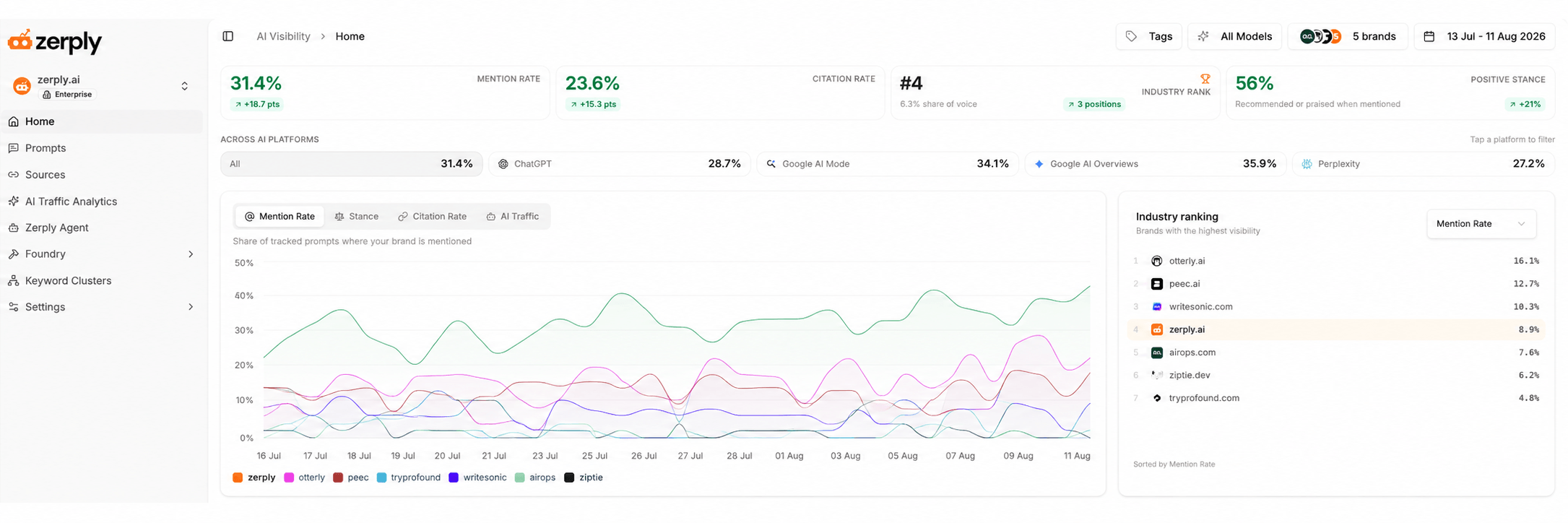
Zerply connects prompt-level visibility, citations, stance, competitor presence, and referral signals in one workflow.
That gives teams a more complete view of which AI answers are only shaping perception and which ones are actually routing high-intent visitors back to owned pages.
How to set up AI search analytics: automated vs. manual tracking
There are two ways to start measuring AI search analytics. You can build a manual baseline using Google Search Console and GA4, or you can use an AI search visibility tool that automates prompt tracking, answer capture, citation analysis, sentiment, and competitor share of voice.
For a one-person experiment, manual tracking can be useful. For a brand team, agency, or enterprise SEO program, it can break very quickly.
AI visibility depends on repeated testing across prompts, models, competitors, and time. A spreadsheet cannot reliably tell you whether sentiment changed, whether a competitor gained citation share, or whether your brand is being recommended less often this week than last week.
Option 1 (Default & preferred): Automated AI Visibility tracking via Zerply
Automated AI visibility tracking should feel like an extension of your existing SEO workflow, not another dashboard your team has to babysit. The goal is to move from scattered manual checks to a repeatable system that tracks how your brand appears across prompts, answer engines, competitors, citations, and time.
With Zerply, the setup is simple:
- Step 1: Add your website URL. Zerply uses your domain as the starting point for tracking how your brand and owned pages appear across AI search environments.
- Step 2: Add your competitors. This creates a benchmark for share of voice, citation gaps, and prompt-level visibility against the brands your buyers are likely comparing you with.
- Step 3: Review your tracked prompts. Zerply helps you monitor the conversational questions your audience actually asks, from category research to vendor comparisons and “best tool” prompts.
- Step 4: Connect Google Search Console and Google Analytics. This connects AI visibility insights with SEO performance, referral traffic, and content opportunities in one workflow.
Once the foundation is in place, the value comes from how Zerply turns raw AI answer data into something the brand and SEO teams can actually use. It helps teams understand which buyer questions surface their brand, how AI systems describe them, whether competitors are being recommended instead, and which visibility gaps should turn into content or SEO actions.
The next three capabilities show how that works in practice.
Custom conversational prompt tracking
AI search does not behave like keyword tracking. Buyers ask full questions: “What is the best AI visibility tracking tool for a B2B SaaS team?” or “Which SEO platform helps track brand mentions in ChatGPT and Perplexity?” Zerply lets teams track custom conversational prompts that match real buyer touchpoints, including roles, constraints, use cases, and competitor comparisons.
This fits AI search better than tracking only short keywords. The market is moving in this direction: AI visibility platforms commonly emphasize prompt-level monitoring, brand presence, and competitor context as core features.
Real-time sentiment & stance distribution
A mention alone does not tell you whether the answer helped. You need to know whether the brand was recommended, listed as a secondary option, compared unfavorably with a competitor, or described with outdated positioning.
Zerply analyzes the answer text itself, then classifies sentiment and stance so marketing teams can see whether AI-generated answers support the intended brand narrative.
Dynamic Competitor Share of Voice (SoV) Benchmarking
AI search analytics also needs a competitive lens. If your brand appears in 30% of category prompts but a competitor appears in 70%, the issue is not only visibility. It is market framing.
Zerply tracks your brand against your competitors, which lets teams see which rivals are winning recommendations, citations, and positive framing across the same prompt set.
Option 2: The manual DIY setup (Google Search Console & GA4)
Manual tracking can help you build a baseline, especially if you are not ready for dedicated ai visibility tracking tools. But it is incomplete by design. It does not reliably show unlinked chatbot mentions, answer-level sentiment, prompt-level competitor framing, or zero-click influence.
Step 1: Estimating GSC impressions with long-tail custom regex
Google Search Console does not isolate AI Overviews as a clean reporting dimension. One workaround is to approximate conversational search behavior by filtering for long queries.
(\S+\s+){5,}\S+
This regex captures queries with six or more words. Those queries often resemble natural-language prompts, such as “best AI search visibility tool for agencies” or “how to track brand mentions in AI answers.”
However, there is a limitation: this only captures long-tail Google search behavior. It does not show whether ChatGPT, Claude, or Perplexity mentioned your brand. It also does not prove that an AI Overview appeared.
Step 2: Isolating AI Referrals in GA4 with Custom Channel Groups
In GA4, teams can create a “Generative AI” channel group to track visits from known AI platforms. Google’s own documentation supports custom channel groups and regex-based rules for classifying acquisition traffic.
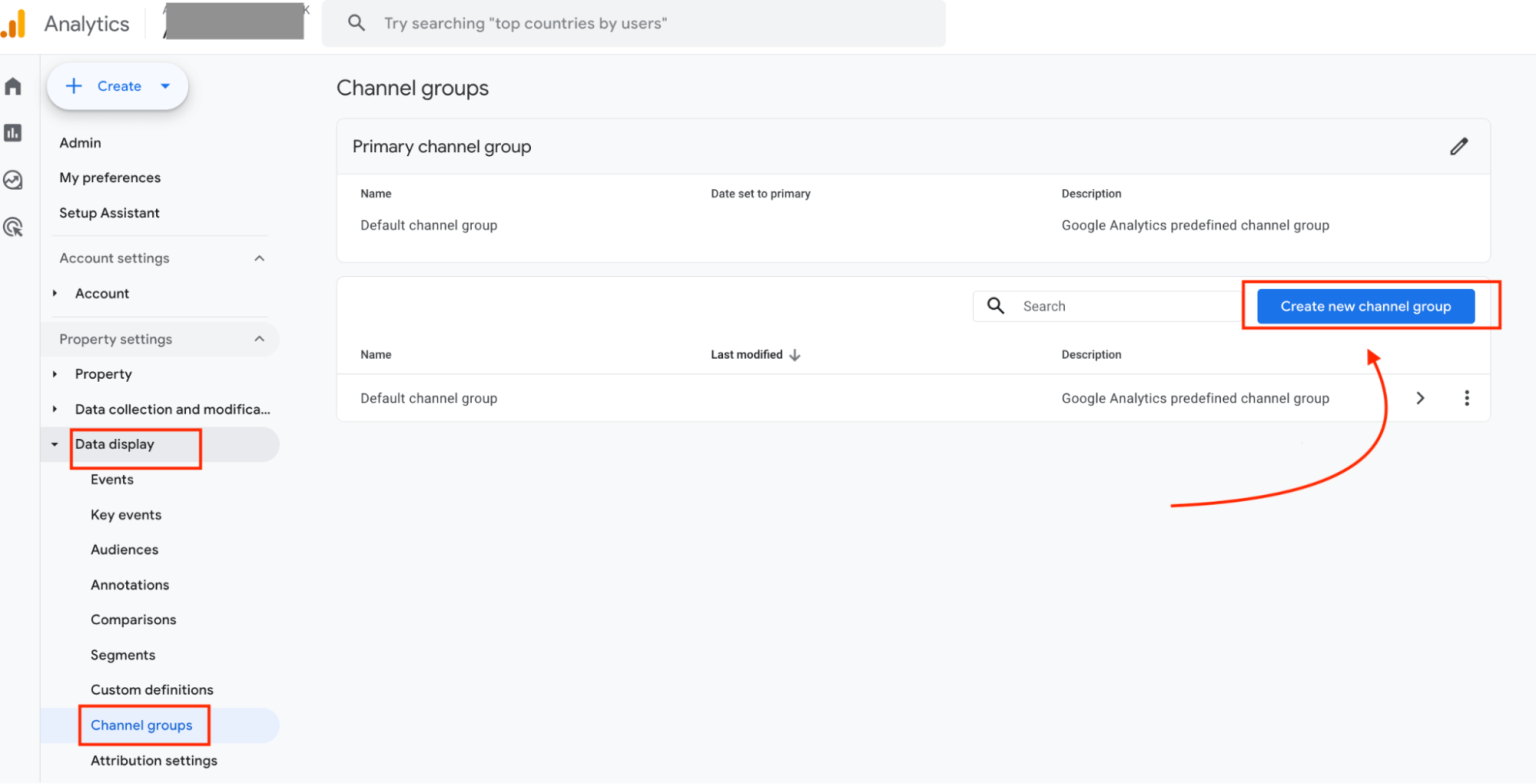
Add a group name, like”Generative AI traffic,” and a short description.
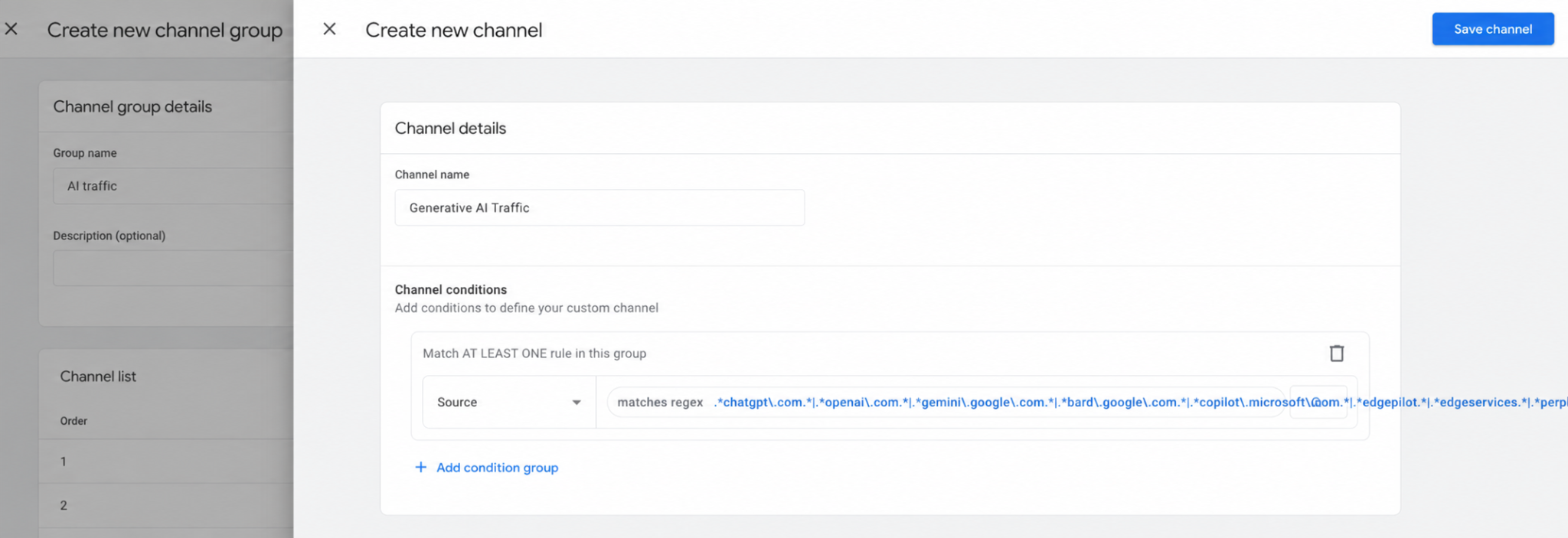
Once done, under Channel lists, click Add new channel:
- Channel name: Generative AI traffic
- Channel conditions: Source, matches regex
- Enter the Value and click Save:
^(metaai|perplexityai|perplexity|chatopenaicom|claudeai|chatmistralai|geminigooglecom|bardgooglecom|chatgptcom|copilotmicrosoftcom|anthropiccom|deepmindcom|deepseekcom)(.)?$*
This helps isolate sessions that arrive from AI interfaces. But it still only captures users who clicked. It misses the larger layer of zero-click influence: the moments when an AI answer summarizes your product, recommends a competitor, or shapes perception without generating a visit.
What does AI search analytics actually measure?
A useful AI search analytics system should measure the signals that influence brand discovery, evaluation, and routing. These are the core metrics.
Brand mentions
Brand mentions show whether and how often AI systems name your company, product, or category association in relevant prompts. Track this across category prompts, product prompts, comparison prompts, problem-aware prompts, and “best tool” prompts.
Citations and source URLs
Citations show which sources AI engines use to support answers. A citation may point to your owned page, a third-party listicle, documentation, review site, community thread, or competitor page. Citation tracking helps you understand which URLs shape the answer, and tracking citation velocity over time shows whether that influence is growing or fading.
Share of voice
Share of voice is your brand’s relative presence compared with competitors across a fixed prompt set. If competitors appear more often, appear earlier, or receive stronger recommendations, your content and citation strategy likely has a gap.
Sentiment and brand framing
Sentiment tracks whether AI systems describe your brand positively, neutrally, negatively, or inaccurately. Framing is just as important as presence. A neutral mention in a weak comparison may not help you. A positive recommendation in a high-intent answer can.
Recommendation rate
Recommendation rate measures how often the brand is actively recommended for “best tool,” “platform,” “vendor,” or “solution” prompts. This is one of the clearest MOFU signals because it reflects buyer shortlist visibility.
AI-referred traffic and assisted conversions
Some of this shows up directly as AI-referred traffic in your analytics. Much of it does not. Users may read an answer, search the brand later, return directly, or convert through another channel. That is why AI-referred traffic should be analyzed alongside mentions, citations, sentiment, and share of voice.
The Platform landscape: Where your brand must show up
AI search is not one platform. Google AI Overviews, ChatGPT Search, Perplexity, and Gemini each have different answer formats, citation behavior, and visibility dynamics.
Citation benchmarks have shown meaningful variation across ChatGPT, Perplexity, and Google AI Overviews, which makes single-engine checks unreliable.
| Platform | Primary data/source behavior | Citation format | Primary tracking metrics |
|---|---|---|---|
| Google AI Overviews & AI Mode | Often grounded in Google Search systems and web index signals | Source links, cards, or AI Overview citations depending on query | AI Overview inclusion, cited URLs, branded query impact, CTR movement |
| ChatGPT Search | May use browsing, retrieval, and source cards depending on mode and query | Inline citations or source panels where available | Mentions, citations, recommendation rate, sentiment, stance |
| Perplexity | Built around answer-engine research with prominent source attribution | Numbered citations and source links | Citation share, source quality, competitor presence, AI referral traffic |
| Google Gemini | May use Google Search grounding and entity signals depending on experience | Grounding links, source cards, or entity references | Brand mentions, entity accuracy, citations, sentiment |
Zerply consolidates these fragmented interfaces into one AI search visibility workflow. Instead of logging into four different platforms and copying answers into a spreadsheet, teams can track coverage, citations, sentiment, and competitor share of voice across the answer engines that matter.
How to turn AI search analytics into clicks
AI search analytics should not stop at dashboards. It should diagnose where visibility breaks and point to the fix.
Issue: You are invisible or blocked (Layer 1 Fail)
If your brand is not appearing at all, start with the technical layer. Audit robots.txt, check whether important pages are crawlable, review server logs, validate sitemaps, improve page speed, and add relevant structured data. Submit structured sitemaps through Bing Webmaster Tools and keep Google Search Console clean.
This work is not glamorous, but it matters. AI visibility cannot compound if your best pages are hard to access or poorly structured.
Issue: Competitors are cited, but you are not (Layer 2 Fail)
If competitors are cited and you are not, the problem is usually source strength. Create answer-ready pages that directly address category, comparison, integration, pricing, problem, and use-case questions. Use Article schema, FAQPage schema where appropriate, BreadcrumbList schema, Organization schema, and SoftwareApplication schema for relevant product pages.
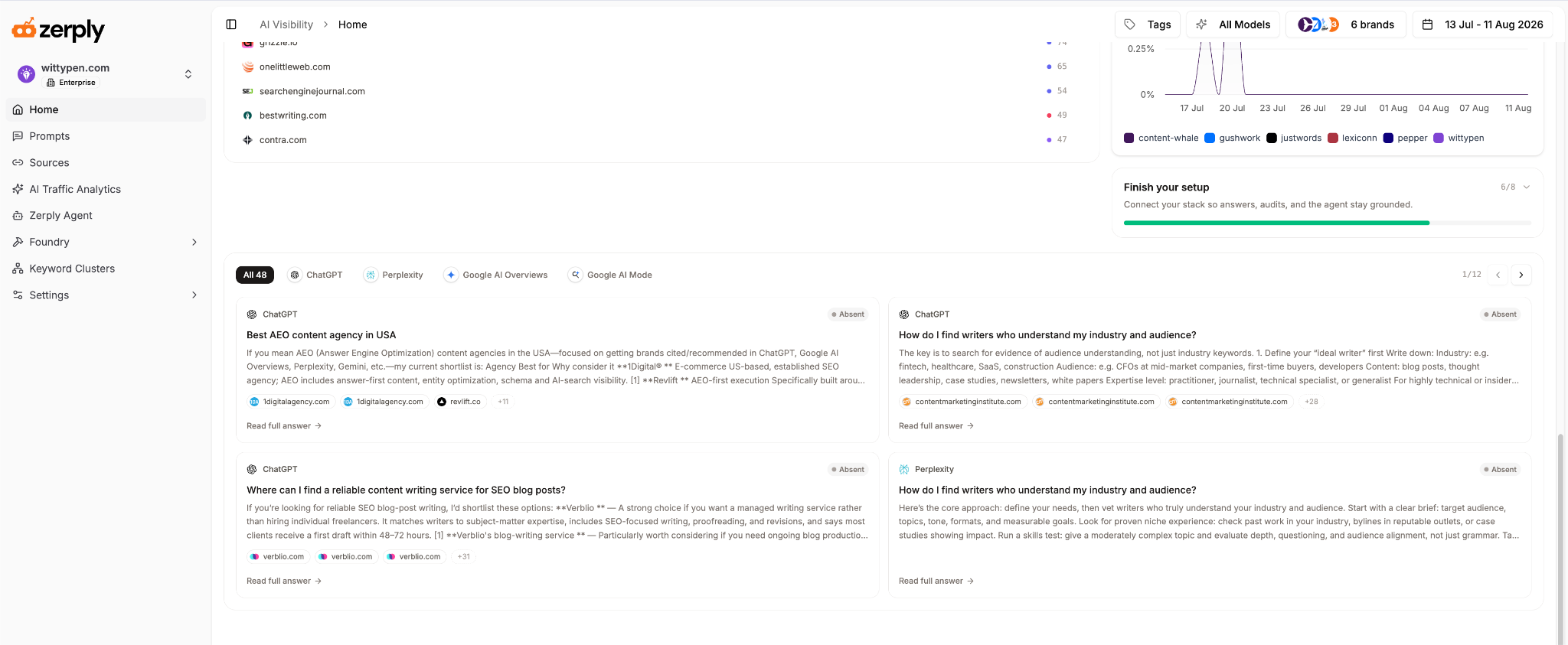
Then build credible third-party coverage. AI systems often draw from sources beyond your website, including reputable industry pages, review content, community discussions, and editorial lists. Your owned content should be clear and your external footprint should confirm it.
Issue: You are mentioned, but nobody is clicking (Layer 3 Fail)
If your brand is mentioned but traffic does not follow, improve the pages most likely to be cited. Use clearer title tags, direct answer-first introductions, strong above-the-fold positioning, comparison proof, and specific CTAs. Create high-intent comparison pages, alternative pages, and use-case landing pages that make the click worthwhile.
Zerply helps address this issue by turning visibility gaps into content actions. When it detects that a competitor is repeatedly cited and your brand is missing, it can highlight the gap and support content strategy automation, from brief creation to drafting and publishing. That is where the best AI visibility analytics for search optimization should go: from measurement to action.
A practical implementation path is simple: identify the prompts that matter, track them across multiple AI engines, compare your visibility with competitors, diagnose the layer where visibility breaks, ship the content or technical fix, and measure whether mentions, citations, sentiment, and referral signals improve over time.
Conclusion
SEO analytics still matter. Rankings, clicks, technical health, and organic conversions are not going away. But they no longer show the full discovery journey.
Brands now need to know whether AI systems can find them, cite them, describe them accurately, recommend them, and route high-intent buyers back to owned pages. AI search analytics gives teams that missing visibility layer.
If your team is still checking AI answers manually, start building a repeatable system. Track your prompts, monitor your competitors, analyze citations and sentiment, and use the gaps to guide your next SEO actions.
Start tracking how your brand appears across AI search with Zerply.
Frequently Asked Questions (FAQs)
What is the difference between SEO and AEO?
SEO optimizes websites for search engine crawling, rankings, and clicks. AEO, or Answer Engine Optimization, optimizes content and entity signals so brands can be included, cited, and recommended inside AI-generated and conversational answers.
How does Google AI Overview affect organic click-through rates?
Google AI Overviews can answer some queries directly on the results page, which may reduce clicks for certain informational searches. That makes citation tracking important because brand visibility can happen before the click, even when traditional CTR does not capture the full influence.
Why does my brand rank differently in ChatGPT compared to Perplexity?
Your brand can appear differently because each platform may use different models, indexes, retrieval systems, browsing behavior, source preferences, and freshness signals. A strong presence in one AI answer engine does not guarantee equal visibility in another.
What are the top AEO tools for AI search visibility analytics?
Top AEO and AI search visibility tools include Zerply, Profound, Peec AI, Otterly.ai, AirOps, ZipTie, Writesonic, Semrush, and SE Ranking. The best choice depends on whether you need simple monitoring, enterprise reporting, or workflow automation. Zerply is built for teams that want AI visibility tracking connected to SEO workflows, Google Search Console data, competitor benchmarking, and agentic content automation.
Written by
Founder at Zerply.ai & Wittypen
Anshul is the founder of Zerply.ai and previously built Wittypen, a content marketplace powering SEO growth for 1,000+ businesses. Over the last decade he has worked hands-on with B2B SaaS and tech teams to turn search data into compounding organic growth. At Zerply he shares practical playbooks on AEO, AI visibility, and modern SEO that come directly from experiments, wins, and failures in real projects.