AI Content Refresh Workflow: How to Update Old Posts for Search and AI Citations

The short answer: An AI content refresh workflow picks old posts to update by evidence instead of age, using Search Console clicks that are down against last year, AI citations below their peak, and facts that are out of date. AI drafts the changes against a brief. An editor verifies every changed claim, and the page's date moves only when its content does.
ChatGPT cites pages that are, on average, 458 days newer than the pages Google ranks organically for the same queries, according to an Ahrefs study of 17 million AI citations. The same study found Google's AI Overviews cite pages about 16 days older than organic results.
So a refresh program built on "update everything every quarter" spends effort where some engines barely reward doing it, and a program that ignores freshness loses ground in the engines that do. Both make the same mistake, because both treat every engine and every page alike. Triage fixes both, because it decides what each page needs from its own evidence before anyone opens a draft.
When does a page need a content refresh?
A content refresh updates an existing page on the same URL, so the page keeps the rankings, links and citations it has already earned while you fix what has gone out of date. A page needs one when any of these signals shows up:
- Search traffic falls, with Search Console clicks or impressions down against the same months last year, which rules out a seasonal dip.
- Rankings fall below the top five, with the page's main query averaging position 6 or worse in Search Console.
- AI citations fall below their peak, meaning fewer of your tracked prompts cite the page than in its best week.
- Facts age, such as prices, statistics, product names, screenshots or regulations that changed after publishing.
- The results change format, such as a query that showed guides now showing comparison pages.
Age isn't on the list, and leaving it off is the hardest habit to break. A refresh calendar sorted by publish date sends editors to the oldest posts first, yet one guide can keep its citations for months while another can peak and lose half its citations within weeks. Old and declining are different problems, and only one of them needs a refresh.
The content refresh triage matrix
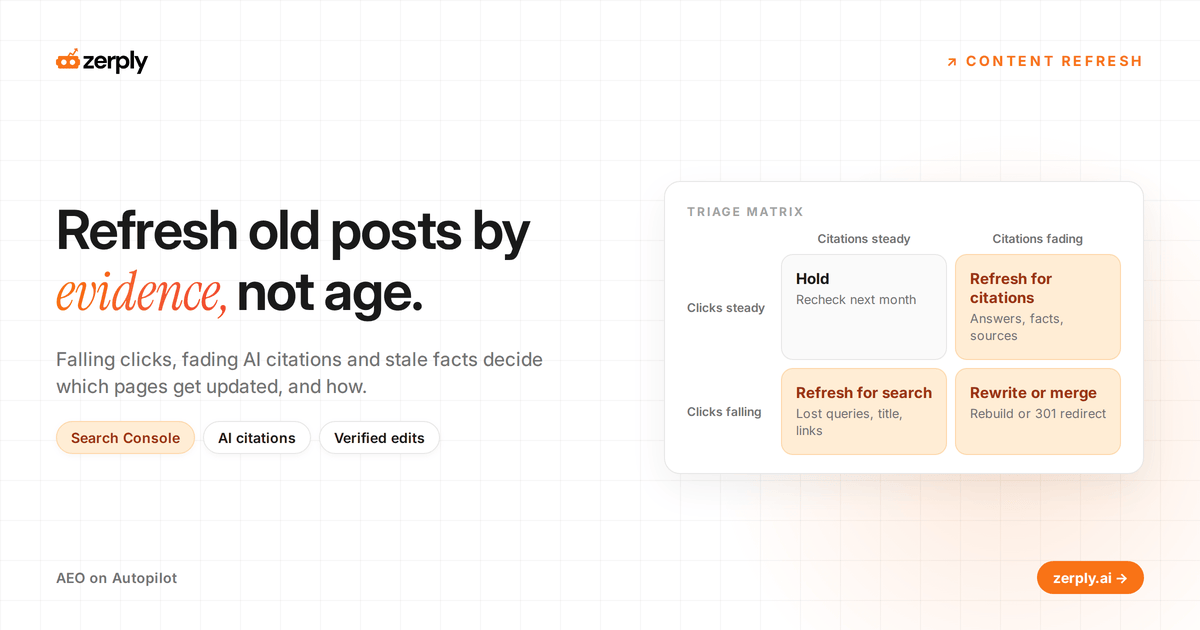
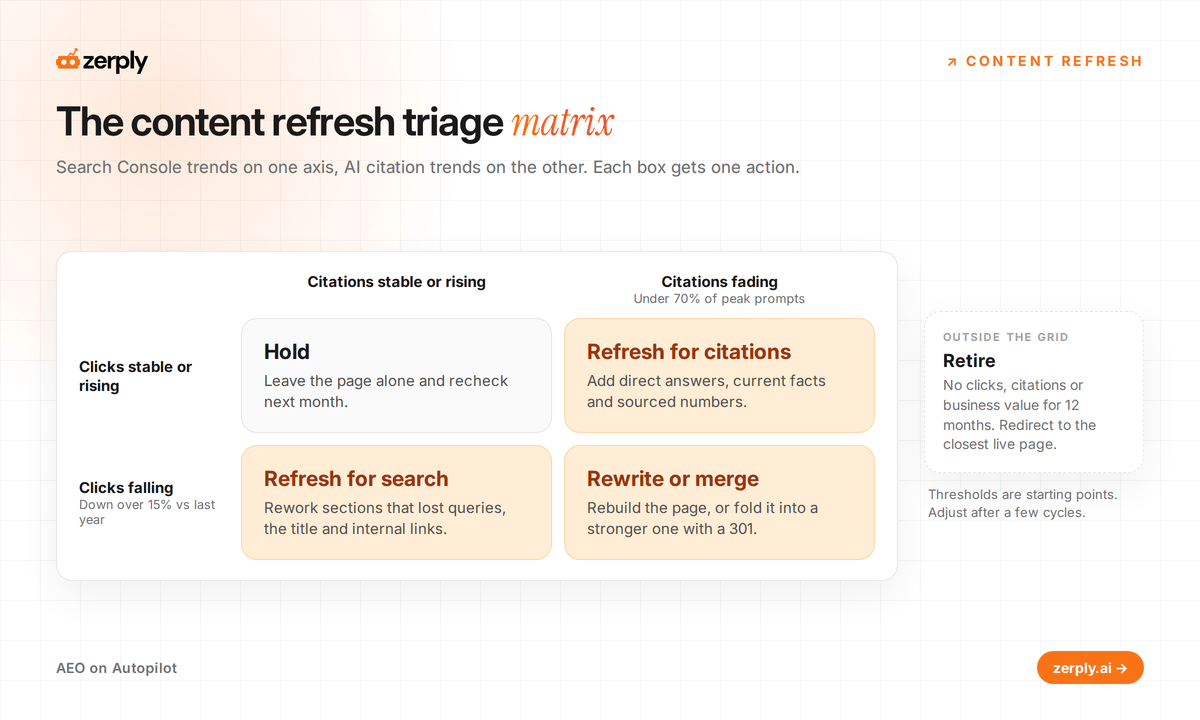
The matrix crosses two trends, search performance from Search Console and citation performance from AI answers, and gives each combination one action:
| Citations stable or rising | Citations falling | |
|---|---|---|
| Clicks stable or rising | Hold. Leave the page alone and recheck next month. | Refresh for citations. Add direct answers, current facts and sourced numbers to the sections AI quotes. |
| Clicks falling | Refresh for search. Rework the sections that lost queries, plus the title and internal links. | Rewrite or merge. Rebuild the page, or fold it into a stronger page with a 301 redirect. |
Set thresholds before you sort a single page, or else every page will land in the refresh box. Clicks count as falling when they're down more than 15% against the same month last year. Citations count as falling when the page appears in fewer than 70% of the prompts it was cited in at its peak. Use both of these factors as starting points, then adjust after a few cycles.
One outcome sits outside the grid. A page with no clicks, no citations and no business value for 12 months is a candidate to retire, with a redirect to the closest live page.
Content refresh triage: a five-page example
The table runs five pages through the matrix. The URLs and numbers are illustrative:
| Page | Clicks, last 3 months vs last year | Cited prompts, now vs peak | Stale facts | Action |
|---|---|---|---|---|
| /blog/payroll-compliance-checklist | Down 8% | 9 of 15, peak 10 | None found | Hold |
| /blog/payroll-software-pricing | Up 4% | 3 of 15, peak 11 | Three plan prices changed | Refresh for citations |
| /blog/how-to-run-payroll | Down 29% | 7 of 15, peak 8 | Last year's tax thresholds | Refresh for search |
| /blog/payroll-mistakes and /blog/payroll-errors | Down 41% and 37% | 1 of 15, peak 6 | Overlapping content | Merge into one URL |
| /blog/payroll-trends-2022 | 12 clicks in total | Never cited | The whole post | Retire with a redirect |
The pricing page is the reason the citation axis exists. Its Google clicks are up 4%, so a search-only review leaves it alone while AI answers keep quoting three prices that are no longer true.
How to update old blog posts for SEO
Every refresh runs through the same seven steps, whichever box of the matrix it came from.
| Step | What to do | Owner | Done when |
|---|---|---|---|
| 1. Snapshot | Save the page's last 3 months of queries, clicks and position, its cited prompts, and its GA4 engaged sessions and key events | Agent | Baseline saved with the date |
| 2. Diagnose | List the queries the page gets impressions for but doesn't answer, the URL that replaced it in AI answers, and every fact that changed | Agent | Gap list attached |
| 3. Brief | Set the action from the matrix, the sections to change, the sections to keep and the sources for new facts | Editor | Brief approved |
| 4. Draft | Give the AI the current page, the gap list and the sources, and ask it to change only the sections in the brief, with changes marked | Agent | Marked-up draft ready |
| 5. Verify | Check every new or changed number, quote, price and product claim against its source, plus the title, meta description and alt text | Editor and subject expert | Every claim traced to a source |
| 6. Publish | Keep the URL, update dates only for substantial changes, and request a recrawl | Editor | Page live and inspected |
| 7. Measure | Compare against the snapshot at 28 days and 8 weeks | Agent | Row closed or sent back to step 2 |
Asking for marked changes in step 4 lets the editor review a diff instead of rereading 2,000 words to find what changed. It also protects the sections that already rank and get cited, which an AI asked to "improve the post" will rewrite for style.
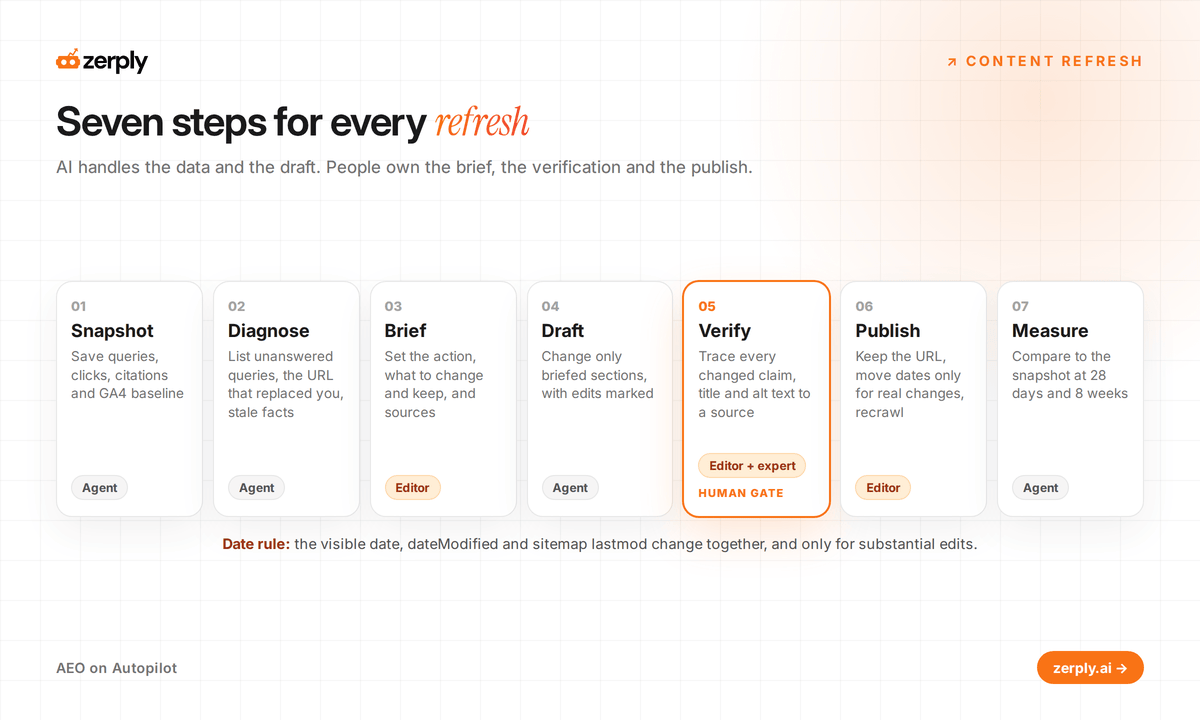
Step 5 is the step to protect when the queue starts growing, because it's the only step that can catch a wrong price or statistic before readers and AI answers repeat it. Google's guidance on generative AI content calls manual fact-checking critical before publishing, and it names titles, meta descriptions, structured data and alt text as part of the review.
Step 6 decides whether you refresh outdated content for Google or only relabel it. The tempting shortcut is a new date on an unchanged page. Google's helpful content guidance asks whether you change page dates to make them seem fresh when the content hasn't substantially changed. Its sitemap documentation says Google uses the lastmod value only when it's consistently and verifiably accurate.
A fixed typo cannot earn a new date by itself. A rewritten pricing section can, and the visible date, the dateModified value and the sitemap lastmod change together. Then ask Google to recrawl the URL from the URL Inspection tool in Search Console.
What AI should change in a content refresh
AI is fast at work that follows from data you give it, and unreliable at work that needs new facts:
| AI handles | People handle |
|---|---|
| Finding queries the page gets impressions for but doesn't answer | New statistics, prices and quotes |
| Restructuring sections so each one answers its heading first | Product claims and screenshots |
| Drafting new sections from sources you supply | First-hand experience and opinions |
| Suggesting internal links to newer posts | The decision to merge, redirect or retire |
| Rewriting dated phrasing such as "this year" or "recently" | Final approval of the title and meta description |
Google's guidance explains the reason behind the split. Generative models predict a likely sequence of words instead of retrieving facts, so their output can contain confident errors, and a refresh is full of the specifics where these errors land. AI can rearrange what you give it. Anything new comes from a person.
For pages in the citation box, pair the AI pass with these citation-ready edits.
How to choose a refresh outdated content tool
A refresh tool earns its place by shortening triage, because drafting is the cheap part. Look for these capabilities.
- It reads Search Console live, so your snapshot isn't a stale export.
- It tracks citations for each page over time instead of only this week's mentions.
- It names the URL that replaced yours, so you know whether you lost the citation to a competitor or to your own newer page.
- It drafts against your existing page instead of starting from a blank prompt.
- It leaves approval with a person.
A tool that rewrites every page on a fixed schedule misses the point of triage. It refreshes pages because a date arrived instead of because the evidence changed, which repeats the age-based calendar at machine speed.
Zerply's Citation Decay covers the citation axis of the matrix. For every cited page, it charts weekly citations, the date first cited, the peak and the half-life, which is how long the page took to fall to about half its peak citations. Each page gets a status of Rising, At peak, Decaying, Past half-life or Low volume, plus a suggested refresh date that turns red when it's overdue.
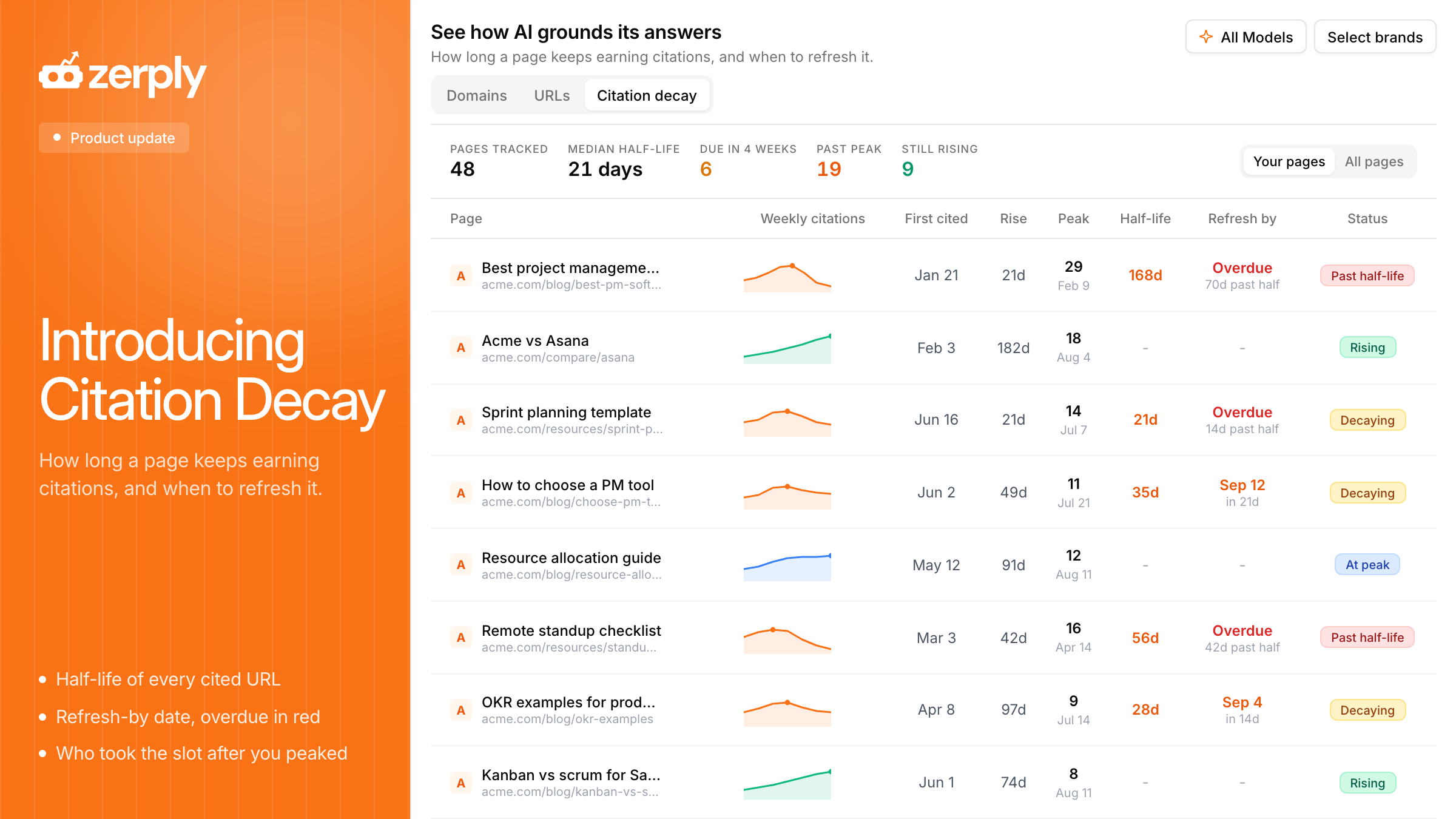
The Who took the slot panel lists the URLs that gained citations on the same questions after your page peaked, and marks each one as yours or a competitor's.
Zerply Agent covers the search axis by pulling Search Console and GA4 into one chat. Through Zerply MCP, you can ask Claude or ChatGPT which cited pages are losing citations and what replaced them. Drafts go through the Foundry editor before anything publishes.
Citation Decay needs history. A page has to be cited across several weeks before its curve appears, and half-life shows only when the peak was high enough to mean something. Standard plans track a fixed four engines:
- Google AI Overviews
- Google AI Mode
- Gemini
- ChatGPT, the engine with the strongest freshness preference in the Ahrefs data
Perplexity, Claude and Copilot tracking sits on Enterprise. In an existing workspace, open Citation Decay and filter by model.
Conclusion
Run the matrix once a month on the 20 pages with the most clicks over the past year, and refresh only as many as your editors can verify that month. Verification is the slowest step in an AI content refresh workflow, so size the program to your editors' hours and let the drafting wait.
Frequently asked questions
How do you update old blog posts for SEO?
Save a baseline of the page's queries, clicks, citations and GA4 results, list what the page no longer answers, and brief the AI to change only those sections. An editor verifies every changed fact, then republishes on the same URL and requests a recrawl in Search Console.
How do you know when a page needs a content refresh?
A page needs a refresh when its evidence changes, such as Search Console clicks down against the same months last year, fewer tracked AI prompts citing the page than at its peak, or prices and statistics going out of date. Age alone is a weak signal, because some pages keep their citations for months while others lose half of them within weeks.
Should you change the publish date when you update a post?
Change the date only when the content changes substantially. Google's helpful content guidance flags changing dates to make pages seem fresh, and Google uses sitemap lastmod values only when they are consistently and verifiably accurate.
Can AI refresh outdated content?
AI is useful for finding unanswered queries, restructuring sections and drafting from sources you supply. People should still handle new statistics, prices, quotes and product claims, because generative models predict likely words instead of retrieving facts.
Do AI search engines prefer fresh content?
An Ahrefs study of 17 million AI citations found ChatGPT cites pages about 458 days newer than Google's organic results for the same queries. The same study found Google's AI Overviews cite pages slightly older than organic results, so freshness weighs differently by engine.
What should a content refresh tool do?
A refresh tool should read Search Console live, track citations for each page over time, and name the URL that replaced yours in AI answers. It should draft against your existing page and leave final approval with a person.
Written by
Founder at Zerply.ai & Wittypen
Anshul is the founder of Zerply.ai and previously built Wittypen, a content marketplace powering SEO growth for 1,000+ businesses. Over the last decade he has worked hands-on with B2B SaaS and tech teams to turn search data into compounding organic growth. At Zerply he shares practical playbooks on AEO, AI visibility, and modern SEO that come directly from experiments, wins, and failures in real projects.