9 Best AI Tools for Keyword Research in 2026

The best AI tools for keyword research combine reliable search data with automation that helps teams choose, brief, publish, and refresh the right pages. For 2026, Zerply is the strongest fit for research-to-publishing execution, Semrush for broad all-in-one keyword intelligence, Ahrefs for SERP and traffic-potential analysis, and Keyword Insights for specialist clustering.
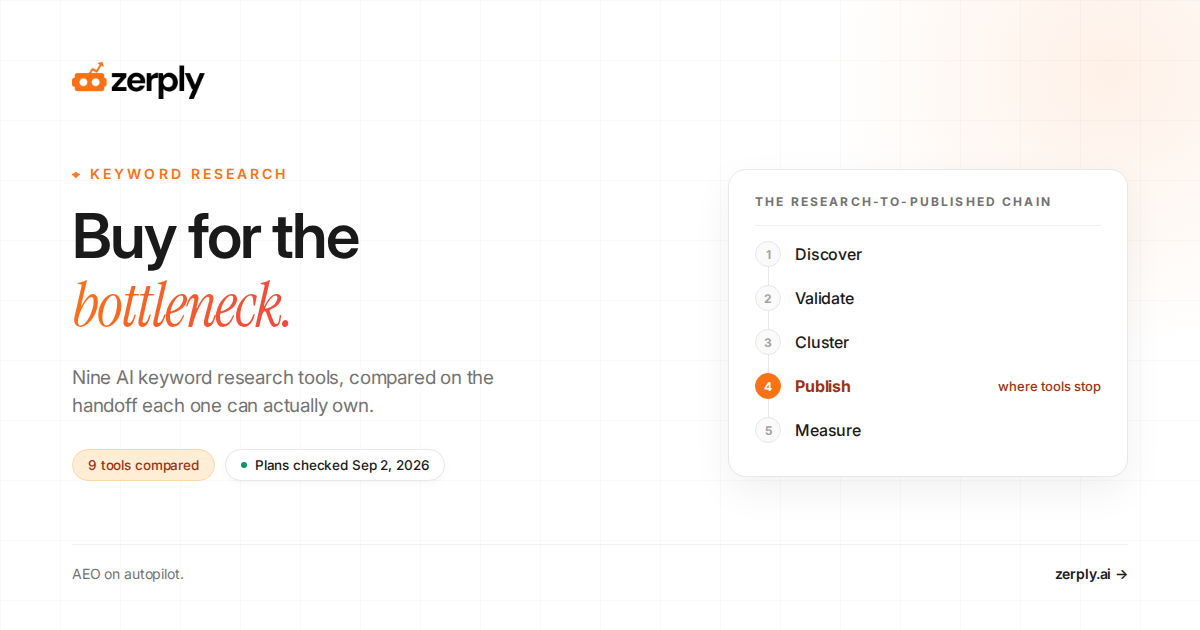
If you want a fast answer, buy around the bottleneck. Choose a database when you need better keyword evidence, a clustering tool when you need a cleaner content map, and an execution platform when research keeps stalling before publication.
Disclosure: Zerply publishes this comparison and is included below. We apply the same criteria to every product and separate documented capabilities from hands-on testing. This is a documentation-based evaluation; we do not assign invented scores or claim to have tested plans we did not access.
Best AI keyword research tools at a glance
Pricing and plan details were checked on September 2, 2026. Prices are monthly list prices unless marked annual-effective. Vendors change limits frequently, so confirm the live plan before buying. “Live metrics” means keyword or first-party performance data retrieved from a maintained source, though availability and limits vary by plan.
| Tool | Best for | Live keyword metrics | Clustering | Competitor research | AI-search research | Publishing or execution | Entry point |
|---|---|---|---|---|---|---|---|
| Zerply | Research-to-publishing automation | Within its connected SEO workflow | Yes, through Keyword Clusters | Yes | Yes | Direct hosted publishing through the paid Foundry add-on | Starter $41/month; 7-day free trial |
| Semrush | Broad all-in-one research | Yes | Yes | Yes | Yes | Content workflow; publishing depends on setup | SEO Toolkit from $139.95/month |
| Ahrefs | SERP intelligence and traffic potential | Yes | Plan-dependent | Yes | Separate and integrated AI features | Content workflow, not hosted publishing | Starter $29/month |
| SE Ranking | Agency research and automation | Yes | Yes | Yes | Available in the wider platform | Content Editor integrations | 14-day trial; 3 free reports/day |
| Keyword Insights | SERP-aware clustering | Yes | Strong | Yes | Mentions and multi-source discovery | Briefing and AI writing | $1 seven-day trial |
| LowFruits | Weak-SERP discovery | Yes | Yes | Focused SERP analysis | Limited | Research output | Free first analysis; credit model |
| AnswerThePublic | Questions and audience language | Paid plans | Topic organization | Limited | AI prompt suggestions | Content Studio; WordPress publishing | Starter $20/month |
| Surfer | Keyword-to-content optimization | Yes | Yes | SERP/content competitors | Content-focused | Briefing and optimization | Free Keyword Surfer extension |
| ChatGPT or Claude with live SEO data | Flexible analysis and orchestration | Only through supplied or connected data | Yes; validate against SERPs | Only with supplied data | Strong reasoning, source-dependent | Connector-dependent | Model and connector dependent |
How we evaluated these AI keyword research tools
We evaluated each AI keyword research tool against the same question: can it turn a topic into a defensible SEO decision? This is a documentation-based comparison, not a controlled product benchmark. We reviewed current first-party product pages, public pricing, feature documentation, and workflow fit as of September 2026, with special attention to AI tools for SEO keyword research that combine ideation with verifiable evidence.
| Evaluation factor | What we looked for | Why it matters |
|---|---|---|
| Data source | Clear keyword, SERP, competitor, or first-party data provenance | AI-generated ideas are useful only after the evidence layer is visible. |
| Discovery | Seed expansion, related terms, questions, comparisons, and long-tail ideas | Strong research starts with broad candidate coverage. |
| Intent and clustering | Search-intent labels, SERP overlap, topic groups, and cannibalization checks | Similar words do not always deserve the same page. |
| Competitor evidence | Ranking pages, content gaps, weak SERPs, backlinks, and market context | Keyword difficulty is easier to judge when the current results are inspected. |
| AI-search support | Prompt research, brand mentions, citations, or AI-answer visibility | Keyword research now has to account for discovery in AI answer engines, not only Google results. |
| Workflow coverage | Briefs, drafting, approvals, publishing, tracking, and refresh paths | A keyword list has little value if it never becomes a live, measured page. |
| Cost and limits | Plan access, credits, tracked brands, API/MCP availability, and usage caps | The practical price is often determined by limits, not the entry price. |
We treated search volume, keyword difficulty, CPC, and traffic potential as estimates rather than facts. Use those numbers to compare opportunities inside one platform, then validate priority topics with the live SERP and your own Google Search Console performance data. Search Console does not show total market demand, but it does show the queries, impressions, clicks, and positions tied to your site.
For AI visibility, we used the same standard: cite the source, name the denominator, and avoid precision without context. Our guide to AI visibility metrics and their denominators explains why mention rate, citation rate, and share of voice need clear measurement boundaries.
Measured behavior needs a named source and context. If a tool cannot show where a volume, ranking, citation, or CPC value came from, treat the number as unvalidated.
What counts as an AI keyword research tool?
An AI keyword research tool uses machine learning or generative AI to find, classify, cluster, prioritize, or brief search opportunities. The category includes four different product types. Knowing the difference prevents you from buying a brainstorming interface when you need market data, or paying for a large database when your real problem is publishing. The strongest AI-powered keyword research tools make that distinction explicit instead of presenting generated ideas as measured demand.
Teams extending keyword research into AI search should also compare the distinct data, coverage, and workflow questions in this AEO and GEO platform buying guide.
LLM keyword generators
ChatGPT, Claude, and similar models are good at expanding a seed topic, modeling audience language, classifying intent, removing duplicates, and turning a validated list into a brief. A free AI keyword generator can be useful at this stage, but by default these tools are not maintained keyword databases. Do not trust them to invent current search volume, keyword difficulty, CPC, rankings, or SERP features.
SEO databases enhanced with AI
Platforms such as Semrush, Ahrefs, and SE Ranking collect or model keyword and SERP data, then use AI for seed expansion, intent classification, clustering, and prioritization. The evidence layer beneath the interface is their primary advantage.
SERP clustering and content-optimization platforms
Keyword Insights, LowFruits, and Surfer specialize in what happens after initial discovery. They examine ranking results, group terms by shared intent, expose weak competitors, or convert a cluster into a content plan. If you are comparing the best keyword clustering tools, this is where a spreadsheet starts becoming a site architecture.
End-to-end SEO execution platforms
A platform such as Zerply extends beyond research. It connects search and analytics data to content strategy, drafting, publishing, AI visibility, measurement, and refreshes. This category suits organizations that have enough data but struggle to turn it into live, maintained pages.
The 9 best AI tools for keyword research
1. Zerply: best for research-to-publishing automation
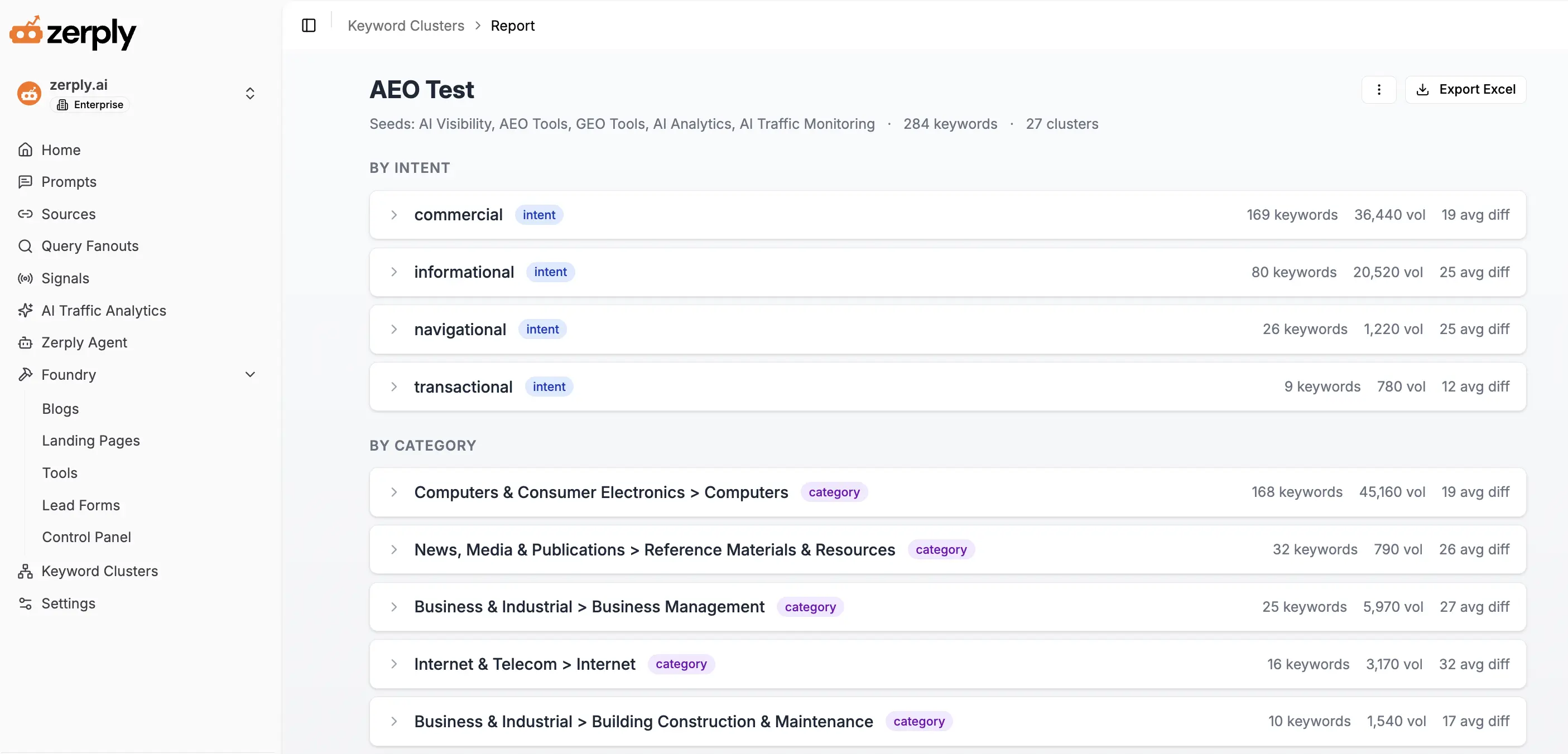
Zerply is an SEO and AI visibility platform for teams that want research to trigger execution. Its Keyword Clusters workflow gathers related queries and organizes them by intent, category, and pattern, turning a seed topic into a prioritized content map rather than another unstructured export.
The Zerply Agent and Blog creation agent then carry approved opportunities into research, briefing, drafting, and review.
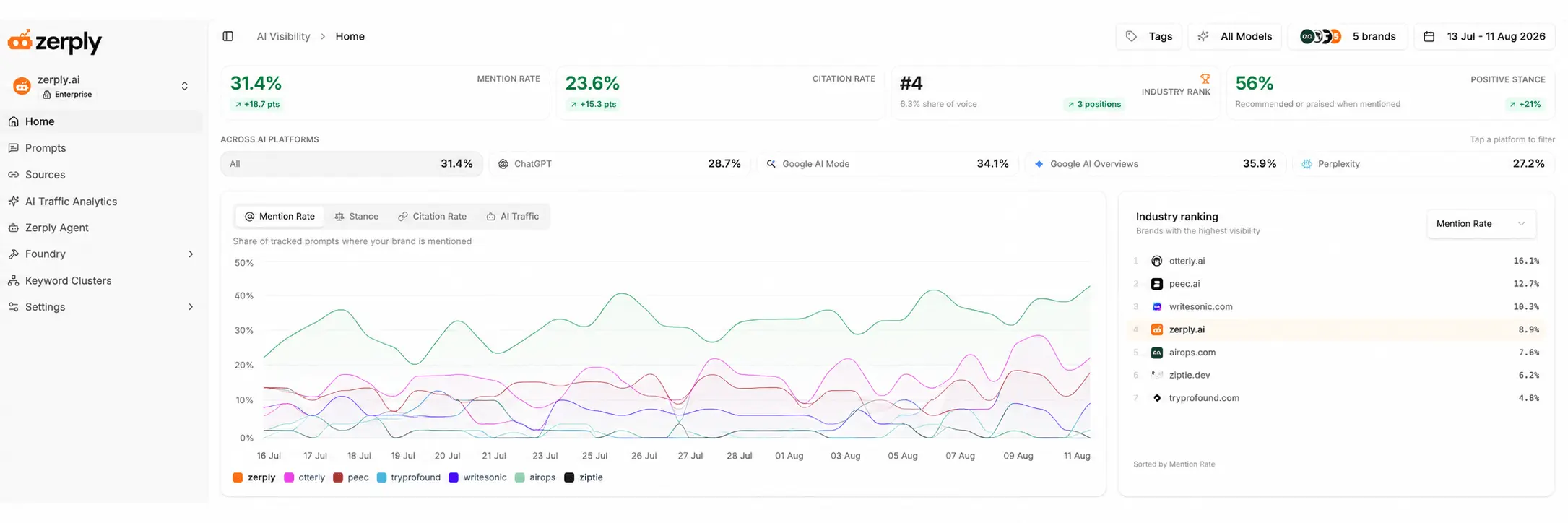
AI visibility tracking classifies how a brand appears in AI answers by stance and context role, while Citation Decay tracks citations that disappear over time. Those signals help teams distinguish a new content opportunity from a page that needs to be defended or refreshed.
Foundry, a paid add-on, publishes approved blogs and landing pages beneath the customer’s domain rather than on a separate publishing subdomain. It works alongside WordPress, Webflow, Shopify, and custom stacks while handling schema markup, metadata, Open Graph images, sitemap inclusion, responsive delivery, and semantic HTML.
Pros
- Keyword Clusters connects keyword discovery to an organized, intent-aware content roadmap instead of leaving teams to manually sort a large export.
- The named Zerply Agent and Blog creation agent carry research into drafting, while Unified AEO Tracking and Citation Decay connect execution to measurable AI-search outcomes.
- The paid Foundry add-on creates a direct hosted publishing path without requiring a CMS migration or development sprint.
- Google Search Console and GA4 connections let teams combine market estimates with first-party search and behavior data.
Cons
- Starter, Pro, and Business each track one brand or domain, so agencies and multi-brand teams need custom-priced Enterprise.
- Foundry costs $25 per month for 500 pages on top of the platform plan.
- Teams that only need a large standalone keyword index for ad hoc lookup will find Semrush or Ahrefs more direct.
Pricing
Starter $41/month, Pro $166/month, and Business $249/month, with annual billing at two months free.
All three track one brand or domain; agency and multi-brand use requires custom-priced Enterprise. Foundry publishing is a $25/month add-on for 500 pages, and 100 additional AI Agent credits cost $20/month. A 7-day free trial is available. (Checked September 2, 2026.)
Verdict: Choose Zerply when your bottleneck is turning research into content that gets published, monitored, and refreshed.
See how your brand shows up in AI search
Track visibility, citations, prompts, and competitors across leading AI platforms.
2. Semrush: best broad all-in-one suite
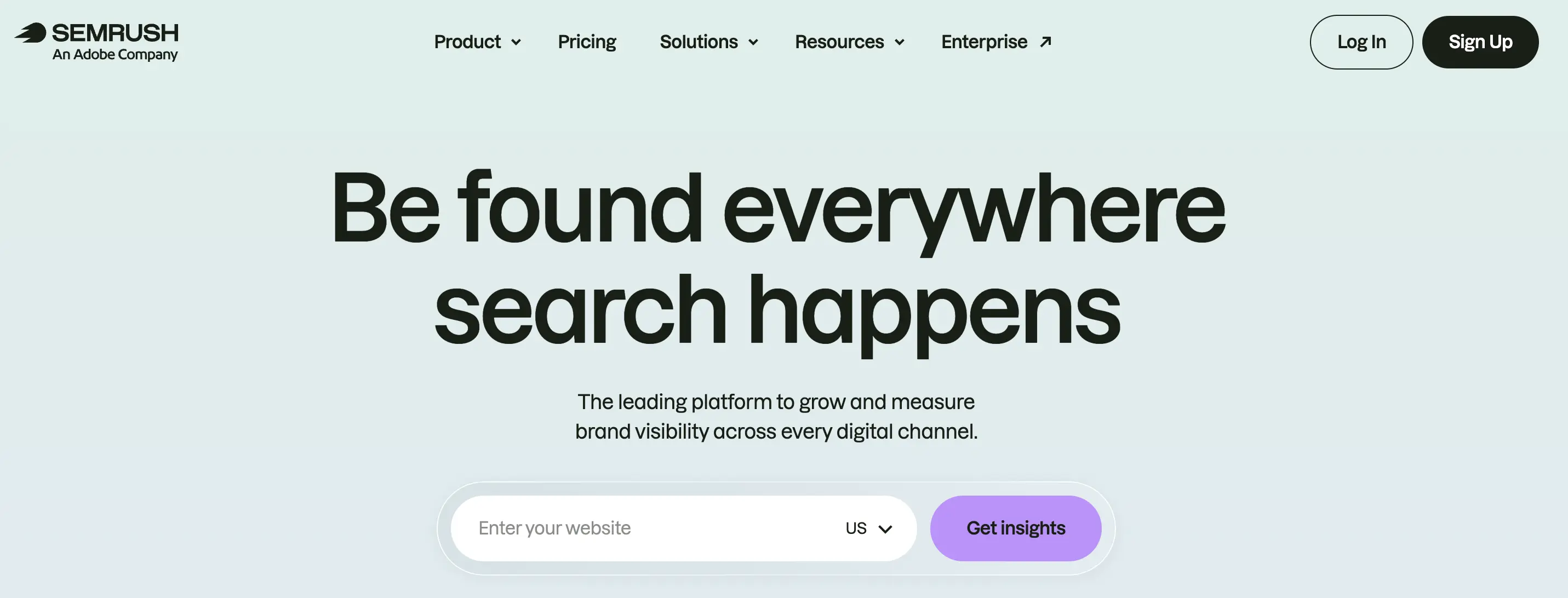
Semrush serves SEO and paid-media teams that want a mature database and broad marketing toolkit.
Keyword Magic Tool combines ideas with volume, intent, keyword difficulty, Personal Keyword Difficulty, CPC, SERP features, filters, and topic-based groups.
Its current documentation describes more than 27 billion keywords across more than 140 countries, while Prompt Research connects conventional keyword work to cited domains, mentioned brands, related prompts, and AI-search intent.
Pros
- A 27-billion-keyword database and deep filtering support high-volume research across SEO and PPC workflows.
- Personal Keyword Difficulty adds domain-specific context beyond a generic market-level difficulty score.
- Competitor analysis, Keyword Strategy Builder, and Prompt Research cover discovery, prioritization, and AI-search investigation in one ecosystem.
Cons
- The SEO Toolkit and AI Visibility Toolkit are separately priced, which can make a complete SEO and AI-search stack materially more expensive than the headline entry point.
- Some prompt and AI-search capabilities sit in Semrush One or another toolkit rather than the base SEO package.
- Its breadth creates interface and packaging complexity for buyers who only need focused keyword discovery.
Pricing
SEO Toolkit starts at $139.95/month, while the AI Visibility Toolkit starts at $99/month. Prompt Research and related AI-search capabilities vary by toolkit and Semrush One plan, so buyers should map required features before purchasing. (Checked September 2, 2026.)
Verdict: Semrush fits a team that wants one mature ecosystem spanning keyword research, competitors, PPC, planning, and AI-search intelligence, and can justify the combined cost.
3. Ahrefs: best for SERP intelligence and traffic potential
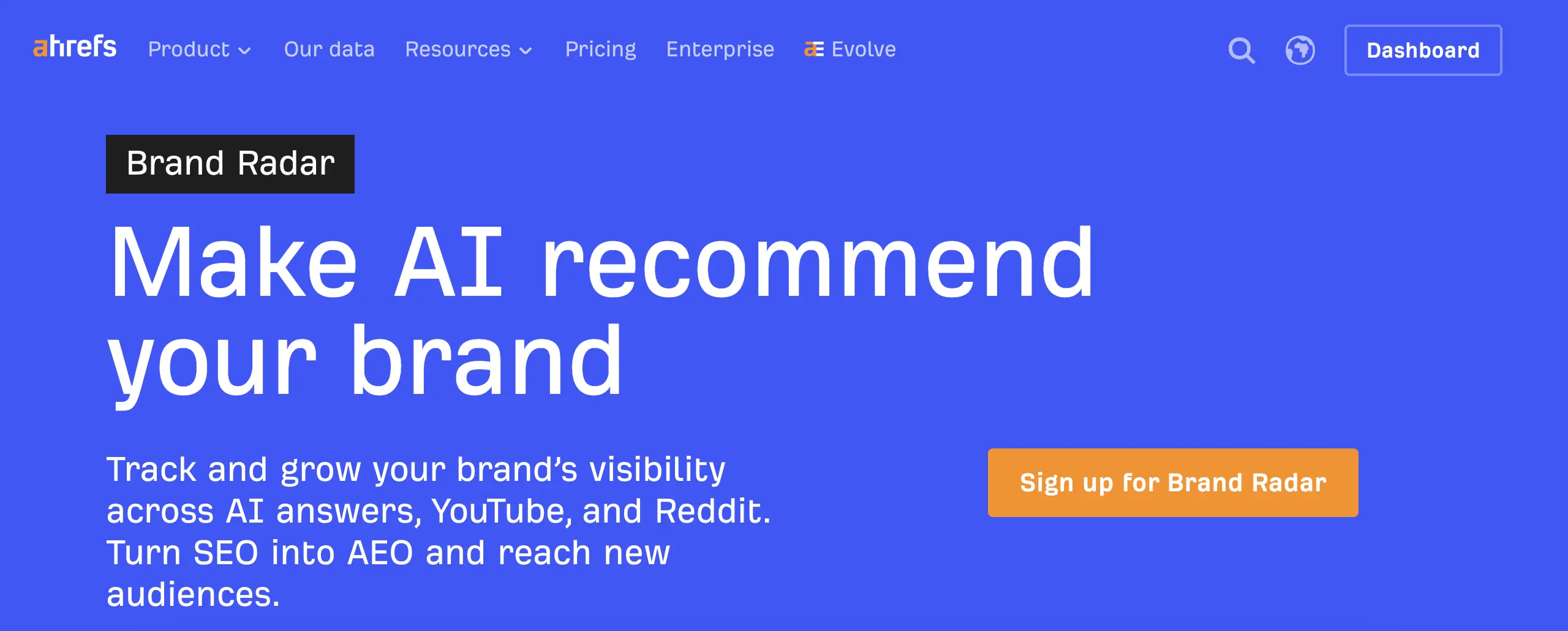
Ahrefs serves SEO teams whose decisions depend on what currently ranks and how much traffic one page could capture across a topic. Keywords Explorer reports volume, a backlink-based Keyword Difficulty score, Parent Topic, Traffic Potential, SERP history, intent, and competitor gaps. Traffic Potential is especially useful when a modest head term belongs to a page that can rank for hundreds of related queries.
Ahrefs reports 28.7 billion filtered keywords from 110 billion discovered terms across 217 locations. That scale sits beside a strong backlink index and page-level SERP history, making it easier to judge whether a topic is realistically winnable and whether one page can serve a broader cluster.
Pros
- Traffic Potential and Parent Topic help value a page by its broader ranking opportunity rather than one keyword’s volume.
- SERP history, backlink context, and Content Gap reports make competitive difficulty easier to inspect.
- MCP access on paid tiers gives technical teams a path to connect Ahrefs data to external analysis workflows.
Cons
- AI Suggestions, AI Search Intent, AI Translations, and keyword clustering require Standard or higher, not the lower-priced Starter or Lite plans.
- The $29 Starter plan is a limited entry product and does not represent the feature depth described in the full review.
- Ahrefs supports content workflows but does not provide Zerply’s direct hosted publishing path.
Pricing
Starter costs $29/month, Lite $129/month, and Standard $249/month. Ahrefs documents that key AI and clustering features require Standard or higher, while MCP begins on Lite with a plan allowance.
Verdict: Choose Ahrefs when SERP evidence, backlink context, content gaps, and traffic potential matter more than a wide marketing suite. If you are weighing this against an execution-first workflow, compare Zerply vs Ahrefs.
Know where your brand stands in AI
Monitor your visibility across ChatGPT, Google AI Overviews, Gemini, and more.
4. SE Ranking: best for agencies seeking value and automation
SE Ranking serves agencies and in-house teams that want core keyword research, competitor analysis, rank tracking, and content workflows in one system.
Its research loop covers keyword suggestions, search volume, difficulty, CPC, intent, trends, SERP features, organic results, and historical changes, then connects selected terms to Content Editor and Rank Tracker.
The agency case rests on coverage and automation. SE Ranking says its keyword database spans 188 geographic markets. Its competitor workflow exposes terms driving traffic to another site, while API and bulk-analysis options can support recurring reports and client data pipelines.
Pros
- Coverage across 188 markets is useful for agencies managing regional or multilingual campaigns.
- Keyword research connects directly to competitor analysis, Content Editor, and Rank Tracker.
- API and bulk-analysis options support repeatable reporting and automation.
Cons
- API capacity, historical data, AI-search access, and project limits vary by plan and need to be checked against weekly client volume.
- The accessible product documentation does not expose a stable, complete subscription price table, making upfront cost comparison less direct.
- Content Editor integrations still require an external publishing destination rather than providing a direct hosted publishing layer.
Pricing
SE Ranking offers three limited reports per day without an account and a 14-day trial. Its accessible documentation does not expose a stable, complete price table, so verify the current subscription, API, project, and AI-search limits on the live pricing page before purchase.
Verdict: SE Ranking is a strong candidate for agencies that want broad keyword and competitor research, rank tracking, and automation without defaulting to the most expensive enterprise stack. For the automation and AI-visibility tradeoff, see Zerply vs SE Ranking.
5. Keyword Insights: best for SERP-aware clustering
Keyword Insights serves content strategists who already have a large keyword set but need a defensible page plan. Its clustering examines similarity across live search results rather than relying only on shared words.
That distinction helps separate semantically similar queries with different intent and combine differently phrased queries that belong on the same page.
The platform combines discovery from Google Autocomplete, Reddit, Quora, and People Also Ask with volume, difficulty, CPC, intent analysis, topical clustering, competitor visibility, cannibalization detection, content briefs, and AI-assisted writing.
Keyword Insights describes this as a workflow across discovery, SERP-based clustering, intent analysis, and content planning.
Pros
- SERP-similarity clustering turns large exports into page-level groups based on ranking overlap rather than wording alone.
- Cannibalization detection helps teams compare proposed clusters with existing URLs before creating competing pages.
- Multi-source discovery and competitor visibility broaden research beyond a single autocomplete feed.
- Strong content briefs make the output usable by editorial teams without another manual mapping stage.
Cons
- Credits are consumed across discovery, clustering, briefs, and writing, so the real cost depends heavily on workflow volume.
- It is a specialist content-planning platform rather than a complete technical SEO, backlink, and rank-tracking suite.
Pricing
The seven-day trial costs $1 and includes 5,000 one-time credits. Ongoing cost depends on the credits consumed by discovery, clustering, briefs, and writing, so test a representative project rather than comparing only the trial.
Verdict: Choose Keyword Insights when the expensive part of keyword research is deciding which terms belong together, which pages to create, and where existing URLs may cannibalize one another.
Is ChatGPT recommending your competitors instead of you?
See where your brand appears, who is winning visibility, and what you can do about it.
6. LowFruits: best for finding weak SERPs
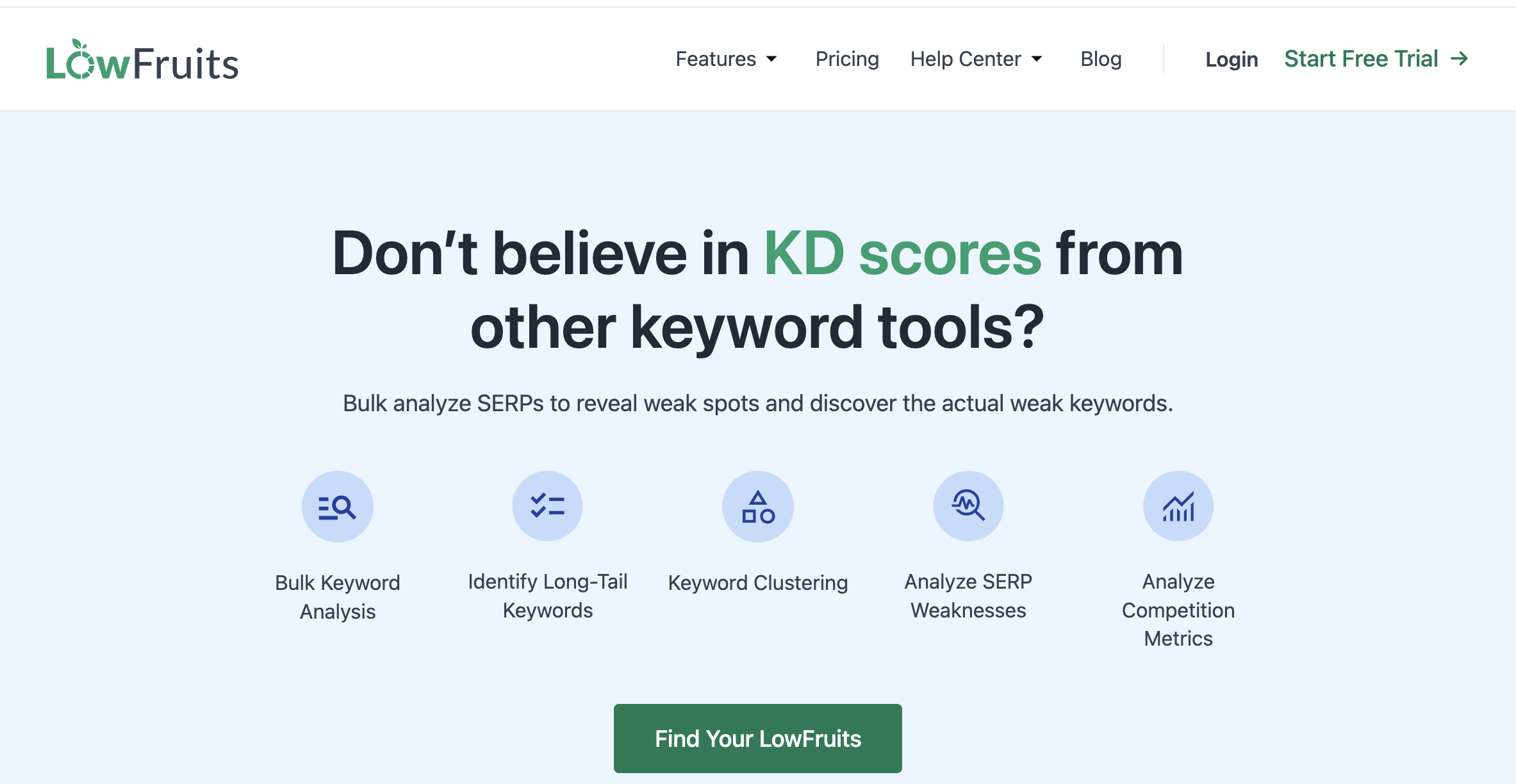
LowFruits serves newer and lower-authority sites that care less about a generic difficulty score and more about whether the current results are vulnerable. It bulk-analyzes SERPs and highlights weaknesses such as low-authority domains, thin title relevance, and result types that may signal room for a focused page.
The platform can generate long-tail ideas from Google Autocomplete or analyze an imported list. It also groups terms that share similar intent. LowFruits positions this direct SERP inspection as an alternative to relying on Keyword Difficulty alone.
Pros
- Weak-spot analysis focuses attention on SERPs where smaller sites may have a realistic opening.
- Bulk processing makes it practical to validate a long-tail list rather than inspect every result manually.
- Intent grouping helps turn selected weak-SERP opportunities into a cleaner content plan.
Cons
- The credit model charges one credit per analyzed keyword or extracted SERP, which can make broad exploratory analysis expensive.
- Pay-as-you-go credits expire after one year, while subscription credits reset and do not roll over.
- It does not replace a broad backlink index, technical crawler, or full competitor keyword database.
Pricing
The first analysis is free. Usage is credit-based, with one extracted SERP or analyzed keyword consuming one credit; pay-as-you-go credits expire after one year, and subscription credits reset without rollover. Confirm current package prices directly.
Verdict: Choose LowFruits when you need realistic long-tail openings and weak results, especially for a new or lower-authority site.
7. AnswerThePublic: best for questions and audience language

AnswerThePublic serves content teams that need discovery and audience phrasing rather than full competitive analysis. It organizes searches into questions, prepositions, comparisons, alphabeticals, numbers, and related terms, making it easy to see how people frame a topic.
The product now extends beyond keyword wheels. Its documentation describes People Also Ask data, AI prompt suggestions, AI response analysis, social sources, shopping searches, keyword lists, exports, and Content Studio. That mix is useful for planning conversational discovery across channels, not just standard Google results.
Pros
- Visual question and comparison patterns expose audience language that a conventional volume-first workflow can miss.
- People Also Ask, social, shopping, and AI prompt sources broaden ideation across discovery surfaces.
- Content Studio gives teams a path from question discovery into content production and WordPress publishing.
Cons
- Useful keyword metrics and higher search allowances depend on a paid plan rather than the core visual discovery experience alone.
- Competitor research is limited compared with Semrush, Ahrefs, or SE Ranking.
- Search, AI-response, user, and content-generation limits differ materially across tiers.
Pricing
Starter costs $20/month, Growth $99/month, and Business $199/month. Search, AI-response, user, and content-generation limits vary by plan.
Verdict: Choose AnswerThePublic when you need audience language, question patterns, cross-channel ideas, and prompt inspiration more than deep backlink or competitor data.
8. Surfer: best for moving from keyword to content brief
Surfer serves teams that have selected a topic and need to turn it into a brief and optimized page. Its free Keyword Surfer Chrome extension shows search volume, CPC, keyword ideas, overlap scores, estimated traffic, and competitor word counts directly in Google results. Users can save terms into collections and export them as CSV files.
Surfer says Keyword Surfer supports datasets across 70 countries. The wider Surfer workflow connects research with clusters, content planning, and optimization, reducing friction between a promising term and a usable content plan.
Pros
- The free browser extension puts volume, CPC, overlap, and competitor-page context directly into the SERP.
- Collections and CSV exports provide a simple bridge from discovery to content planning.
- The wider platform turns selected clusters into briefs and on-page optimization guidance.
Cons
- Surfer does not replace a full backlink index, technical crawler, or broad competitor keyword intelligence suite.
- Its optimization score can encourage mechanical term usage if a team treats it as an instruction rather than directional evidence.
- The free Keyword Surfer extension does not include the full briefing and optimization workflow of the paid platform.
Pricing
Keyword Surfer is a free Chrome extension. Full Content Editor, audit, planning, and AI capabilities require a paid Surfer plan with limits that vary by content volume; verify the current live package before purchase.
Verdict: Choose Surfer when keyword selection is settled, but creating a structured brief and optimizing the resulting page takes too much time.
9. ChatGPT or Claude with live SEO data: best flexible reasoning layer
ChatGPT or Claude can serve strategists who need a flexible analysis layer over exports and connected systems. Either model can expand product and problem themes, classify a supplied list, detect duplicates, propose clusters, summarize recorded SERP observations, map queries to personas, and convert an approved cluster into a brief.
Dependability comes from supplied facts. Upload a Search Console or keyword-tool export, provide current SERP notes, enable browsing, or connect an API or MCP server. Ahrefs documents MCP access in paid plans; Semrush describes ChatGPT as an ideation tool rather than a dedicated keyword database.
Pros
- Flexible instructions can adapt one verified dataset to intent classification, persona mapping, clustering hypotheses, and briefing.
- API and MCP connections can place reasoning inside an existing data and approval workflow.
- The model can explain its proposed groupings and flag ambiguous cases for SERP validation.
Cons
- The analysis is totally dependent on the data, browsing results, or connector context supplied to the model.
- It can fabricate precise-looking volume, difficulty, CPC, or ranking values when the prompt does not enforce source boundaries.
- Semantic clusters are hypotheses until validated against live ranking overlap, unlike a purpose-built SERP clustering product.
Pricing
Cost depends on the selected ChatGPT or Claude plan plus any SEO database, API, MCP, or automation connector required to supply live data. Usage-based API charges and third-party data allowances may become the main cost driver at scale.
Verdict: Use ChatGPT or Claude as the reasoning layer over verified data. Keep measurement in the source system.
Capability comparison: where each tool fits
The first table helps with purchase decisions. This matrix maps each product to a stage in the working process, from discovery and evidence through briefing and publication. “Live metrics” refers to retrieved keyword estimates or connected first-party data. “AI-prompt research” means discovering or analyzing prompts, not generating a list from a seed. Plan restrictions apply throughout.
| Tool | Discovery | Live metrics | SERP-based grouping | Competitor gaps | AI-prompt research | API/MCP | Briefs | Publishing path |
|---|---|---|---|---|---|---|---|---|
| Zerply | AI-powered keyword research and Keyword Clusters | Connected and platform data | Yes | Yes | Unified AEO Tracking | Workflow integrations | Zerply Agent | Paid Foundry add-on |
| Semrush | Strong | Keyword estimates | Yes | Strong | Strong | Plan-dependent | Yes | Integrations/workflow |
| Ahrefs | Strong | Keyword estimates | Plan-dependent | Strong | Separate capabilities | Plan-dependent | Content tools | External CMS workflow |
| SE Ranking | Strong | Keyword estimates | Yes | Strong | Wider-platform feature | Yes; check limits | Yes | Content Editor integrations |
| Keyword Insights | Strong | Keyword estimates | Strong | Topic-focused | Mentions/discovery | Limited | Strong | External CMS workflow |
| LowFruits | Long-tail | Keyword/SERP data | Yes | SERP-focused | No | Limited | No | Research export |
| AnswerThePublic | Questions | Plan-dependent | Topic organization | Limited | Yes | Limited | Yes | WordPress via Content Studio |
| Surfer | Yes | Keyword estimates | Yes | Content-focused | Limited | Integrations | Strong | External CMS workflow |
| Connected LLM | Generated ideas | Only when supplied | Semantic; validate by SERP | Only when supplied | Source-dependent | Connector-dependent | Strong | Connector-dependent |
Unlike the at-a-glance purchase table, this matrix shows the handoff each product can own and where an external database, brief, connector, or CMS is still required.
Three stack patterns cover most teams. A database plus Keyword Insights works for large-scale content architecture. A database plus Surfer works when editorial optimization is the constraint. A consolidated platform such as Zerply fits teams that want research, creation, publishing, and measurement in one operating loop.
Developers with custom products should also assess API-first data providers such as DataForSEO. That route offers flexibility, but the team assumes the cost of building storage, normalization, interfaces, and quality controls.
Which AI keyword research tool should you choose?
For a solo creator or early-stage site: start with the narrowest bottleneck. AnswerThePublic is useful when you need realistic questions and angles. LowFruits is more useful when you already have ideas but need to find beatable SERPs. Validate critical targets before writing.
For a small in-house content team: choose Zerply, Semrush or Ahrefs when dependable research data is the foundation. Add Surfer if briefs and optimization consume too much editorial time. Avoid paying for overlapping suites unless each has a defined owner and recurring use.
For an agency: With the newest feature of Zerply for agencies, Zerply deserves as serious evaluation for AI-powered keyword research, competitor analysis, AI visbility tracking, and automation. Semrush fits agencies that also need PPC and broad marketing intelligence. Keyword Insights can strengthen clustering-heavy audits and content-roadmap deliverables.
For an enterprise SEO team: When the priority is data coverage, permissions, API limits, historical depth, support, procurement requirements, and reproducibility, Zerply, Ahrefs and Semrush are the natural candidates. Evaluate AI visibility as a separate requirement rather than assuming conventional rank tracking covers it.
For a team that already has research but publishes too slowly: Zerply addresses the operational gap. It covers the chain from data and strategy to agentic drafting, approval, hosted publication, monitoring, and refreshes. This is a different buying decision from selecting the biggest keyword database.
For a developer or data team: assess API quality, units, rate limits, regional coverage, data licensing, and change management before the interface. A connected LLM can orchestrate the analysis, but the source system must remain auditable.
Buy for the bottleneck. A sophisticated tool that does not change a weekly decision is expensive shelfware.
A practical AI keyword research workflow
A reliable process gives generative AI room to reason while keeping measured facts traceable.
1. Define the business constraint
Specify the audience, offer, target country, conversion action, and page type before collecting terms. “Find SaaS keywords” is too broad. “Find commercial US queries used by agency owners comparing AI visibility platforms” gives the research a useful boundary.
That boundary improves relevance and stops attractive but disconnected keywords from crowding out terms tied to revenue.
2. Generate candidates
Use a maintained database, a specialist discovery tool, customer language, sales notes, site search, or an LLM. Keep the source attached to each term. Mark model-generated phrases as candidates rather than measured demand.
Ask for categories such as problems, use cases, alternatives, integrations, pricing, comparisons, and objections instead of demanding 1,000 undifferentiated ideas.
3. Validate demand and intent
For every priority term, record the data source, market, and collection date. Then inspect the current SERP. Note which page types dominate, which SERP features appear, whether the intent is mixed, and whether the current results are credible.
Compare estimates with Search Console where your domain already has impressions. A low-volume term with clear buying intent and existing visibility can be more valuable than a high-volume term disconnected from the product.
4. Cluster by shared SERP intent
Put queries on the same page when one asset can satisfy the same audience, task, and conversion purpose. Shared wording is not enough. “Keyword research software” and “keyword research service” discuss the same topic but usually require different pages.
For important clusters, validate overlap among ranking URLs. Compare the proposal with existing pages so the new content does not create cannibalization.
5. Publish, measure, and refresh
Turn the approved cluster into a brief with a clear reader task, angle, evidence plan, internal links, and conversion goal. Draft it, verify every consequential claim, edit for the brand’s voice, publish, and measure the query set after indexing.
Research often stalls at this stage. Our From Insights to Impact workflow connects visibility gaps to content strategy while buildings content that gets cited with focuses on clear answers, sound structure, authority, and specific evidence.
Use this prompt when handing validated data to an LLM:
Create a page-level content map from the attached keyword export and URL inventory.
Preserve all supplied metrics. Group terms only when one page can satisfy the same
intent and task. For each cluster, name the proposed page type, primary topic,
supporting terms, existing URL fit, conversion goal, confidence, and validation gaps.
Do not invent volume, difficulty, rankings, or SERP observations.
The output should produce defensible page actions: create, update, merge, redirect, monitor, or reject.
Final verdict
No product wins every category. Zerply is an complete AI vsibility platform that also offers Keyword research, Semrush offers the broadest conventional marketing suite. Ahrefs is strong for SERP evidence, backlinks, and traffic potential. SE Ranking is compelling for agency workflows and automation.
Keyword Insights handles large-scale clustering, LowFruits exposes weak SERPs, AnswerThePublic finds audience language, and Surfer connects target selection to content optimization.
A connected LLM adds flexible reasoning without replacing the data source, which is why free AI tools for keyword research should be treated as idea generators rather than final evidence.
Choose Zerply when the problem includes disconnected tools, slow handoffs, delayed publishing, and a weak connection between search performance and AI visibility.
Keyword Clusters structures the opportunity, the Zerply Agent and Blog creation agent execute it, Unified AEO Tracking and Citation Decay reveal what changed, and the paid Foundry add-on publishes the approved page.
See how your brand shows up in AI search
Track visibility, citations, prompts, and competitors across leading AI platforms.
Frequently asked questions
What is the best AI tool for keyword research?
The best tool depends on the workflow. Zerply fits teams that want research, drafting, publishing, and performance monitoring in one platform. Semrush is a strong broad SEO suite, Ahrefs excels at SERP and traffic-potential analysis, and Keyword Insights specializes in SERP-based clustering.
Can ChatGPT do keyword research?
ChatGPT can expand seed topics, classify intent, remove duplicates, cluster supplied keywords, and create briefs. It should not be trusted to invent current search volume, CPC, difficulty, or ranking data unless it is connected to a reliable live source.
What is the best free AI keyword research tool?
Free tools are best used as a stack. Keyword Surfer can show basic metrics in Google, AnswerThePublic can surface questions, and limited versions of established SEO platforms can validate selected terms. Confirm important opportunities with live SERP and first-party data.
What is the difference between an AI keyword generator and a keyword research tool?
An AI keyword generator predicts relevant phrases from language patterns. A full keyword research tool connects ideas to demand estimates, difficulty, CPC, trends, intent, SERP results, and competitor data. Use generators for brainstorming and maintained databases for validation.
Which AI tool is best for keyword clustering?
Keyword Insights is a strong specialist choice because it groups terms using SERP similarity rather than wording alone. Semrush, Ahrefs, SE Ranking, and Surfer also offer clustering, but availability and depth vary by plan.
Are AI keyword research tools accurate?
Their metrics are estimates, not exact counts. Accuracy varies by source, market, update frequency, and methodology. Compare opportunities within one platform, inspect the live SERP, and use Google Search Console when first-party query data is available.
How should agencies choose an AI keyword research tool?
Agencies should compare data coverage, client and project limits, exports, API capacity, reporting, permissions, regional support, and total cost. They should also decide whether they need research only or a workflow that extends into briefs, publishing, and performance monitoring.
Written by
Founder at Zerply.ai & Wittypen
Anshul is the founder of Zerply.ai and previously built Wittypen, a content marketplace powering SEO growth for 1,000+ businesses. Over the last decade he has worked hands-on with B2B SaaS and tech teams to turn search data into compounding organic growth. At Zerply he shares practical playbooks on AEO, AI visibility, and modern SEO that come directly from experiments, wins, and failures in real projects.