8 Best SEO Tools in 2026: Research, Content, Technical SEO, and AI Visibility

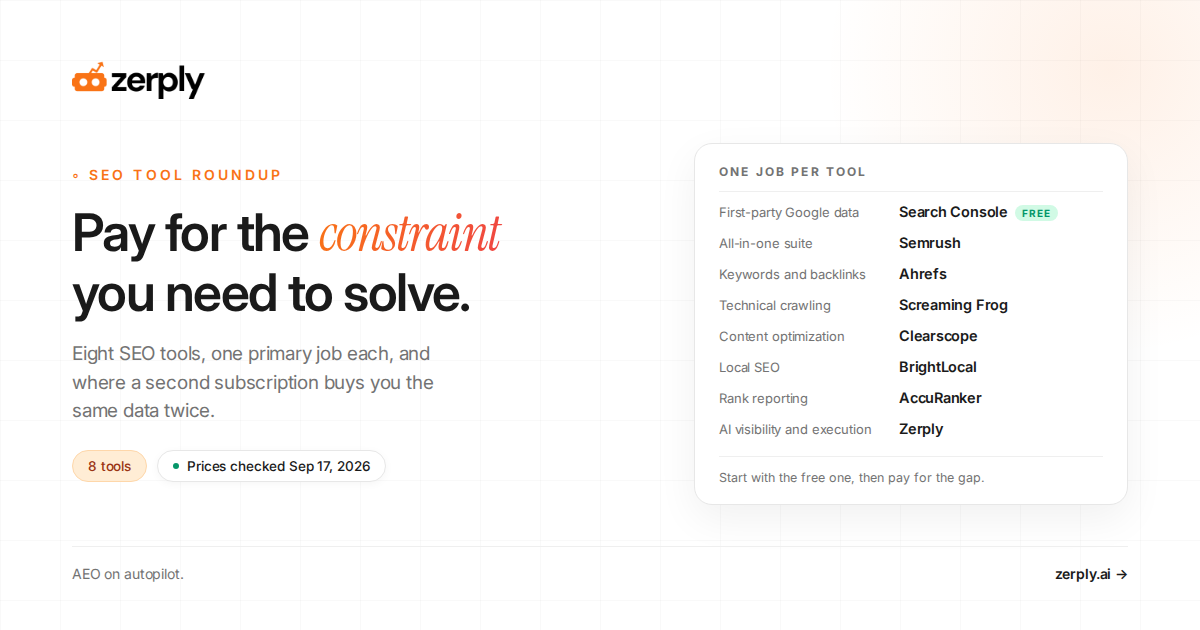
The best SEO tools in 2026 are Zerply, Semrush, Ahrefs, Screaming Frog, Clearscope, Google Search Console, BrightLocal, and AccuRanker. Zerply is the best SEO tool for teams that want research, AI visibility tracking, content strategy automation, agentic drafting, and publishing in one workflow.
It also belongs on any shortlist of the best SEO automation tools because it connects insights to execution. Use specialist tools alongside it when you need deep crawling, backlink research, local SEO, or dedicated rank reporting.
This guide compares the best tools for SEO across AI visibility, content execution, keyword research, technical SEO, on-page SEO, local SEO, and reporting. It is written for marketing managers, in-house SEO leads, and agency owners who need a practical SEO tool stack without paying for overlapping features.
Disclosure: This comparison is published by Zerply. There are no affiliate links in this article. Zerply is ranked first because this list prioritizes AI visibility, content execution, publishing, and search-performance workflows as the core SEO constraint for 2026 teams.
How we chose the best SEO tools
Each tool on this list has a clear primary job. We did not fill the list with eight similar suites. The shortlist covers AI visibility and SEO workflow, all-in-one SEO, keyword and backlink research, technical crawling, content optimization, free SEO data, local SEO, and rank tracking.
We checked product claims and public pricing against official vendor pages on September 17, 2026. We evaluated each tool by primary use case, workflow fit, pricing clarity, integrations, and the gap it solves in a modern SEO stack. Pricing can change, so treat the numbers here as a snapshot and confirm current limits, seats, add-ons, and billing terms before buying. This is a commercial-investigation comparison, not a hands-on benchmark. No vendor supplied test results.
A good SEO stack should help the team act faster, not create another reporting layer. Semrush, Ahrefs, and Clearscope start at $139, $129, and $129 per month respectively, or $397 per month before seats, add-ons, and overages.
That stack can make sense for a large team, but it is expensive if your main constraint is turning search data into published work. Zerply belongs at the top of this list because it connects SEO research, AI visibility tracking, content creation, and publishing in one system.
Best SEO tools comparison
| Rank | Tool | Best for | Standout capability | Main drawback | Starting price | Verdict |
|---|---|---|---|---|---|---|
| 1 | Zerply | AI visibility, SEO workflow, and content execution | Tracks AI-answer visibility, finds citation decay, creates content, and publishes from one platform | Standard plans cover one brand and four of seven engines | $41/mo | Best all-in-one choice for AI SEO workflows and content execution |
| 2 | Semrush | Broad SEO suite | Research, tracking, site audit, and AI-search monitoring | Costs rise with add-ons and larger limits | $139/mo | Strong suite for teams that want broad SEO coverage |
| 3 | Ahrefs | Keywords and backlinks | Web-scale competitive and link research | Research does not run the content workflow | $129/mo | Best specialist for competitor-led research and backlinks |
| 4 | Screaming Frog | Technical SEO crawling | Configurable page-level crawls | Desktop software with a technical learning curve | Free; $279/year paid | Essential for audits, migrations, and technical QA |
| 5 | Clearscope | On-page SEO and content optimization | Topic exploration and content grading | Expensive for a light publishing cadence | $129/mo | Useful editorial layer for content teams |
| 6 | Google Search Console | Free SEO data | Queries, clicks, indexing, and crawl diagnosis | Google-only, with no competitor database | Free | The free foundation for every Google SEO program |
| 7 | BrightLocal | Local SEO and agencies | Local rank tracking, audits, and geo-grid maps | Citation building is a separate paid service | $39/mo | Best fit for local and multi-location search programs |
| 8 | AccuRanker | Dedicated rank reporting | High-volume keyword and prompt reporting | Public entry price is not displayed | Quote-based | Best where rank tracking needs its own reporting system |
Prices are monthly list prices in USD unless a vendor sells only an annual license or does not publish an entry rate. Screaming Frog lists an annual per-user license. AccuRanker does not display a public entry price.
1. Zerply: best SEO tool for AI visibility and content execution
Zerply is built for the part of SEO that often slows teams down: moving from evidence to shipped work. A marketer can find visibility gaps, see which prompts and citations matter, turn those signals into content ideas, draft pages, and publish without stitching together a keyword tool, a content planner, an AI writing app, a CMS workflow, and an AI visibility dashboard.
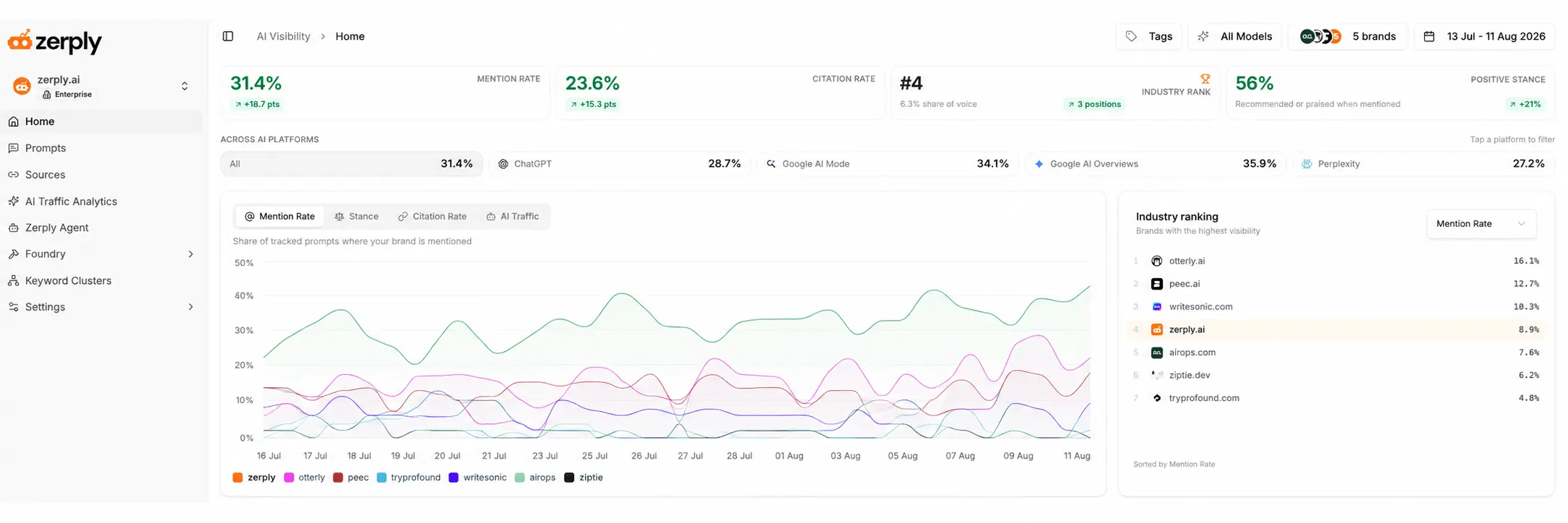
That matters more in 2026 because SEO work no longer stops at blue-link rankings. Teams also need to know where they appear in AI answers, which pages get cited, which citations are decaying, and whether search performance improves after content ships. Zerply combines SEO research, AI visibility, content strategy automation, agentic drafting, and publishing so those jobs sit in the same workflow instead of five browser tabs.
It is not trying to replace every specialist tool. If you need a deep JavaScript crawl, use Screaming Frog. If your program depends on heavy backlink prospecting, keep a backlink index. Zerply is the strongest first choice when the bottleneck is execution: turning visibility gaps into briefs, pages, refreshes, and published content.
Pros
- Zerply connects AI visibility tracking, keyword clusters, Google Search Console data, GA4 data, content creation, and publishing in one platform.
- Citation Decay shows when pages or citations lose visibility, which gives teams a concrete refresh queue instead of a static report.
- Foundry can create and publish blogs and landing pages in the same workflow, so the team can go from signal to live asset without exporting a brief.
- AI Traffic Analytics tracks AI-bot activity at the server layer, giving technical teams another signal for how AI systems access the site.
- It is one of the best AI SEO tools for teams that need to report on AI SEO KPIs such as citations, share of voice, prompt coverage, sentiment, and AI-referred traffic.
Cons
- Standard plans track one brand or domain. Agency and multi-brand work requires Enterprise.
- Standard plans support any four of seven engines: ChatGPT, Google AI Overviews, Google AI Mode, Gemini, Perplexity, Copilot, and Grok. Claude is Enterprise-only via API.
- Foundry is a $25/month add-on for 500 pages, so publishing at scale may add to the base subscription.
Pricing
- Starter is $41/month for 15 prompts, any four supported platforms, one seat, one brand, and 100 AI Agent credits.
- Pro is $166/month for 100 prompts, three seats, one brand, and 100 credits.
- Business is $249/month for 200 prompts, five seats, one brand, and 200 credits.
- Annual billing gives two months free, and the trial lasts seven days.
Best for
Zerply is best for single-brand teams that want one SEO and AI optimization workflow for research, planning, drafting, publishing, and visibility tracking. It is also a strong choice for teams moving from classic keyword reporting toward semantic search optimization, answer-first content, and AEO.
See how your brand shows up in AI search
Track visibility, citations, prompts, and competitors across leading AI platforms.
2. Semrush: best broad SEO suite
Semrush is the broad-suite pick. It suits teams that want one place for keyword research, competitor analysis, rank tracking, site audits, and client-ready reporting, especially when several people need to look at the same SEO program from different angles.
The product has enough depth for daily SEO operations, but that breadth is also the trade-off: teams get the most value when they know which reports matter and ignore the rest.
Its SEO plan combines keyword and competitor research, Position Tracking, Site Audit, AI-search performance tracking, AI sentiment monitoring, and AI visibility reports.
For teams that want a familiar enterprise-style SEO suite with newer AI-search reporting layered in, Semrush is still one of the safest options.
Pros
- Semrush puts keyword research, position tracking, site audits, competitive analysis, and AI-search monitoring under one subscription.
- The entry SEO plan includes five monitored websites and 500 daily tracked keywords.
- AI visibility reports and custom-prompt monitoring are available alongside conventional SEO reporting.
Cons
- Add-on users, reporting, and higher limits can push the cost well above the entry price.
- The product is broad, so teams need a clear reporting routine instead of opening every report.
- It can overlap with other best SEO optimization tools if your stack already includes separate research, rank tracking, and audit tools.
Pricing
Semrush SEO starts at $139/month. The plan includes five websites, 500 daily tracked keywords, basic keyword and competitor analysis, Position Tracking, and Site Audit.
Best for
Semrush is best for teams that want broad SEO coverage from one vendor and can justify the cost of a full suite.
3. Ahrefs: best SEO tool for keyword and backlink research
Ahrefs is the research-heavy choice for teams that plan SEO around competitor gaps, link profiles, and demand discovery. It is especially useful when the question is not “what should we write today?” but “where are competitors earning traffic, links, and topical authority that we are missing?”
The tool is strongest when a strategist knows how to turn data into a roadmap. It can surface keyword gaps, link opportunities, broken-link angles, and competing pages, but the writing, approval, publishing, and refresh process still happens elsewhere.
Pros
- Ahrefs has a large web index for link prospecting, competitor analysis, and content-gap research.
- Content Explorer and broken-link reports appear on higher tiers for teams running digital PR or link campaigns.
- Brand Radar AI prompt packages are available separately for teams that want AI-search research in the same ecosystem.
Cons
- The $129 Lite plan is an entry point; advanced research functions sit on higher tiers.
- Ahrefs surfaces research opportunities, but drafting, approvals, publishing, and refresh workflows still happen elsewhere.
- It is not the best all-in-one SEO tool if the team’s main bottleneck is content execution rather than discovery.
Pricing
Ahrefs Lite costs $129/month and includes one user, Site Audit, Rank Tracker, competitive analysis, and web analytics.
Best for
Ahrefs is best for SEO teams where link gaps, competitor-led keyword research, and backlink analysis set the roadmap.
4. Screaming Frog: best technical SEO crawler
Screaming Frog is the crawler SEOs keep open when a site needs a real technical look. It turns a website into a spreadsheet of URLs, status codes, canonicals, metadata, links, directives, duplicates, structured data, and crawl paths, which makes it much easier to find problems before they become ranking or indexing losses.
It is not a light “score your SEO” tool. It rewards technical judgment. The free version crawls up to 500 URLs, which is enough for small checks and quick diagnosis. A paid US license costs $279 per user per year and removes that crawl limit, subject to machine capacity.
Pros
- Screaming Frog checks links, redirects, metadata, robots directives, hreflang, duplicates, structured data, and more at page level.
- Crawl exports give developers a concrete backlog for migrations, launches, and redirect cleanups.
- The paid license supports Google Analytics, Search Console, and PageSpeed Insights integrations.
Cons
- It is desktop software, so large crawls depend on the user’s memory and storage.
- Canonicals, response codes, JavaScript rendering, and indexability reports require technical SEO judgment.
- It is one of the best tools for SEO audits, but it does not replace planning, writing, publishing, or AI visibility tracking.
Pricing
Screaming Frog is free for up to 500 URLs. The paid license is $279 per user per year for unlimited crawling and advanced features.
Best for
Screaming Frog is best for technical SEOs, site migrations, recurring QA, and large sites where crawl issues can quietly hurt rankings.
5. Clearscope: best on-page SEO tool for content optimization
Clearscope is for content teams that already have writers, editors, and a publishing process, but want a better way to decide what a strong page should cover. It helps turn a target query into related topics, common questions, and coverage signals, then gives editors a consistent way to review drafts before they go live.
The value is editorial discipline. Clearscope can keep writers from missing obvious subtopics, but it works best when editors treat the score as guidance, not as a mandate to stuff terms into a page. Its Essentials plan costs $129 per month and includes 50 pages, 20 Topic Explorations, 20 monthly drafts, and 50 tracked prompts.
Pros
- Topic Explorations turn a target query into related language, concepts, questions, and entities for a content brief.
- Page grading gives editors a consistent review point across writers, refreshes, and priority pages.
- The Essentials plan supports unlimited sharing and exporting, which helps distributed editorial teams.
Cons
- A $129 monthly subscription needs a steady volume of priority content to justify it.
- Scores can push writers toward formulaic copy when editors treat recommended terms as a checklist.
- Clearscope is one of the best on-page SEO tools, but it is not a publishing system or a full search-performance workflow.
Pricing
Clearscope Essentials costs $129/month and includes 50 pages, 20 Topic Explorations, 20 monthly drafts, and 50 tracked prompts.
Best for
Clearscope is best for content teams with an established editorial process, a meaningful publishing cadence, and a need for consistent on-page optimization.
Know where your brand stands in AI
Monitor your visibility across ChatGPT, Google AI Overviews, Gemini, and more.
6. Google Search Console: best free SEO tool
Google Search Console is the free tool every SEO program should install before buying anything else. It shows how Google sees a verified site: which queries trigger impressions, which pages earn clicks, which URLs fail indexing, and where crawl or coverage issues may block performance.
It does not replace a competitor database, crawler, content workflow, or AI visibility tracker. Its job is narrower and more important: it gives teams first-party Google data they can trust. Use it to find high-impression pages with weak click-through rates, queries that lack a strong page, and URLs Google cannot index as expected. Then add paid tools only where they solve a specific gap.
Pros
- Search Console is the direct source for Google Search performance and indexing information on a verified property.
- URL Inspection and Indexing reports help diagnose crawl and coverage issues without a paid suite.
- Performance reports expose queries and pages already earning impressions, which makes it a practical source for content refreshes.
Cons
- It covers Google and verified properties only.
- It does not provide a full competitor keyword database, backlink prospecting workflow, or editorial brief generator.
- It is essential, but it is not enough on its own for a complete SEO automation stack.
Pricing
Google Search Console is free.
Best for
Google Search Console is best for every site that wants reliable Google performance, indexing, and query data.
7. BrightLocal: best SEO tool for local SEO and agencies
BrightLocal is built for the kind of SEO where location changes the answer. A rank in one neighborhood may not match a rank three miles away, and local teams need to see that variation instead of relying on one city-level keyword position. That makes BrightLocal a strong fit for local service brands, franchises, multi-location companies, and agencies managing Google Business Profile work.
Its Track plan supports local audits, keyword monitoring, competitor benchmarking, and geo-grid views. The tool is most useful when local visibility, listings, and location-level reporting matter more than national keyword databases or backlink research.
Pros
- Geo-grid maps show ranking variation across a service area instead of reporting one generic location-level position.
- The Track plan monitors up to 100 keywords and four competitors for each location.
- Paid plans include local audits and Google Business Profile benchmarking for location-level delivery.
Cons
- Citation Builder is pay-as-you-go, starting at $3.20 per site, rather than included in the subscription.
- BrightLocal does not offer the backlink and national keyword-research depth of a broad SEO suite.
- It is a strong local SEO tool, but it is not the best fit for non-local SaaS or national content programs.
Pricing
BrightLocal Track costs $39/month on monthly billing. The $31 figure promoted on BrightLocal’s local-tools page reflects annual billing, so it is excluded from this monthly-price comparison.
Best for
BrightLocal is best for multi-location businesses, local service brands, franchises, and agencies managing local search programs. It also deserves consideration among the best SEO tools for agencies that need local reporting at scale.
8. AccuRanker: best dedicated rank tracking tool
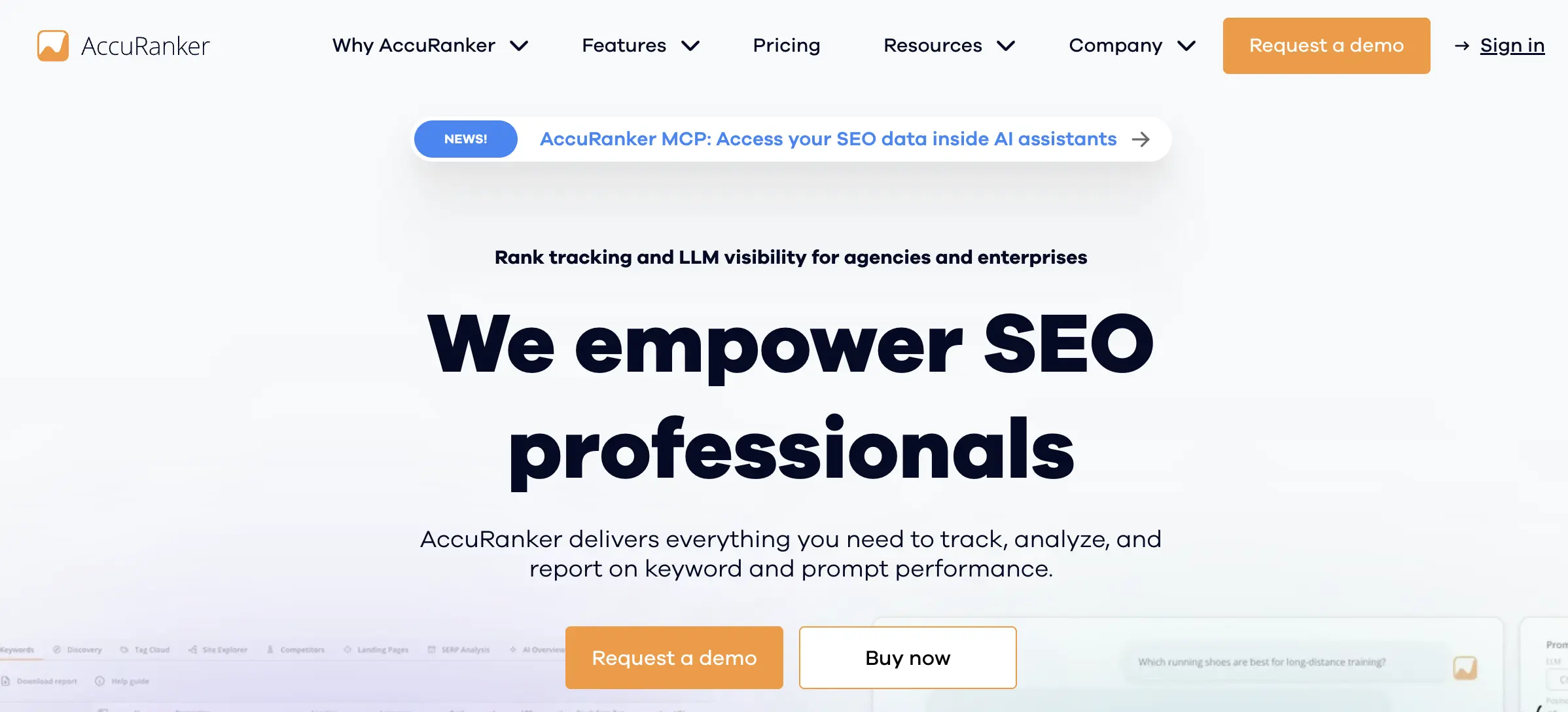
AccuRanker is for teams that need rank tracking to be its own system, not a side report inside a broader SEO suite. That usually means agencies, enterprise SEO teams, and reporting-heavy programs with large keyword sets, many markets, and stakeholders who expect clean movement data on demand.
It organizes keyword and prompt performance with real-time updates, reporting, filters, tags, competitor views, forecasting, and integrations. The strength is segmentation: teams can slice performance by client, market, intent, page group, or campaign without forcing every ranking question into one generic dashboard.
Pros
- More than 50 filters and tags help teams segment large keyword sets by client, market, intent, or page group.
- The product is built to organize and report on thousands of keywords, with unlimited users, domains, and API calls stated on its site.
- AccuLLM covers prompt visibility across ChatGPT, Perplexity, AI Overviews, and AI Mode.
Cons
- AccuRanker does not publish an entry price; pricing is quote-based.
- It reports movement, but diagnosing a drop still requires search, crawl, and page-level evidence.
- It is a reporting specialist, not a complete content strategy automation platform.
Pricing
AccuRanker pricing is quote-based. AccuRanker does not display a public entry rate on its current product page. Request pricing.
Best for
AccuRanker is best for agencies and enterprise teams reporting on large, segmented keyword portfolios.
Best SEO tools by use case
Choose Zerply if you want one workflow for AI visibility, SEO research, content planning, drafting, publishing, and performance measurement. It is the best fit when the team needs to create content from search and AI-answer signals instead of adding another dashboard.
Choose Semrush if you want a broad SEO suite with research, auditing, position tracking, and AI-search monitoring. Choose Ahrefs if backlinks, competitor research, and keyword gaps drive most of your roadmap. Choose Screaming Frog if technical SEO risk is high because the site is large, old, JavaScript-heavy, or changing often.
Choose Clearscope if you already have a publishing workflow but need stronger content briefs and on-page coverage checks. Choose Google Search Console as the free foundation for every Google SEO program. Choose BrightLocal if rankings depend on local packs, service areas, listings, and location-level reporting. Choose AccuRanker if rank tracking and client reporting need their own dedicated system.
The simplest stack for many teams is Google Search Console plus Zerply. That combination gives you first-party Google data, AI visibility tracking, content strategy automation, drafting, publishing, and reporting without forcing the team to manage several disconnected tools. Add specialist software only when the job clearly demands it.
Bottom line
The best SEO tool is the one that removes the biggest constraint in your workflow. If you only need indexing and query data, start with Google Search Console. If you need deep backlinks, use Ahrefs. If you need deep crawls, use Screaming Frog.
If you need to turn SEO and AI visibility signals into published content, Zerply should be first on your shortlist. Explore Zerply with a 7-day free trial.
Frequently asked questions
What are the best SEO tools in 2026?
The best SEO tools in 2026 are Zerply, Semrush, Ahrefs, Screaming Frog, Clearscope, Google Search Console, BrightLocal, and AccuRanker. Zerply ranks first for teams that want AI visibility tracking, SEO research, content strategy automation, drafting, and publishing in one workflow.
What is the best SEO tool for AI visibility and content execution?
Zerply is the strongest choice for AI visibility and content execution because it connects prompt tracking, citation signals, keyword clusters, Google Search Console data, content generation, and publishing. It works best when the team needs to turn visibility gaps into live content.
What is the best free SEO tool?
Google Search Console is the best free SEO tool because it provides first-party Google data for queries, clicks, impressions, indexing, crawl issues, and verified site performance. Most teams should use it as the foundation before adding paid tools.
Does Zerply replace a technical crawler or backlink index?
No. Zerply is built for AI visibility, SEO workflow automation, content strategy, drafting, publishing, and performance tracking. Use Screaming Frog for deep technical crawls and Ahrefs for backlink-heavy research when those jobs are central to the program.
Which SEO tools should agencies consider?
Agencies should consider Zerply for AI visibility and content execution, BrightLocal for local SEO reporting, AccuRanker for dedicated rank tracking, and Semrush or Ahrefs for broader research. The right stack depends on whether the agency sells content, technical SEO, local SEO, reporting, or link-led strategy.
Written by
Founder at Zerply.ai & Wittypen
Anshul is the founder of Zerply.ai and previously built Wittypen, a content marketplace powering SEO growth for 1,000+ businesses. Over the last decade he has worked hands-on with B2B SaaS and tech teams to turn search data into compounding organic growth. At Zerply he shares practical playbooks on AEO, AI visibility, and modern SEO that come directly from experiments, wins, and failures in real projects.