Semrush AI Visibility Products Reviewed: What Each One Does and Costs

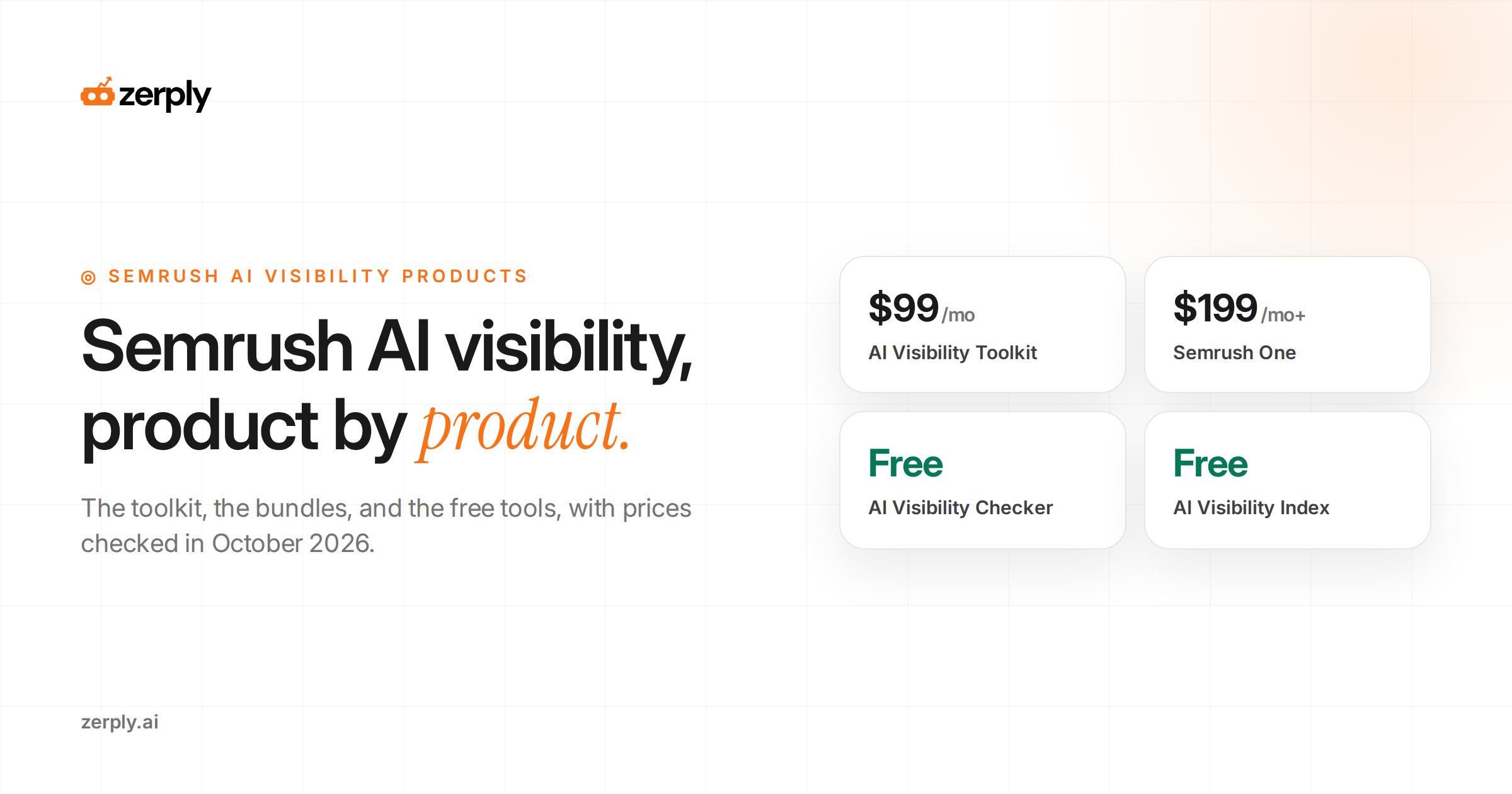
The short answer: Semrush sells its AI visibility products three ways: a $99-a-month AI Visibility Toolkit, Semrush One plans that bundle it with the SEO suite, and free tools including an AI Search Visibility Checker and the AI Visibility Index. Its research reports go deep, especially on prompt demand and brand sentiment. Its tracking is the weak spot, with 25 prompts on the base toolkit and a $99 charge for every extra user or domain.
Semrush changed owners this year, so its AI products now sit inside a much bigger company's roadmap. We went through Semrush's knowledge base, product pages, and announcements on October 27, 2026, to see what each product does, what it costs, and how it compares with other AI visibility tracking tools.
| Product | What it does | Price |
|---|---|---|
| Semrush AI Visibility Toolkit | AI visibility research, brand reports, and prompt tracking | $99 a month per user and domain |
| Semrush One | The SEO suite and AI Visibility Toolkit in one plan | From $199 a month |
| AI Search Visibility Checker | A free snapshot of a brand's AI visibility | Free |
| AI Visibility Index | A free public study of brand visibility in AI search | Free |
| Semrush Enterprise AIO | AI visibility for large enterprises | Custom |
Semrush is now an Adobe company
Adobe completed its acquisition of Semrush on April 28, 2026, in a deal announced at about $1.9 billion. In its announcement, Adobe said it would combine Semrush's data with its own brand visibility products, including Adobe Experience Manager and Adobe LLM Optimizer.
The bigger question for users is direction. Adobe's products are built for large enterprises, and Semrush's AI Visibility Toolkit is built, in Semrush's own words, for SMBs, agencies, and mid-market companies. How Adobe balances these audiences will shape where the toolkit goes next.
Semrush AI Visibility Toolkit
The AI Visibility Toolkit is Semrush's main AI product. According to Semrush's knowledge base, it bundles six reports:
- Visibility Overview gives any brand an AI Visibility Score, worldwide or by region.
- Competitor Research shows the prompts and topics where competitors get cited and you don't.
- Prompt Research works like keyword research for AI, with topic volume, difficulty, and intent.
- Brand Performance analyzes share of voice, sentiment, and the narratives behind your reputation.
- Prompt Tracking monitors chosen prompts daily on platforms including ChatGPT and Google AI Mode.
- AI Search Site Audit flags technical issues that could block AI crawlers.
The research side draws on a large prompt database. Semrush says it monitors more than 239 million LLM prompts globally.
Pros
- Prompt Research shows demand by topic before you choose which prompts to track.
- Brand Performance goes past mentions into sentiment and narrative, with AI-written recommendations.
- Prompt Tracking covers more than 220 countries and territories.
- It sits in the same login as Semrush's SEO data.
Cons
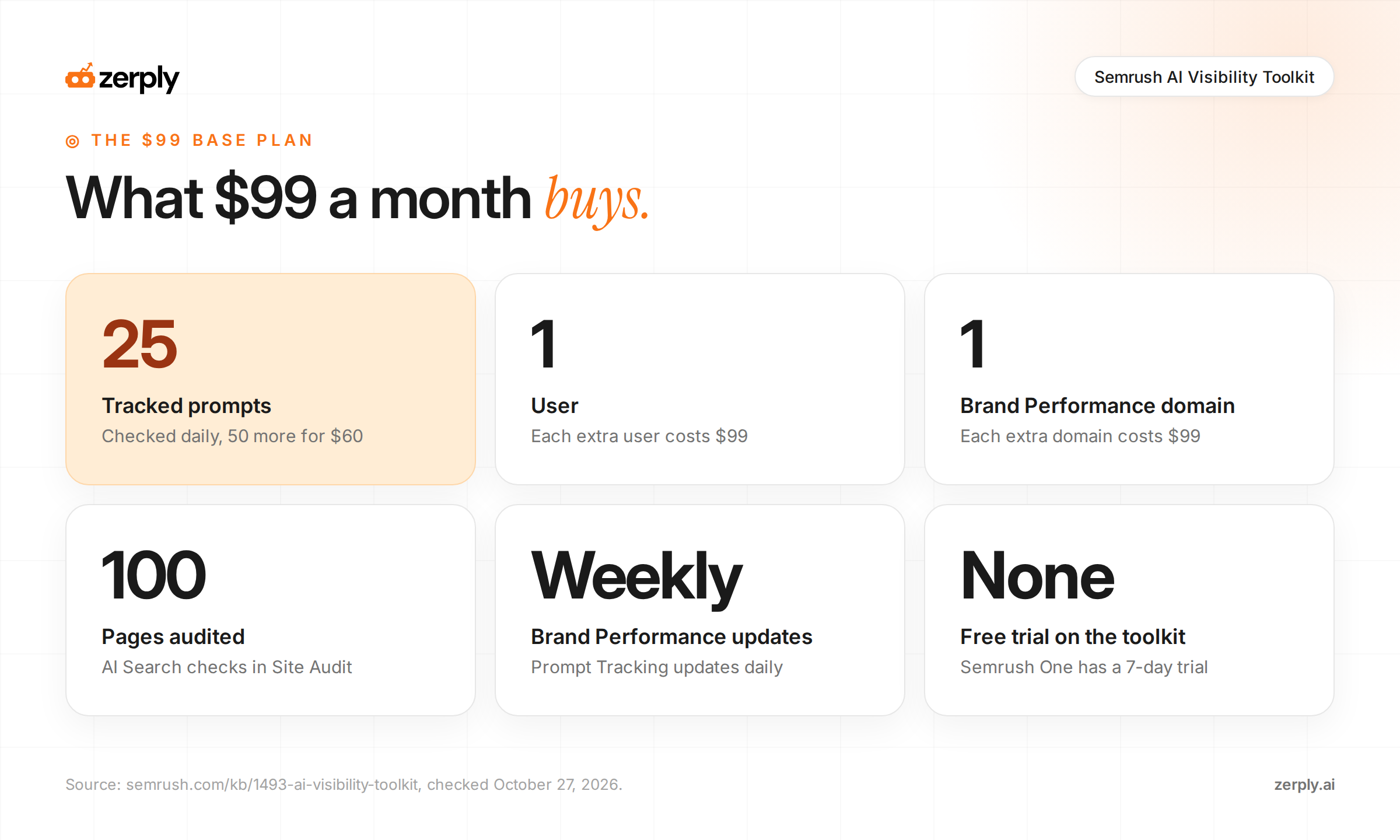
- The base plan tracks only 25 prompts, and 50 more cost $60 a month.
- Every user needs their own $99 license, because the toolkit can't use shared limits.
- Brand Performance covers one domain, and each extra domain or location costs $99.
- Brand Performance updates weekly, not daily.
- There's no free trial for the standalone toolkit.
Pricing: $99 a month, which covers one user, one Brand Performance domain, 25 tracked prompts, and AI Search checks on up to 100 pages.
Semrush One
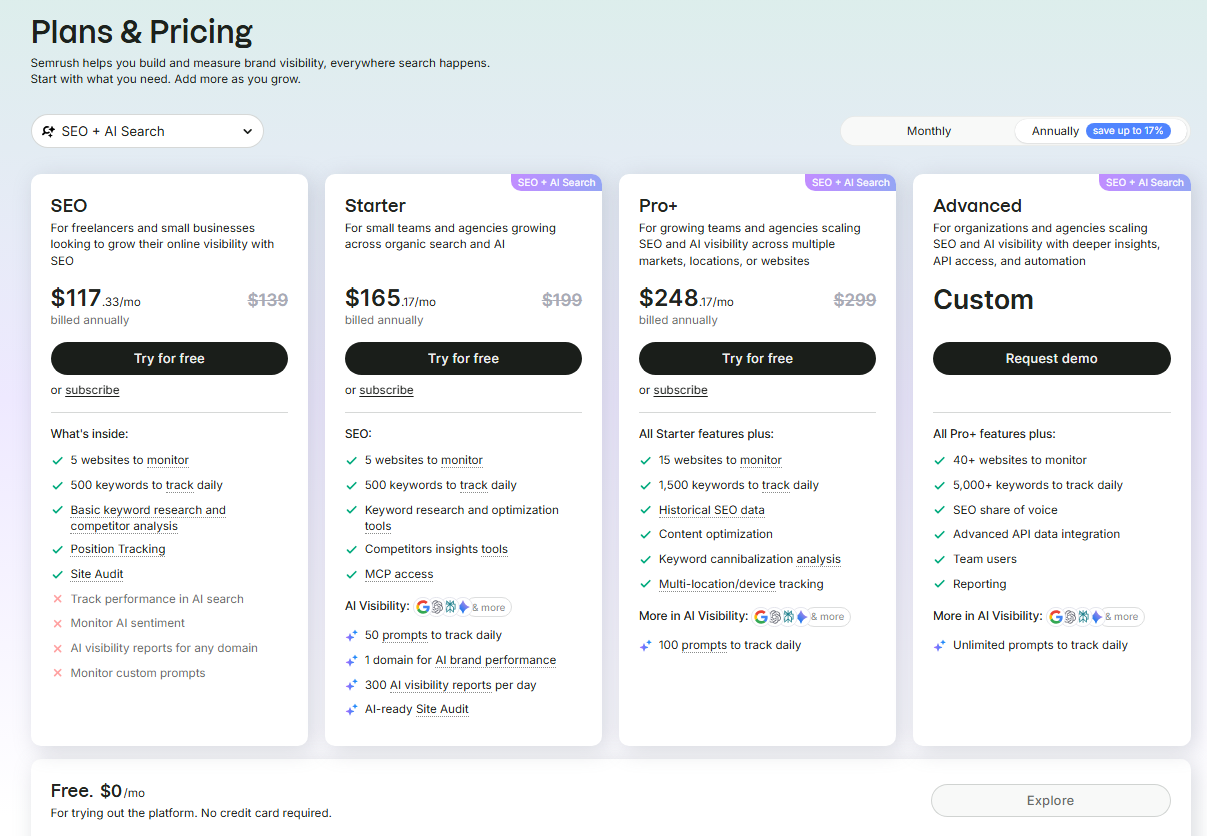
Semrush One bundles the SEO toolkit and the AI Visibility Toolkit into one plan, with higher prompt limits than the standalone toolkit. Semrush's knowledge base lists three tiers.
Pros
- It puts SEO and AI visibility in one plan, so teams that need both don't stack two subscriptions.
- Prompt limits are at least double the standalone toolkit's.
- New users get a 7-day free trial.
- It includes MCP access, so you can query Semrush data from AI assistants such as ChatGPT and Claude.
Cons
- You pay for the full SEO suite even if AI visibility is all you need.
- The top tier has no listed price.
Pricing: Starter costs $199 a month, or $165.17 billed annually, with 50 prompts, 5 websites, and 500 tracked keywords. Pro+ costs $299 a month, or $248.17 billed annually, with 100 prompts, 15 websites, and 1,500 keywords. Advanced comes with custom enterprise pricing and unlimited prompts tracked daily.
Semrush AI Search Visibility Checker
The AI Search Visibility Checker is a free tool that grades a brand's visibility across ChatGPT, Gemini, and Google AI Overviews. Its report shows the prompts that trigger a mention and the most-cited sources in your industry.
Pros
- It's free and needs no setup.
- It gives a quick read on whether AI platforms mention your brand at all.
Cons
- It's a one-time snapshot, not ongoing tracking.
- You can't choose the prompts it runs.
Pricing: free.
Semrush AI Visibility Index
The AI Visibility Index is a free public study, not a product you track with. Semrush released the 2026 edition on June 26, analyzing 126 million US AI search prompts from January through April 2026 across ChatGPT, Gemini, Google AI Mode, and Google AI Overviews, with benchmarks for 22 industries. A UK edition followed in October.
The findings are useful for planning. In Semrush's release, ChatGPT cited an average of 15 sources per response and Gemini an average of 3. Only 36 brands kept top-100 visibility on all four platforms every month.
Pros
- It's free, with industry and platform benchmarks.
- It shows how differently each AI platform picks sources.
Cons
- It covers large brands and categories, so a small brand won't find itself in it.
- It's a periodic study, not live data.
Pricing: free.
Semrush Enterprise AIO
Semrush Enterprise AIO is the enterprise version of AI visibility tracking, and it supplied the data behind the original AI Visibility Index in 2025. It's sold through Semrush's enterprise sales team, with custom pricing.
Pros
- It's built for large brands with many domains and regions.
- It sits alongside Semrush's other enterprise products.
Cons
- There's no public pricing.
- It's out of reach for small teams.
Pricing: custom.
What Semrush AI visibility costs at scale
Semrush's per-user and per-domain pricing is easy to read and adds up quickly. Here's how the standalone toolkit grows:
| Setup | Monthly cost |
|---|---|
| One user, one domain, 25 prompts | $99 |
| One user, one domain, 75 prompts | $159 |
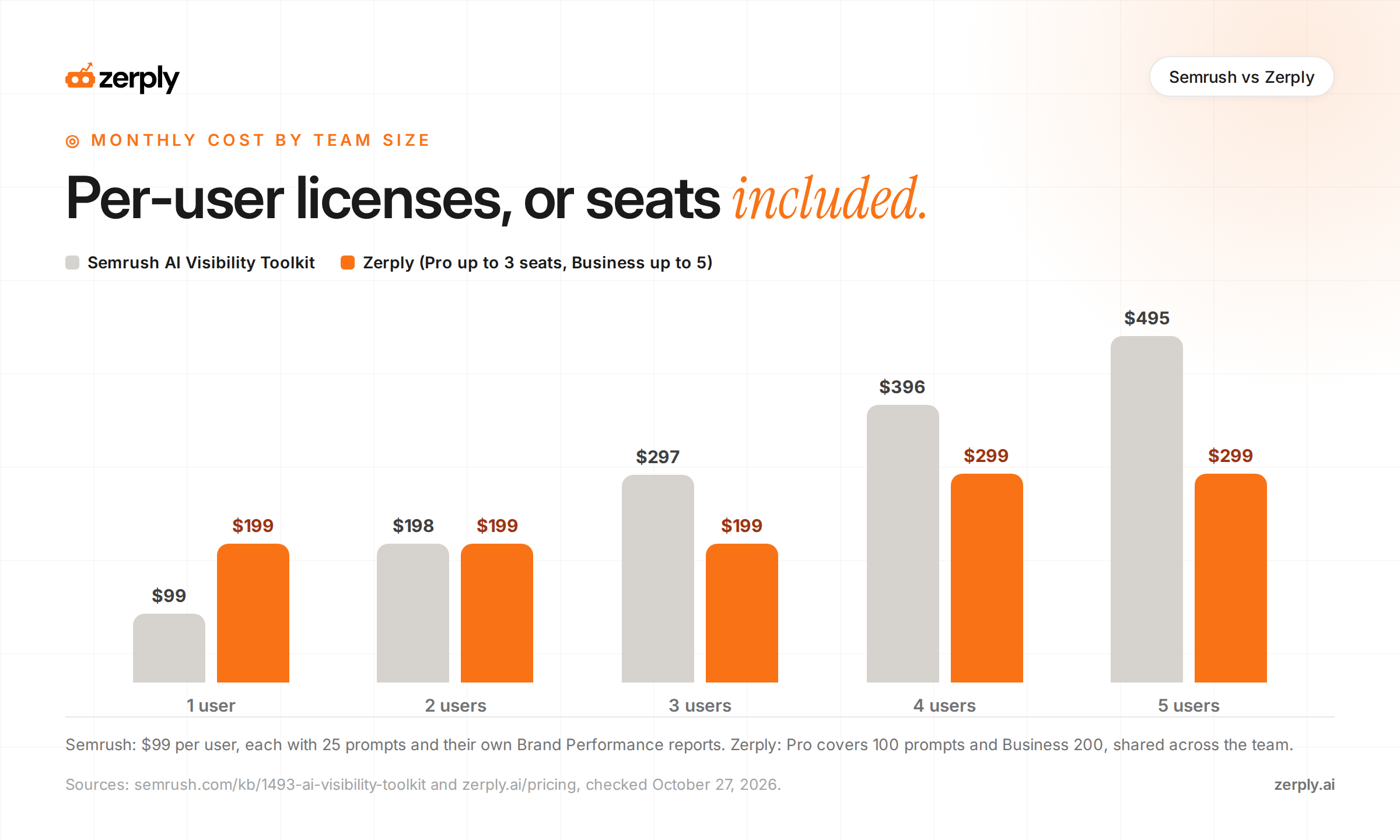
| Three users, one domain | $297 |
| One user, three domains | $297 |
Semrush vs Zerply for AI visibility
Zerply is our product, so here's the comparison using numbers from both pricing pages, starting with where Semrush is ahead.
Semrush's research reports have no direct equivalent in Zerply. Prompt Research shows demand across its prompt database, and Brand Performance digs into sentiment and narrative. Semrush also tracks prompts in more than 220 countries and territories, and Semrush One includes a full SEO suite.
Zerply's case is tracking volume and what comes after it. Zerply Pro costs $199 a month for 100 prompts tracked daily on ChatGPT, Gemini, Google AI Overviews, and Google AI Mode, with up to three seats included. At the same price, Semrush One Starter tracks 50 prompts, and the standalone toolkit would cost $297 a month for three users with 25 prompts each.
Pro also includes agents that draft blog posts and landing pages for the gaps tracking finds. Foundry, a $25-a-month add-on, publishes up to 500 of those pages on your own domain without a separate CMS. Zerply's Citation Decay shows when a page's citations start to fade and which URL is replacing it.
Among AI search visibility tools, the split is clear enough. Semrush suits teams who already run SEO in Semrush and want AI research beside it. Zerply suits teams who want more tracked prompts per dollar and want content produced from what they find. For a wider comparison, see our guide to the best AI visibility tools.
Which Semrush AI visibility product do you need?
Match the product to the job:
- Checking whether AI mentions you at all: the free AI Search Visibility Checker.
- Planning around industry benchmarks: the free AI Visibility Index.
- Researching prompts and brand sentiment for one domain: the AI Visibility Toolkit at $99.
- Running SEO and AI visibility for several sites: Semrush One Starter or Pro+.
- Covering many brands and regions at enterprise scale: Enterprise AIO.
Conclusion
Start with the free checker to see where you stand, then decide whether you need research or tracking. If research is your priority and you're already in Semrush, the AI Visibility Toolkit is the natural add-on. If you need to track more than 25 prompts for a team of more than one, price the per-user and per-prompt add-ons against a tool built for tracking volume, including Zerply, before you commit.
Frequently asked questions
What AI visibility products does Semrush offer?
Semrush's AI visibility products include the AI Visibility Toolkit at $99 a month, Semrush One plans that bundle it with the SEO toolkit, the free AI Search Visibility Checker, the free AI Visibility Index study, and Semrush Enterprise AIO for large enterprises with custom pricing.
How much does the Semrush AI Visibility Toolkit cost?
The Semrush AI Visibility Toolkit costs $99 a month, according to Semrush's knowledge base. That covers one user, one Brand Performance domain, and 25 tracked prompts. Each additional user or domain costs another $99 a month, and 50 more prompts cost $60 a month.
Is the Semrush AI search visibility checker free?
Yes. Semrush's AI Search Visibility Checker is free and grades a brand's visibility across ChatGPT, Gemini, and Google AI Overviews, showing the prompts that trigger a mention and the most-cited sources in your industry. It's a one-time snapshot rather than ongoing tracking.
What is the Semrush AI Visibility Index?
The Semrush AI Visibility Index is a free public study of brand visibility in AI search. The 2026 edition, released June 26, analyzed 126 million US prompts from January to April 2026 across ChatGPT, Gemini, Google AI Mode, and Google AI Overviews, with benchmarks for 22 industries.
Does the Semrush AI Visibility Toolkit have a free trial?
No. Semrush's knowledge base says the standalone AI Visibility Toolkit doesn't offer a free trial. New users can try Semrush One, which includes the AI Visibility Toolkit alongside the SEO toolkit, free for seven days.
What is a good alternative to the Semrush AI Visibility Toolkit?
Zerply is one alternative for teams that need more tracked prompts. Its Pro plan costs $199 a month for 100 prompts tracked daily on ChatGPT, Gemini, Google AI Overviews, and Google AI Mode, with up to three seats, plus agents that draft content. It doesn't offer Semrush's prompt research or sentiment reports.
Written by
Founder at Zerply.ai & Wittypen
Anshul is the founder of Zerply.ai and previously built Wittypen, a content marketplace powering SEO growth for 1,000+ businesses. Over the last decade he has worked hands-on with B2B SaaS and tech teams to turn search data into compounding organic growth. At Zerply he shares practical playbooks on AEO, AI visibility, and modern SEO that come directly from experiments, wins, and failures in real projects.