How to Turn Product Data Into Citation-Ready Landing Pages for AI Search

The short answer: Build each landing page from your product data: what the product does, what it doesn't do, which tools it connects to, what it costs, and what customers got from it. These are facts no other site can publish, and they're what make a page worth citing in an AI answer. Write one page per real use case, keep every fact in plain text, and add structured data that matches what's visible.
Software landing pages often say very little that's specific. They lead with adjectives like "powerful," "seamless," and "all-in-one," and the details that make a product different get left out. That's a problem in AI search, and Google's own guidance points in the other direction. Its guide to generative AI features asks site owners for non-commodity content, meaning information that goes beyond what's already available elsewhere. For a software company, the richest source of that information is the product itself.
What is a product-led landing page?
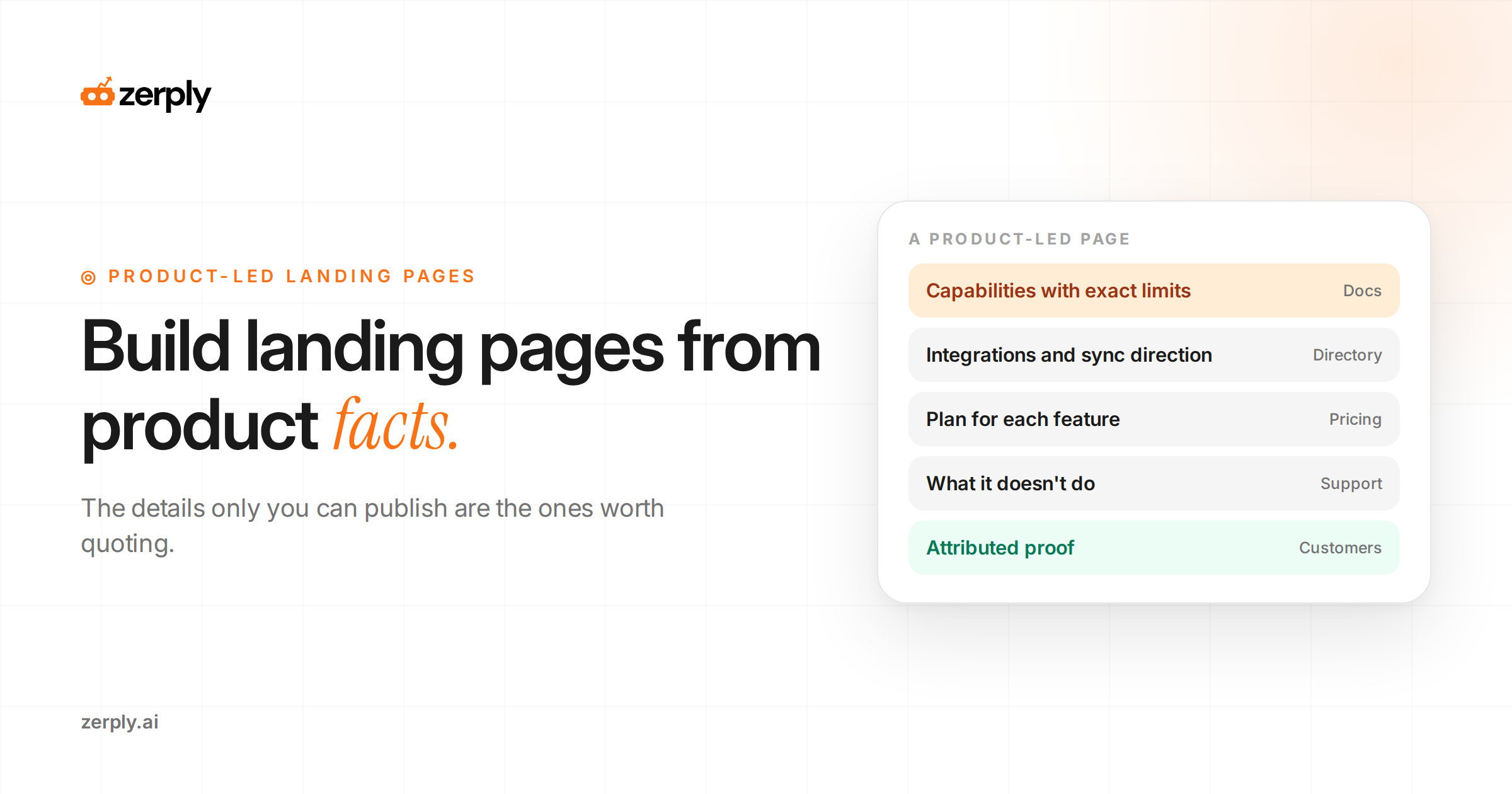
A product-led landing page is a page built from product facts rather than marketing claims. It covers one use case or buyer, and it states specific capabilities, limits, integrations, prices, and customer outcomes.
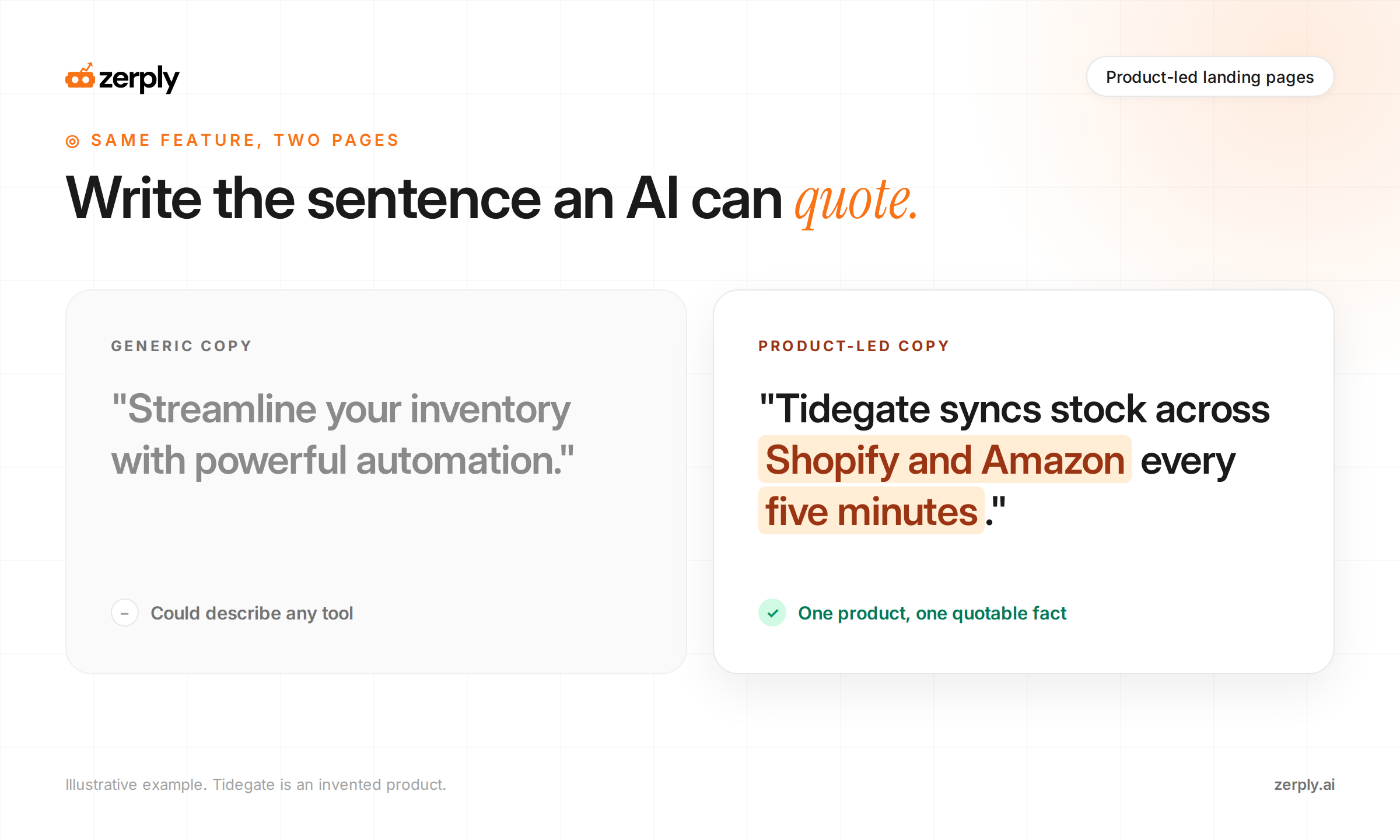
That's why product-led landing pages for AI search start from facts. The difference shows up in a single sentence. "Streamline your inventory with powerful automation" could describe any tool in the category. "Tidegate syncs stock counts across Shopify and Amazon every five minutes" describes one product, and an AI assistant can quote it as an answer.
Illustrative example. Tidegate is an invented inventory tool for retailers selling across several channels. It runs through the rest of this guide.
AI search engine optimization for landing pages
Google treats AI search engine optimization as SEO. Its guide to optimizing for generative AI features says AI Overviews and AI Mode pull pages from the regular Search index, and from Google's point of view, optimizing for AEO or GEO is still optimizing for search.
That puts the usual landing page SEO optimization work first. A page has to be indexed and eligible to show with a snippet, and the guide adds a requirement that's easy to miss. The site must be included in generative AI features in Search Console.
The guide also explains why product facts carry so much weight. When someone asks a question, Google's AI runs related queries in the background, which it calls query fan-out. A question about inventory tools fans out into sub-questions such as which tools sync with Shopify and what they cost. A landing page that answers those directly has more ways to be pulled in.
Other AI assistants add a technical condition. A December 2024 Vercel and MERJ analysis found that crawlers such as OpenAI's OAI-SearchBot don't render JavaScript, so a page that loads its product details with scripts can look empty to them. Our guide to help docs for AI search shows how to test for that in a minute.
Turn product data into page blocks
The facts a product-led page needs already sit in other teams' systems. The job is mapping each source to a block on the page.
Illustrative example. The right-hand column shows what an AI answer could quote from Tidegate's page.
| Product data source | Page block | What an AI answer can quote |
|---|---|---|
| Product docs and changelog | Capability block with exact limits | "Syncs stock every five minutes across up to 10 warehouses" |
| Pricing page | Plan line under each feature | "Multi-channel sync is included on Growth and Scale" |
| Integration directory | Integration list with sync direction | "Two-way sync with Shopify, one-way import from Amazon" |
| Support tickets and sales calls | Objection answers | "Doesn't track consignment stock" |
| Aggregated product usage data | Outcome numbers | "Median setup time is two days" |
| Customer interviews | Proof blocks and testimonial snippets | A named customer's result, with their role and company |
Include what the product doesn't do. Buyers ask assistants whether a tool supports something specific, and a page that states the limit gives the assistant a correct answer instead of a guess. It also keeps the wrong customers off your trial.
Build one page per use case
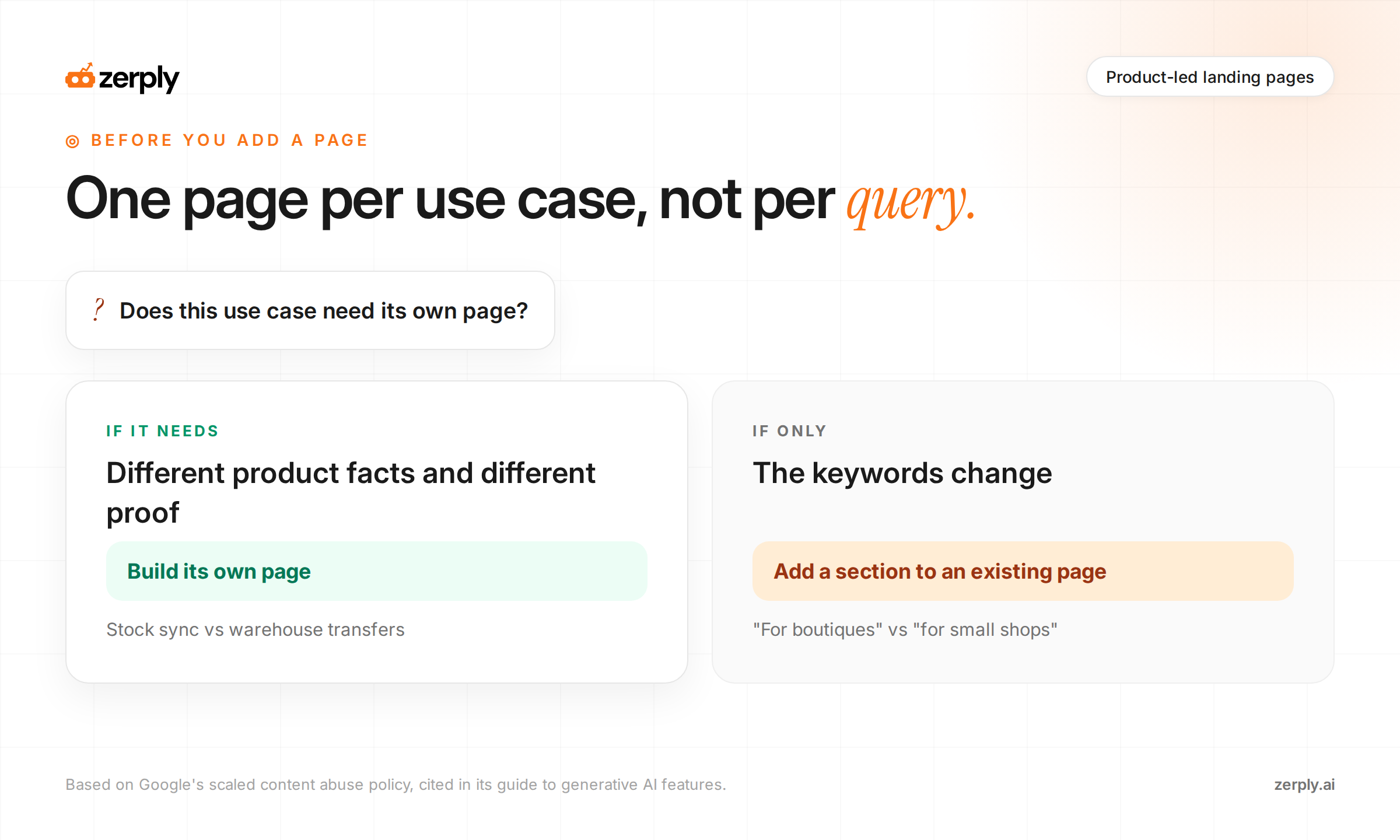
A use case earns its own page when it needs different product facts and different proof. When only the keywords change, it belongs as a section on an existing page.
Google draws that line too. Its guide warns that creating separate content for every variation of how people might search, mainly to influence rankings or AI answers, violates its scaled content abuse policy. Twenty pages that swap "inventory software for boutiques" for "inventory software for small shops" are the pattern it describes.
Illustrative example. These three Tidegate use cases each need their own facts, so each one gets a page.
| Use case | Who it's for | Product facts the page needs | Proof to include |
|---|---|---|---|
| Multi-channel stock sync | Retailers selling on Shopify and Amazon | Sync interval, supported channels, how conflicts are resolved | Fewer oversold orders, from a named customer |
| Warehouse transfers | Operations teams running three or more warehouses | Transfer workflow, warehouse limit, barcode support | Time saved per transfer |
| Low-stock alerts | Purchasing leads | Alert rules, reorder points, supplier export format | Fewer emergency orders in a quarter |
To decide which page to build first, our AI prompt taxonomy helps sort the prompts buyers ask by funnel stage, which shows which use cases come up early in evaluation.
Proof blocks and testimonial snippets
Proof is where a landing page goes from claiming to showing. A proof block states one outcome with the number, the timeframe, who achieved it, and how it was measured.
Illustrative examples. Northwind Outfitters and its quote are invented.
Proof block: Northwind Outfitters cut oversold orders from 41 to 6 a month in the first quarter after connecting Tidegate to Shopify and Amazon, measured from its order cancellation reports.
Testimonial snippet: "We stopped overselling on Amazon the week we switched." Dana Ruiz, Operations Manager, Northwind Outfitters
Both work because they're specific enough to quote and attributed to a named person, their role, and their company. "Tidegate is a game changer!" from "a happy customer" gives an assistant nothing to repeat.
Keep testimonials as readable proof rather than markup aimed at review stars. Google's review snippet guidelines make pages ineligible for star results when a company controls the reviews about itself under Organization markup. The same rules ban fake or undisclosed incentivized reviews, and they require marked-up reviews to be visible on the page.
Structured data for SEO and AI answers
Structured data helps with rich results, and it isn't required for AI features. Google's AI guide says there's no special schema to add for generative AI search, and it still recommends structured data as part of a normal SEO setup.
On a product-led landing page, a few types work:
- SoftwareApplication describes a software product, and Google requires a price plus a rating or review before the page can show the software app rich result.
- Product fits physical goods, and ecommerce brands can also supply product data through Merchant Center feeds, which Google says can help products appear in AI responses.
- Organization identifies the company behind the page.
- BreadcrumbList shows where the page sits in your site.
Whatever you add has to match what a visitor can see. Markup that claims a price or rating the page doesn't show breaks Google's guidelines, and it gives an AI system a fact it can't verify. Our guide to pricing pages for AI search covers the price side of this in more detail.
Does llms.txt help landing page SEO?
No, not for Google. Google's AI guide says Search ignores llms.txt files, and that creating one neither helps nor harms a site's visibility in Google Search, including AI Overviews.
So advice that treats llm txt for SEO as a ranking lever runs against Google's own documentation. The file can still help AI agents that read developer docs, and our llms.txt guide covers who actually fetches it. For a landing page, the product facts in the HTML do the work.
Check which pages get cited
Track the questions each landing page should answer, then look at which pages AI answers cite for them. This is where AI search engine optimization strategies get tested against real answers.
Google's Search Console now has a Generative AI performance report that shows how your pages appear in AI features on Google Search. For other assistants, run the same prompts on a schedule, as covered in our guide to AI search prompt tracking, and record which page each answer cites.
Look at which facts get quoted, too. If assistants cite your integration list but never your outcome numbers, the proof blocks probably need sharper figures or clearer attribution.
Conclusion
Pick the use case your sales team hears about most and pull its facts from the six sources in the table: docs, pricing, integrations, support tickets, usage data, and customer interviews. Write one page from them, open it with JavaScript turned off to make sure the facts survive, and track the prompts it should answer for a month before building the next one.
Zerply's landing page agent does the first draft from the same kind of research, and Foundry, an add-on on any plan, publishes the page on your own domain and adds it to your sitemap. Once it's live, AI Visibility Tracking shows whether the page starts getting cited for the prompts you track.
Frequently asked questions
What is a product-led landing page?
A product-led landing page is built from product facts rather than marketing claims. It covers one use case or buyer and states specific capabilities, limits, integrations, prices, and customer outcomes, which gives AI assistants concrete statements they can quote in answers.
How do you optimize a landing page for AI search?
Start with standard SEO: the page must be indexed, crawlable, and eligible for a snippet, and Google also requires your site to be included in generative AI features in Search Console. Then fill the page with specific product facts in plain HTML, including limits, integrations, pricing, and attributed proof.
Does structured data help pages appear in AI search?
Google says structured data isn't required for its generative AI features and there's no special schema to add. It still recommends structured data for rich results, such as SoftwareApplication or Product markup, as long as the markup matches what visitors can see on the page.
Does llms.txt help SEO?
Not for Google. Google's guide to generative AI features says Google Search ignores llms.txt files, and creating one neither helps nor harms visibility in Google Search, including AI Overviews. The file can still help AI agents that read developer documentation.
How many landing pages should you build for different use cases?
Build a separate page only when a use case needs different product facts and different proof. Google's scaled content abuse policy warns against creating pages for every variation of a search query mainly to influence rankings or AI answers, so keyword-only variations belong as sections on existing pages.
Can testimonials on a landing page use review schema?
Google's review snippet guidelines make pages ineligible for star results when a company controls the reviews about itself under Organization markup. Testimonials still work as visible, attributed proof that AI assistants can quote, with a named person, role, company, and specific result.
Written by
Founder at Zerply.ai & Wittypen
Anshul is the founder of Zerply.ai and previously built Wittypen, a content marketplace powering SEO growth for 1,000+ businesses. Over the last decade he has worked hands-on with B2B SaaS and tech teams to turn search data into compounding organic growth. At Zerply he shares practical playbooks on AEO, AI visibility, and modern SEO that come directly from experiments, wins, and failures in real projects.